
At a Glance
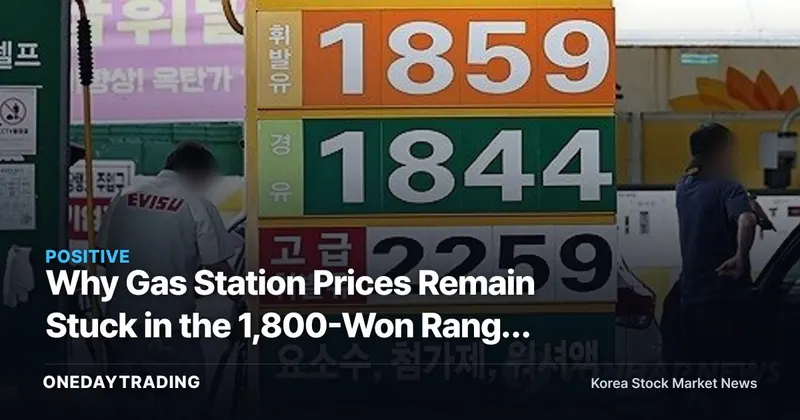
Gasoline and diesel prices at gas stations nationwide have fallen for 14 consecutive weeks, with both fuel types settling in the mid-1,800-won-per-liter range. This reflects a lag period in which weak international oil prices filter through to domestic prices — the decline has lasted a long time, but the weekly drop has been modest.
Why It Matters
What matters more than the fact that fuel prices have fallen is the size of the decline. Despite 14 straight weeks of drops, prices have still not broken out of the mid-1,800-won range. That means domestic gas station prices don't move in lockstep with international oil price swings. A significant portion of the per-liter price consists of fuel taxes and distribution/refining margins, so even when global oil prices fall, the price cut consumers actually feel ends up smaller.
What the market has already priced in is the downtrend in international oil prices itself. What remains unpriced is how much further this decline will run, and how quickly it will feed through into inflation gauges. Fuel prices carry meaningful weight in the calculation of the consumer price index, so a prolonged decline would help slow inflation — a factor that also feeds into the rate-decision calculus of the Bank of Korea's Monetary Policy Board.
Key Issues
- The gap between the length of the decline (14 weeks) and its size (modest) — because fuel taxes make up such a large share of the domestic price structure, swings in international oil prices aren't fully passed through
- The inflation pathway — the lag and intensity with which falling fuel prices contribute to slower consumer price growth
- The refining margin variable — for refiners, a drop in crude input costs doesn't necessarily translate into wider profits
- Reversal risk — if geopolitical tensions or production cuts by oil-producing nations push international oil prices back up, this decline could be reversed
Related Stocks (Tickers) and Sector Impact
- Korean Air — jet fuel accounts for a large share of costs, making it a prime beneficiary of a lighter fuel-cost burden during an oil price downturn
- HMM — lower bunker fuel costs (e.g., bunker C oil) leave room for improved operating costs
- S-Oil, SK Innovation — crude input costs are falling, but selling prices are declining in tandem, so the direction of refining margins will determine earnings. Potential inventory valuation losses on crude stockpiles are also a variable
- GS — a holding company whose refining subsidiary's earnings are tied to oil price movements
Investment Considerations
- Don't simply equate falling fuel prices with improved earnings for refining stocks (tickers) — the direction of refining margins matters more than whether selling and input prices are falling together
- Pricing in rate cuts based solely on expectations of slowing inflation is premature — the Monetary Policy Board weighs a combination of factors beyond oil prices, including the exchange rate and household debt
- The fuel-cost savings for airline and shipping stocks (tickers) can be offset by the won-dollar exchange rate, so the two should be checked together
- Approach this on the premise that the downtrend could be reversed at any time by a rebound in international oil prices
Overall Outlook
In the optimistic scenario, weak international oil prices persist, domestic fuel prices continue their gradual decline, inflationary pressure eases, and the cost structure improves for industry sectors like airlines and shipping where fuel makes up a large share of expenses. In that case, the effect would also be indirectly positive for related consumer goods and retail sectors as household spending power recovers.
The risk runs in the opposite direction. If international oil prices rebound due to Middle East tensions or production-cut decisions by oil-producing nations, the decline accumulated over 14 weeks could be reversed in a short period, simultaneously increasing inventory valuation losses for refiners and the cost burden for airlines and shipping companies. Whether this decline represents a long-term trend or merely a temporary adjustment is difficult to judge without clarity on the direction of international oil prices themselves.
Frequently Asked Questions
Why have fuel prices fallen for 14 straight weeks, yet the price cut feels so small?
Fuel taxes and distribution/refining margins make up a substantial share of domestic gas station selling prices, so even when international oil prices fall, that decline isn't fully passed through to consumer prices. As a result, even after a decline spanning many weeks, the per-liter price only edges down gradually.
Is falling fuel price a positive catalyst or a negative catalyst for refiners' stock prices?
It can't be judged from the fact that oil prices are low alone. Refiners' earnings depend on refining margins — the gap between crude input costs and selling prices — so during a period when both prices fall together, margins could actually shrink.
Could falling fuel prices lead to a rate cut?
Fuel prices are one component of the consumer price index, so a continued decline could contribute to slower inflation growth. However, the Bank of Korea weighs a comprehensive set of factors beyond oil prices — including the exchange rate and household debt — so it's premature to conclude a rate cut based on falling fuel prices alone.
This article is automatically summarized and analyzed based on the original news report. View original (Yonhap News Agency, Securities)