
At a Glance
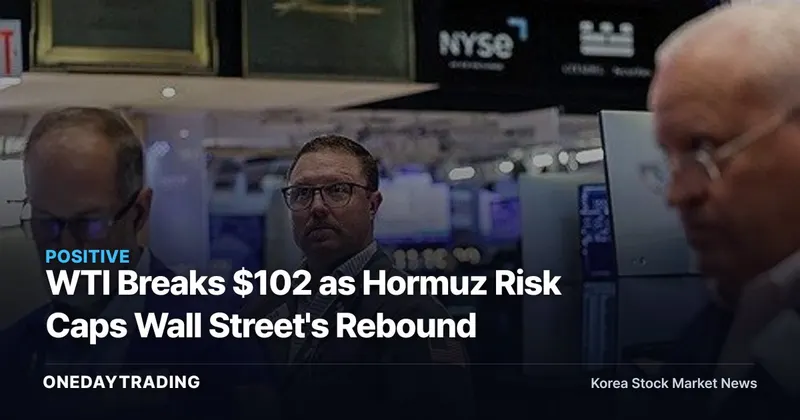
Crude trading above $102 turned Wall Street's rebound on March 30, 2026 into a repricing of geopolitical risk rather than a signal of economic recovery.
As of 9:51 a.m., the Dow Jones was up 0.42%, the S&P 500 0.28%, and the Nasdaq 0.14%. What this really reflects is not the strength of bargain hunting but the pressure oil prices are putting on the ceiling for valuation multiples.
Why It Matters Now
Bargain hunting refers to investors buying back into stocks after judging that a recent decline has made prices attractive. But the buying on March 30, 2026 is hard to read as a genuine return of risk appetite. At the same time, WTI's May 2026 delivery contract was up 2.89% from the previous session to $102.52 a barrel.
When oil trades above $100, the market runs two separate calculations. The first is inflation. Energy prices feed into corporate costs through shipping and electricity expenses, delaying hopes for cooling inflation. The second is interest rates. As expectations for rate cuts weaken, the present value of long-duration growth stocks declines — which is why the Nasdaq's 0.14% gain was thinner than the Dow's 0.42%.
The Strait of Hormuz is the critical chokepoint for Middle East crude shipments. On March 30, 2026, U.S. President Donald Trump warned that the United States could strike Iran's energy infrastructure if Iran did not keep the Strait of Hormuz open. Over the weekend, the Iran-aligned Houthi militia fired missiles toward Israel, adding Red Sea shipping risk to the mix.
Key Issues
- The quality of the index rebound: The Dow gained 191.03 points, the S&P 500 17.76 points, and the Nasdaq 30.20 points — all positive, but tech stocks showed relatively weak momentum.
- Valuation pressure from oil prices: With WTI climbing to $102.52 a barrel, inflation expectations are being shaken again, and high-multiple sectors that are priced for falling rates are the first to face discount-rate pressure.
- Sector rotation: According to Yonhap News Agency, energy, financials, and utilities were strong while technology and industrials lagged. The market favored cash flow and pricing power over growth.
- Company-specific events: Alcoa surged more than 12% after aluminum prices rose in the wake of an attack on Middle East aluminum production facilities. Cisco fell 12.44% after agreeing to a $29.1 billion acquisition.
Impact on Related Stocks and Sectors
- S-Oil: Rising global oil prices boost expectations for inventory valuation gains and refining margins. However, crude procurement costs are rising as well, so actual profits will hinge on how quickly product prices can be passed through.
- SK Innovation: The refining segment is sensitive to oil prices and margins. Given the drag from its battery business, the market is separately weighing how much of the oil-price benefit will translate into an improvement in the group's overall earnings.
- GS: Both the value of its refining subsidiary and its sensitivity to energy prices are coming into focus. Its defensive, dividend-paying stock profile tends to work better once the rate path stabilizes.
- Korean Air: Oil in the $100-plus range means a heavier jet fuel cost burden. Even with resilient passenger demand, quarterly margins get squeezed if fuel costs rise faster than fare increases.
- KEPCO (Korea Electric Power): Higher fuel costs widen the gap between electricity purchase costs and tariff policy. If electricity rate adjustments lag, rising oil prices weigh negatively on earnings.
Investment Considerations
- The rally that began on March 30, 2026 should not be read as a trend reversal. CFRA's Sam Stovall characterized the day's move as a technical bounce following an oversold condition.
- Watch how long WTI stays above $100 a barrel. It's not the single-day price but an average sustained over two weeks or more that will move earnings estimates for refiners, airlines, and utilities.
- If Strait of Hormuz and Red Sea shipping risks escalate simultaneously, shipping costs and insurance premiums will rise together — spreading beyond the refining windfall into cost pressure on industrials and consumer goods.
- Rate-sensitive growth stocks find it hard to defend their multiples when oil reignites inflation expectations. Note that the Nasdaq's rebound was smaller than the Dow's.
Overall Outlook
What the market has already priced in is the Middle East risk itself. What it has not fully priced in is how long oil in the $100-plus range will persist and how much it will reverse U.S. inflation and rate expectations. If the Strait of Hormuz situation stabilizes quickly, bargain hunting could spread into tech stocks.
The trigger for the opposite scenario is oil prices. If WTI becomes entrenched above $100 a barrel and Red Sea shipping disruptions continue, refiners and some commodity stocks can hold up, but airlines, utilities, and high-multiple tech stocks will face scrutiny on both earnings and valuation. The next triggers to watch are whether WTI holds above $100, upcoming U.S. inflation data, and Fed commentary on rates.
FAQ
Why did bargain hunting emerge on Wall Street?
U.S. stocks opened higher on March 30, 2026 as investors judged that the preceding decline had made valuations attractive, lifting all three major indexes. As of 9:51 a.m., the Dow was up 0.42%, the S&P 500 0.28%, and the Nasdaq 0.14%.
How does WTI at $102 affect Korean equities?
With the WTI May 2026 contract up to $102.52 a barrel, refiners are the first candidates cited as beneficiaries in the Korean market. Conversely, sectors with heavy fuel-cost exposure — airlines, utilities, and transportation — need to be watched for cost pressure.
What does Strait of Hormuz risk mean?
Strait of Hormuz risk refers to the danger that this critical shipping route for Middle East crude could be blocked by military conflict or blockade. President Trump's March 30, 2026 warning of a possible strike on Iran's energy infrastructure was a key variable that moved both oil prices and energy stocks.
S-Oil: A Real-Time Data Snapshot
S-Oil's most recent closing price was 141,100 won (-1.05% versus the previous session), and the signal combining foreign/institutional order flow with news and momentum reads 🟢 Net Buy Bias. With foreign investors and institutional investors both positioned positively, the stock (ticker) may be worth watching.
- ▲ Dual buying — Foreign investors +600 million won · institutional investors +300 million won, buying in tandem
- ▼ Trend alignment — Short- and medium-term downward alignment (day -1.1% · 1 week -0.3% · 1 month -0.4%)
Recent related news is mixed, with 1 positive catalyst and 1 negative catalyst.
※ Price and foreign/institutional order-flow data are provided by Korea Investment & Securities (KIS) as of the time of publication.
This article was automatically summarized and analyzed based on the original news report. View original (Yonhap Infomax)