
Key Takeaways
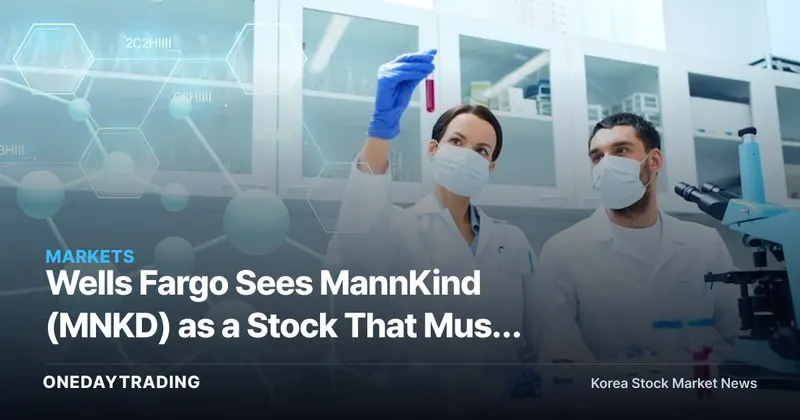
U.S. investment bank Wells Fargo assessed inhaled insulin company MannKind (ticker MNKD) as still being at a stage where its commercialization potential has yet to be proven. While acknowledging the potential itself, the firm takes a cautious view that it needs to see this translate into actual revenue and profit. Rather than an immediate strong buy signal, it is closer to a wait-and-see diagnosis that hinges on earnings visibility.
What Happened
Wells Fargo's assessment essentially frames MannKind as a stock with significant potential, but one that must deliver concrete results before the market will shed its doubts. The notion of a "show-me" stock conveys that even when the outlook for a new product or new business is bright, a re-rating of the share price may be limited until revenue growth and margin improvement are confirmed in the numbers.
MannKind's core businesses consist of its inhaled insulin product Afrezza and royalty income tied to inhaled therapeutics secured through a partnership in the chronic lung disease space. While its own product revenue and partner royalties together form its growth engine, the cited rationale for caution is that earnings volatility is high, depending on the pace at which the inhaled insulin market expands its penetration and on whether new pipeline candidates succeed.
Background and Context
MannKind is a biotech company that has cycled through prolonged losses and expectations over the years, and despite holding a differentiated technology in inhaled insulin, it has been viewed as slow to gain a foothold in the market. More recently, partnership-based royalty income has grown and its financial structure has shown signs of improvement, and on that basis it is moving to expand its new respiratory-disease pipeline. Wells Fargo's diagnosis reads as a balanced view that simultaneously points to the potential and the uncertainty surrounding a company in this transitional phase.
Impact on the Market and Stocks
- MannKind (MNKD): The direct subject of the assessment; the visibility of new-product revenue and royalty growth will dictate the short-term direction of the share price.
- Inhaled drugs / biotech sector: A case that reaffirms the market's conservative yardstick for the pace at which differentiated technologies are commercialized.
- Partnership royalty-model companies: Offers implications for the broader valuation debate over biotech firms that run their own revenue alongside partner royalties.
- Diabetes / chronic lung disease therapeutics market: Expectations for rising demand in inhaled insulin and pulmonary arterial hypertension treatment influence investor sentiment toward related companies.
- Korean biotech investors: Through the way U.S. small- and mid-cap biotechs are assessed, it serves as a reference for gauging the revenue-visibility yardstick applied to domestic new-drug companies.
Investor Checkpoints
- Check whether quarterly earnings consistently confirm a growth trend in both own-product revenue and partner royalty income.
- Track catalyst events such as the clinical progress and approval timelines of the new respiratory-disease pipeline.
- Also monitor financial stability metrics, including cash flow and the timing of the turn to profitability.
- Given the high volatility characteristic of small- and mid-cap biotech, control risk through phased entry and position sizing.
Outlook
On the optimistic side, if expanding inhaled insulin market penetration, rising partner royalties, and results from the new pipeline come together, MannKind has room to take its earnings up a notch and dispel the market's doubts. That said, slow growth in the inhaled insulin market, clinical failures or approval delays, continued losses, and funding burdens are clear risks. Ultimately, the core message of this assessment is that a cautious approach is reasonable until the realization of that potential is proven in the numbers.
This article is content automatically summarized and analyzed based on the original news. View original (Yahoo Finance)