
At a Glance
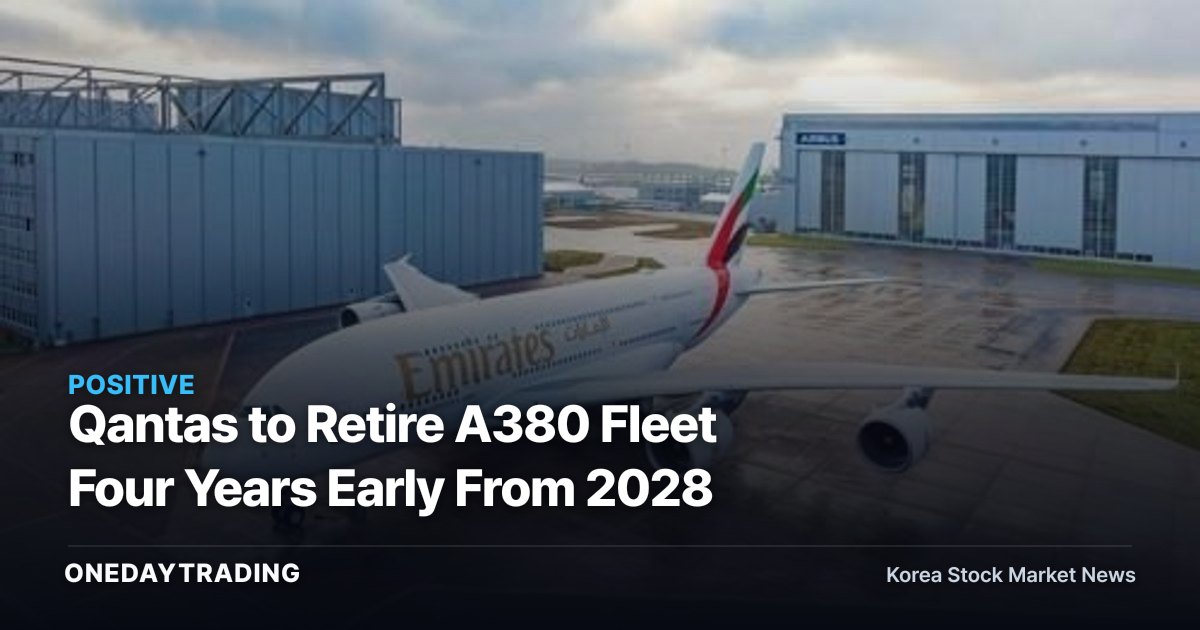
Whether airlines continue operating the Airbus A380 ultimately comes down to how many seats they can fill. Australia's Qantas Airways will begin phasing out its 10 A380s in 2028, four years earlier than planned, while the global fleet in service has fallen by more than 60 aircraft, from a late-2010s peak of over 230 to 171 today. The result is a structurally heavier fuel and maintenance cost burden for the superjumbo's four engines compared with newer twin-engine jets.
Why It Matters Now
Qantas' accelerated retirement schedule is more than a simple move to clear out aging aircraft. A380 production ended in 2021, thinning the parts supply chain itself and making maintenance costs rise the longer the remaining aircraft stay in service. According to CNN's report on the 13th (local time), Qantas plans to switch to the replacement A350-1000 while increasing the share of first-class, business-class and premium-economy seats. The airline intends to reshape its earnings model by raising revenue per seat instead of maintaining a larger seat count.
This trend also reflects a pattern that briefly reversed after the COVID-19 pandemic before returning to its prior course. Air France and Thai Airways retired their entire A380 fleets during the pandemic, while Lufthansa declared permanent retirement in 2021. But when Airbus and Boeing deliveries of new aircraft were delayed, Lufthansa returned the A380 to scheduled service just two years later. The temporary reprieve caused by shortages of new aircraft has ended, bringing the A380's underlying economic viability back to the forefront.
Key Issues
- Cost burden of the four-engine design: The A380 can carry more than 500 passengers, but its four engines mean higher fuel and maintenance costs than newer twin-engine jets. Profitability deteriorates rapidly when the airline cannot fill all the seats.
- Supply-chain risk: Since production ended in 2021, parts-sourcing channels have narrowed, so maintenance costs and waiting times rise together the longer the aircraft remain in service.
- Emergence of replacement aircraft: New twin-engine jets such as the A350 and Boeing 787 have fewer seats but better fuel efficiency and longer range, allowing airlines to adjust available capacity more flexibly by route.
- Shift in premium-seat competitiveness: Services once unique to the A380, such as Emirates' onboard showers and Etihad Airways' three-room luxury suites, are now being introduced on smaller aircraft, eroding the superjumbo's scarcity value.
Impact on Related Stocks and Sectors
- Boeing: A direct potential beneficiary of airlines switching from four-engine widebody aircraft to newer twin-engine jets. With the Boeing 787 being discussed as an A380 replacement, changes in the future widebody order backlog are worth monitoring as an indicator.
- Airbus: Although A380 production has already ended, demand for the A350 family selected by Qantas as its replacement is more of an indirect beneficiary of this trend. However, A380-related revenue is structurally heading lower.
Investment Considerations
- This trend varies widely by airline. Emirates operates 101 aircraft and has 15 in storage, and says it will spend billions of dollars to keep flying the A380 into the early 2040s. Lufthansa also plans to upgrade its remaining eight aircraft and operate them into the 2030s. Retirement should not be simplified as the end of the A380 as a whole.
- Airlines that continue operating aircraft with thinning parts supply chains may face heavier maintenance costs. Those switching to newer aircraft, meanwhile, must absorb initial transition costs, so neither side is entirely free of expense.
- Precise airline-by-airline A380 profitability and the financial impact of retirement cannot be confirmed from publicly available data. A key point to watch is whether individual airlines separately mention fleet-transition costs in their earnings releases.
Overall Outlook
Experts believe that by the early to mid-2030s, the A380 may effectively remain only at Emirates. Travel-industry analyst Henry Harteveldt said, "Airlines now fly for profit, not pride." Airlines with route networks suited to transporting large volumes between major hubs, like Emirates, will hold on to the A380, while others will increasingly follow Qantas in switching to newer twin-engine jets. However, if deliveries of new aircraft are delayed again, retirements could be postponed once more, as in Lufthansa's case. Delivery schedules for new Airbus and Boeing aircraft therefore remain the variable that will determine the pace of this shift.
Boeing Key MetricsAs of 2026-09-14
| Period returns | 1 week -0.03% 1 month -8.97% |
|---|
Price and supply-demand (order flow) data are real-time values from Korea Investment & Securities (KIS); supply-demand (order flow) and news-tone calculations are independently produced by One Day Trading.
Supply-Demand (Order Flow) & Momentum Assessment🟡 Neutral · Watch
Positive and negative signals are mixed, so this is a period to watch.
This article is automatically summarized and analyzed based on the original news report. View original (Maeil Business Newspaper)
。