
3-Line Briefing
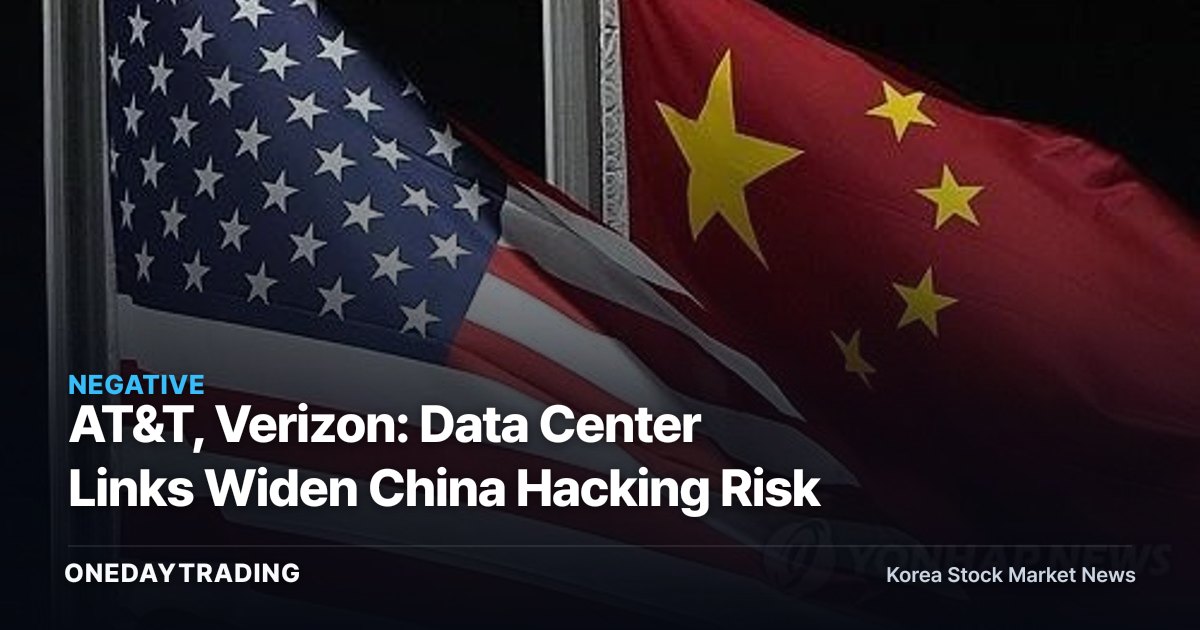
- The US Congress found that American telecom carriers became exposed to the Chinese hacking group Salt Typhoon as they connected their systems to data centers and related infrastructure.
- Based on publicly available materials, at least nine US telecom carriers — including AT&T, Verizon, and T-Mobile — were named as affected, with the incident described as a cyber-espionage operation that spread to roughly 80 countries.
- For Korean investors, the key takeaway is that telecom carriers' rising security costs, network equipment replacement, and cloud/data center security demand are all moving in tandem.
What's Changing
Yoon Jae-ho sees the core of this story as the fact that telecom hacking no longer stays confined to switching-center incidents. Carriers today aren't just voice-network companies — they're massive network operators tying together routers, cloud access, data center interconnects, and law-enforcement wiretap systems. The attack surface has widened, and the defense budget won't be settled by swapping out a single piece of equipment.
US authorities' documents specify that Salt Typhoon targeted phone call records, a limited set of private communications, and information tied to court-approved wiretap requests. That detail feeds directly into carrier valuations. Data breaches create fines and litigation risk, while breaches of wiretap systems invite regulators to demand security certification. For telecom stocks, dividend stability is the core investment case — and rising security capex and operating costs are the first thing to test the resilience of free cash flow.
On the flip side, data center connectivity creates a revenue opportunity for cybersecurity and network-visibility vendors. As carriers route more traffic through cloud and data center infrastructure, what's needed isn't a single firewall but a system that can see device logs, account permissions, router vulnerabilities, and anomalous traffic all at once. The unit of security demand is moving up from the branch level to the backbone.
Numbers in Context
The numbers that keep recurring across congressional records and official statements are at least nine carriers and roughly 80 countries. The FBI has cited theft of call data logs, copying of some sensitive communications, and access to law-enforcement request information. This isn't a simple ransomware attack — rather than demanding a payout and leaving, it's a long-term, hidden infiltration designed to read network architecture and its users.
Breaking this down by supply chain, the operational layer stands out before materials or chips do. The patch status of routers and switches, data center interconnection points, and carriers' aging, merger-inherited networks are the vulnerabilities. Equipment makers can expect replacement demand, but if a specific piece of equipment is identified as the attack vector, that comes with short-term reputational risk too. Cybersecurity stocks face structurally growing demand, but names already trading at high multiples need their actual pace of new contract growth confirmed.
Winners and Losers
- AT&T: One of the carriers named as a likely core victim. Higher security spending and regulatory-response costs weigh on dividend capacity and the discount rate applied to cash flows.
- Verizon: As a major US network operator, it faces the same exposure. Enterprise-client trust and network security certification are the key variables in defending its share price.
- T-Mobile US: Given its heavy weighting toward wireless, subscriber data protection issues could carry through to brand perception and churn management.
- Cisco: Sits across the core network equipment supply chain. Replacement and upgrade demand is a positive, but vulnerability-management controversy is a near-term risk.
- Palo Alto Networks and CrowdStrike: Candidates to benefit from expanding telecom and data center security budgets, but actual order wins need to be confirmed in next quarter's billings and remaining performance obligations.
Risk Check
- From the carriers' standpoint, security investment doesn't immediately boost revenue. The costs hit first, and rate hikes can be blocked by regulation and competition.
- Cybersecurity stocks tend to attract a narrative quickly. However, carrier budgets are executed through multi-year contracts, so quarterly revenue recognition can lag.
- If the China-linked hacking issue spreads into broader US-China tech regulation, procurement standards for network equipment and cloud services could change. Supply chain realignment creates winners and losers at the same time.
- If the scope of the breach is confirmed to be wider, litigation, fines, and customer attrition could be priced in with a lag.
Bottom Line
This issue is a discount factor tied to costs and trust for US telecom stocks, and a medium-term demand catalyst for security and network infrastructure. The next things to watch are follow-on regulation from the congressional hearings, FCC security-certification discussions, AT&T's and Verizon's security capex guidance, and growth in telecom-client contract wins for cybersecurity vendors.
This article is automatically summarized and analyzed based on the original news report. View original (Yonhap News, Securities)