
Key Takeaways
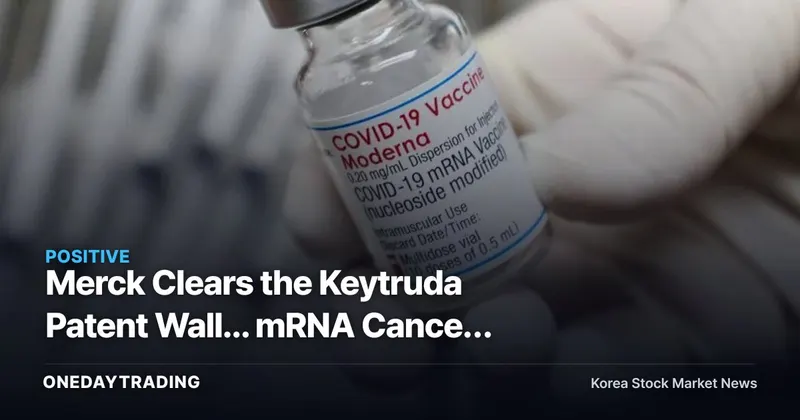
Merck's stock reached a 52-week high not because concerns over Keytruda's patent expiration have disappeared, but because the market has begun pricing in the Phase 3 results of its mRNA cancer vaccine as the company's next growth driver.
Sera Park's take is clear: what the market bought wasn't the word "cancer vaccine" itself, but a shift in the probability that the post-Keytruda revenue gap can be narrowed.
What Happened
According to Maeil Business Newspaper's securities coverage, global pharma giant Merck hit a 52-week high as its mRNA cancer vaccine's Phase 3 results took the spotlight, even as concerns mounted over Keytruda's patent expiration. Keytruda is Merck's flagship oncology drug, and its patent expiration is an event that could shake up pricing and market share through competition from generics and biosimilars.
The mRNA cancer vaccine is a treatment approach designed to help a patient's immune system better recognize cancer cells. Rather than being aimed purely at prevention like an infectious-disease vaccine, it is being evaluated as a therapy used alongside existing immuno-oncology drugs to alter relapse risk or treatment response.
What matters most to investors is whether Merck can reduce its dependence on a single product. If Keytruda's patent expiration represents a revenue-slowdown risk, the mRNA cancer vaccine's Phase 3 results are a signal that pipeline value could partially offset that risk.
Background and Context
Big pharma stocks rarely move on a single clinical result alone. Valuation is shaped jointly by the patent cliff, the probability of new-drug approval, combination strategies with existing products, and the likelihood of insurance reimbursement. Merck's latest high can be read as a stretch where the shift in the cancer vaccine's commercialization probability outweighed the negative catalyst of patent expiration.
That said, the results touted in press coverage need to be separated from what the actual data show. The term "Phase 3" means the drug has entered the later stage of development — it does not mean revenue is locked in. The final endpoints, safety profile, dosing convenience, and the cost burden of combination therapy all need to be confirmed before the new drug's value flows down to the income statement.
Impact on the Market and Related Stocks
- Merck: If concerns over Keytruda's patent expiration had been weighing on the valuation as a discount factor, the mRNA cancer vaccine's Phase 3 results are a catalyst that narrows that discount. Still, until new-drug revenue actually materializes, the stock could remain sensitive to swings on clinical-trial headlines.
- Global big pharma: Drugmakers with oncology portfolios are being re-rated on their ability to offset the patent cliff through their pipelines. The more a company depends on a single blockbuster, the more sensitive its stock becomes to upcoming clinical data.
- mRNA platform companies: The cancer vaccine results provide evidence that mRNA technology can extend beyond infectious disease into oncology. However, if platform-wide expectations run too high, a single clinical failure could drag down valuations across the entire sector.
- Domestic (Korean) biotech stocks: Companies positioned around immuno-oncology drugs, cancer vaccines, or drug-delivery platforms could see thematic supply-demand (order flow) inflows. However, since clinical stages and cash-burn rates vary widely among individual Korean companies, Merck's Phase 3 results should not be directly translated into equivalent value for them.
Investor Checkpoints
- Final Phase 3 data: Investors need to confirm whether the efficacy metrics of Merck's mRNA cancer vaccine hold up statistically. If the final results diverge from interim expectations, the stock could unwind the logic behind its 52-week high.
- Regulatory timeline: Safety data, evidence for combination therapy, and the scope of approved indications will be central to the approval application and review process. A narrower indication would also mean lower revenue estimates.
- Defending Keytruda revenue: Watch Keytruda's pricing, market share, and combination-prescription trends before and after patent expiration. The case for a defensible revenue base strengthens the more the cancer vaccine is used alongside Keytruda.
- Valuation burden: The risk after a 52-week high is that good news is already partly priced in. Further upside will require both the quality of clinical data and the commercialization timeline to follow through.
Outlook
The optimistic scenario is straightforward. If the final Phase 3 data for Merck's mRNA cancer vaccine hold up to current expectations, and regulators recognize the value of the combination therapy during review, the risk from Keytruda's patent expiration would be partly cushioned. In that case, Merck's stock would be re-rated not as an oncology company facing a patent cliff, but as a big pharma with a next-generation immuno-oncology platform.
The downside scenario also needs to be viewed in numbers. If the expectations behind the 52-week high weaken in the final data, or if safety issues narrow the approved indication, the stock would price the patent-expiration risk back in. In biotech investing, endpoints matter more than press-release language. The next checkpoints to watch are the detailed Phase 3 data, the regulatory filing timeline, and the actual pace at which combination prescribing with Keytruda expands.
Frequently Asked Questions
Why did Merck's stock hit a 52-week high?
According to Maeil Business Newspaper's securities coverage, Merck's stock hit a 52-week high as its mRNA cancer vaccine's Phase 3 results took the spotlight despite concerns over Keytruda's patent expiration. The market priced in the possibility that its next-generation oncology pipeline could narrow that gap, rather than reacting to the patent cliff itself.
Why does Keytruda's patent expiration matter for Merck?
Because Keytruda is Merck's flagship oncology drug, its patent expiration could lead to price competition and market-share erosion. As patent protection weakens, the defensibility of existing revenue declines, and the success of the new-drug pipeline carries greater weight in the company's valuation.
Do all mRNA cancer-vaccine-related stocks benefit equally?
News about mRNA cancer vaccines can boost interest in the platform technology, but not every related stock benefits equally. Investors should distinguish between companies based on their clinical-trial stage, data disclosure, cash-burn rate, and commercialization partners.
This article was automatically summarized and analyzed based on the original news report. View Original (Maeil Business Newspaper Securities)