
Key Takeaways
The crux of this issue is that ocean freight rates are not coming down across any vessel type, even amid signals of easing geopolitical risk. If the strength in freight rates stems from supply-demand (order flow) dynamics rather than a temporary fluctuation, it bodes well for the earnings visibility of shipping companies — who book freight rates directly as revenue — and shipbuilders who win newbuild orders. That said, because freight rate indices are highly volatile, confirming whether the trend is sustained comes first.
What Happened
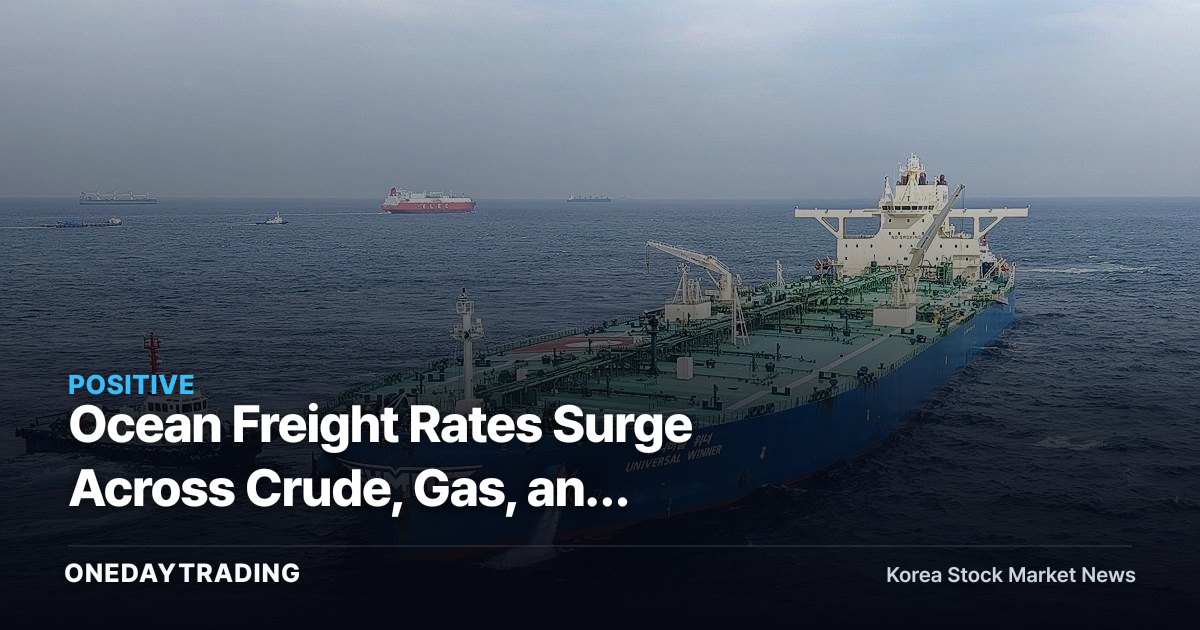
Even though a ceasefire agreement between the U.S. and Iran has been reported, global ocean freight rates are holding at elevated levels regardless of vessel type — crude tankers, gas carriers, and container ships alike. Typically, when geopolitical tensions originating in the Middle East ease, freight rates tend to settle as safety margins and the burden of detour routes diminish. This time, however, the fact that rates did not immediately turn lower has caught the market's attention.
On top of this, air cargo rates are also showing strength, producing a pattern in which logistics costs are rising broadly across the board. The simultaneous rise in ocean and air freight rates suggests that, rather than a temporary bottleneck on a specific route, a demand advantage or supply constraint may be at work across transport modes as a whole.
Background and Context
Freight rates are determined by the interplay of limited supply — ships and aircraft — and demand driven by trade volumes and inventory cycles. Easing tensions, such as a ceasefire, is usually a downside factor, but when the time lag until route realignment normalizes, accumulated congestion, year-end and peak-season cargo volumes, and delays in newbuild deliveries all overlap, freight rates do not come down in the short term. Simultaneous strength across all vessel types is typically observed in phases where this supply-side rigidity cannot keep pace with demand.
Impact on the Market and Stocks
- HMM: As Korea's flagship shipping company, whose revenue and operating profit are most directly tied to container freight rates, sustained rate strength is an upside factor for quarterly earnings. Conversely, if rates fall rapidly from a peak, earnings volatility will be just as large.
- Pan Ocean and Korea Line: As shipping companies with exposure to non-container vessel types such as gas carriers and bulkers, strength in crude tanker and gas carrier rates could translate into improved charter rates and shipping margins.
- HD Hyundai Heavy Industries, Samsung Heavy Industries, and Hanwha Ocean: If the freight boom is prolonged, shipping lines gain greater capacity to place newbuild orders, which is positive for shipbuilding orders with a lag. However, freight rates and orders are not immediately linked — there is a lag of several months or more.
- Korean Air and Asiana Airlines: Strength in air cargo rates is favorable for cargo-segment revenue. The higher an airline's cargo weighting, the greater its sensitivity.
- Export manufacturers and distributors: On the other side, rising logistics costs act as a cost burden and can pressure margins, so freight rate strength is a cost factor for shippers.
Investor Checkpoints
- Check on a weekly basis whether the Shanghai Containerized Freight Index (SCFI), the Baltic Dry Index (BDI), and tanker rate indicators are trending upward or merely pulling back after a short-term sharp gain (surge).
- At shipping companies' next earnings releases, examine whether average freight rates, load factors (utilization), and guidance have converted rate strength into actual profit.
- For shipbuilders, you need to look at new order disclosures, order backlogs, and newbuild price trends (the Clarksons Newbuilding Price Index) together to confirm the freight-rate-to-order linkage.
- Track Middle East geopolitics, the pace of normalization on key routes (such as the Suez Canal and the Red Sea), and oil price trends together, as these are the variables that will determine the direction of freight rates.
Outlook
If supply-side rigidity and solid cargo volumes are sustained, a favorable scenario in which shipping companies' profit momentum and shipbuilders' order expectations continue is possible. Conversely, if geopolitical tensions genuinely ease, detour demand disappears, and newbuild deliveries ramp up in earnest, freight rates could normalize quickly, and there is a risk that concerns over a freight rate peak-out get priced into shipping stock valuations in advance. It is too early in the cycle to conclude a trend based solely on a short-term sharp gain (surge), without confirmation from the direction of freight rate indicators and earnings releases.
HMM Through Real-Time Data
HMM's most recent closing price is 20,150 won (-1.47% from the previous day), and the signal light — which combines foreign investor and institutional investor order flow with news and momentum — is 🔴 Caution. With foreign investors, institutional investors, and momentum all negative, caution is warranted at this time.
- ▼ Dual-front selling — foreign investors −1.8 billion won and institutional investors −2.8 billion won selling in tandem
- ▲ News flow — 8 positive catalysts vs. 1 negative catalyst — positive catalysts dominate
Recent related news is favorable, with 8 positive catalysts and 1 negative catalyst.
※ Price and foreign/institutional order flow data are provided by Korea Investment & Securities (KIS), as of the time of publication.
This article is content automatically summarized and analyzed based on the original news. View original (Yonhap News)