
Three-Line Briefing
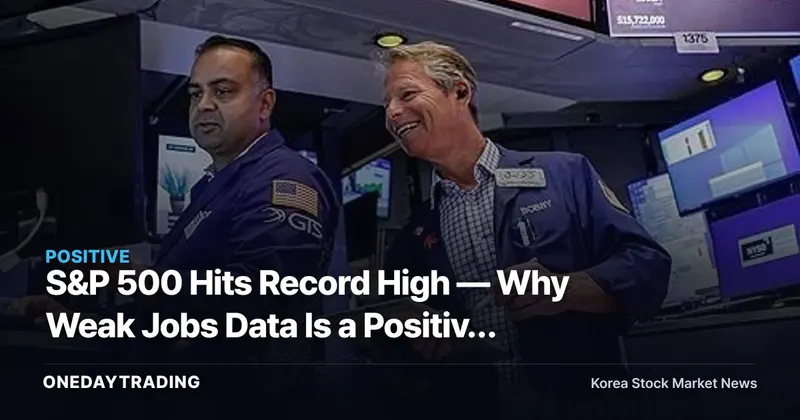
- All three major New York indexes closed higher on August 7 (local time), with the S&P 500 setting a fresh record high.
- Weaker-than-expected U.S. jobs data eased concerns over further Fed rate hikes.
- In a paradoxical twist, a negative-catalyst reading — a cooling labor market — actually pushed up stock valuations by lowering discount-rate expectations.
What's Changing
A weaker jobs report is typically read as a sign of slowing growth and viewed as a drag on stocks. Yet New York markets reacted in exactly the opposite way on this occasion. The reason is simple: the variable driving the market right now isn't corporate earnings but the Fed's next move, and signs of a cooling labor market were read as the Fed losing its justification for further rate hikes. This is a classic case of "bad news is good news," where weak economic data translates into a favorable stock market reaction.
What matters here isn't the headline index gain but the mechanism behind it: labor-market cooling → reduced expectations for further tightening → falling government bond yields → a lower discount rate (cost of capital) for equities → an expansion in the valuation multiple applied to future earnings. Earnings forecasts themselves haven't changed — the market is simply paying a higher multiple for the same earnings. And the sectors that benefit first and most from this mechanism are always the same: growth stocks and long-duration assets, where future earnings weigh more heavily than current earnings.
The catch is that much of this rally has already priced in expectations for rate cuts. What the market has already priced in is the end of the Fed's tightening cycle. What it hasn't yet priced in is whether the labor-market slowdown is simple normalization or the early stage of a pullback in consumer spending. How that distinction resolves will determine the direction of the next phase.
Numbers in Context
The fact that the S&P 500 closed at a record high says a lot about the character of this rally. Index records typically come during bursts of earnings surprises, but this time the trigger was weak jobs data — meaning the current rally is driven less by earnings improvement than by falling discount rates, in other words, a multiple-driven rally. Because a multiple-driven rally depends on rates continuing to move favorably, even a single data point moving the other way could trigger an outsized pullback.
Consensus has now tilted firmly toward the view that the Fed's hiking cycle is over. But the more one-sided that consensus becomes, the easier it is to trigger the opposite scenario. If the next jobs or inflation reading comes in hotter than expected, the valuations built up now could face reversal pressure. Conversely, if a soft-landing scenario is confirmed — labor-market cooling that continues without tipping into recession — this rally would buy time to convert rate-cut expectations into an actual improvement in earnings.
Winners and Losers
- U.S. large-cap growth stocks such as Nvidia and Microsoft — the benefit of falling discount rates flows first to stocks (tickers) with a heavier weighting toward future earnings.
- Top S&P 500 market-capitalization names such as Apple — since the index itself hit a record high, stocks (tickers) with heavy index weightings see an outsized boost from supply-demand (order flow) improvement.
- Korean large-cap semiconductor stocks (tickers) such as Samsung Electronics and SK Hynix — easing concerns over U.S. rates typically bring improved foreign investors' supply-demand (order flow) and upward pressure on the won, both positive catalysts for Korean exporters and tech stocks (tickers).
- Domestic and international bank and financial stocks (tickers) could be relatively left behind, as firming expectations for rate cuts tend to slow the pace of net interest margin improvement.
Risk Check
- If the labor-market slowdown turns out to be an early warning of a pullback in consumer spending rather than gentle normalization, the positive catalyst of rate-cut expectations could flip into a negative catalyst driven by recession fears.
- If Fed officials' comments push back against the market's eagerness for rate cuts, some of this rally's gains could be reversed.
- Since the rally is unfolding on top of already-elevated valuation multiples, any downward revision to earnings forecasts could trigger a larger pullback.
- The next jobs report and Consumer Price Index (CPI) release could still shift the market's direction, and that possibility should be kept in mind.
Bottom Line
This rally is the product of favorable rate movements, not improving earnings — and this setup will hold only until the Fed's actual rate path is confirmed by the next jobs and inflation data.
This article was automatically summarized and analyzed based on the original news report. View original (Yonhap News Agency, Securities)