
Key Takeaways
South Korea's July exports totaled $98.9 billion. What this figure really signals isn't the economic recovery itself, but rather that foreign investors now have fresh justification to move semiconductors and export-driven stocks (tickers) back to the front of the line in the Korean equity market.
What the market has already priced in is the export recovery. What it hasn't fully priced in yet is how much of that 62.8% export growth rate will translate into margins and won-denominated earnings.
What Happened
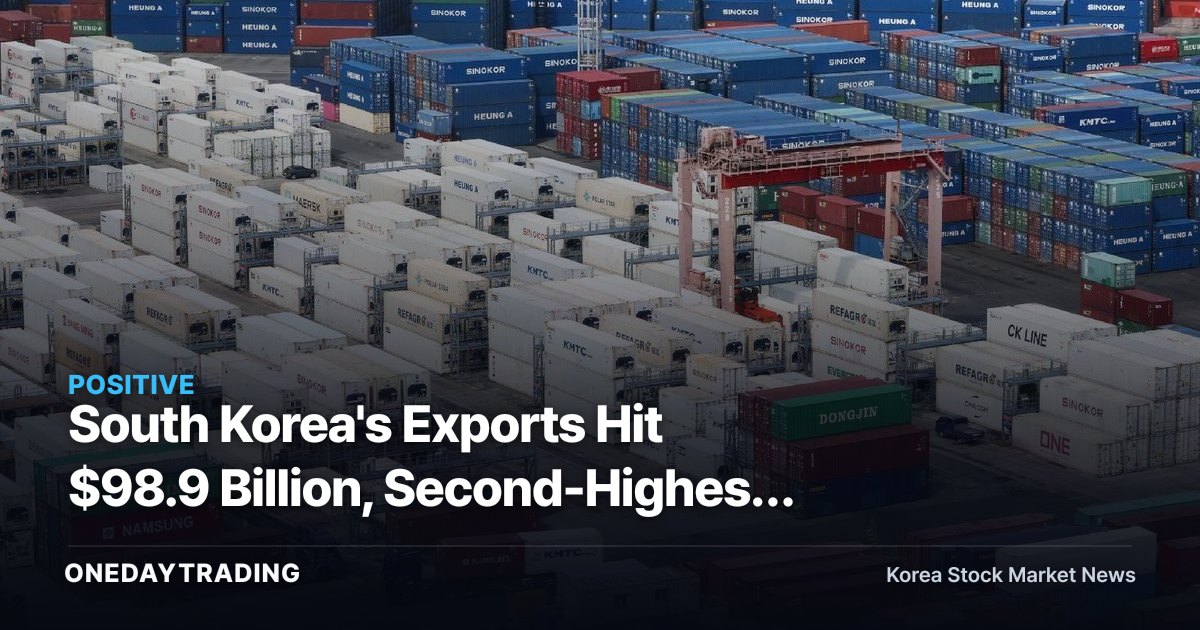
South Korea's July exports came in at $98.9 billion, up 62.8% from a year earlier. On a monthly basis, that's the second-highest total on record, trailing only June's $102.25 billion. The key point is that export levels held up without a major pullback even after breaking the $100 billion mark for the first time the month before.
This figure is hard to attribute to a simple base effect alone. Coming this close to $100 billion in July, right after June's exceptional peak, suggests that Korean companies' foreign-currency revenue strength is holding steady. With semiconductors — the country's flagship product category — cited as the key support, the focus of KOSPI earnings expectations is shifting back toward memory chips and the AI server supply chain.
In the stock market, the order of importance runs: export value, exchange rate, then operating profit. Even if dollar-denominated revenue rises, a rapid won appreciation would dilute those gains once converted back to won. Conversely, if the won stays weak, there's a higher probability that export stocks' (tickers) revenue growth will translate into upward earnings revisions.
Background and Context
The Korean stock market is highly sensitive to the export cycle. The reason is simple: a large share of KOSPI's market capitalization sits in industry sectors with heavy overseas revenue exposure — semiconductors, autos, refining, chemicals, and steel. When export data comes in strong, foreign investors tend to re-rate won-denominated assets as cyclical plays.
That said, a 62.8% growth rate doesn't translate directly into an equivalent move in share prices. The market pays for durability, not just the growth rate. Two consecutive months of elevated levels — $102.25 billion in June and $98.9 billion in July — is a positive sign. The next question is whether this demand came with price appreciation, or was simply a volume recovery.
Impact on the Market and Stocks (Tickers)
- Samsung Electronics (005930): If semiconductors are leading exports as the flagship category, this is the first stock (ticker) to watch. When memory prices and shipment volumes improve at the same time, export growth can flow through to upward revisions in operating profit estimates.
- SK Hynix (000660): The stronger demand for high-value-added memory for AI servers, the higher the quality of export growth. The mix shift toward premium products matters more for margins than a simple rebound in commodity memory.
- Hyundai Motor and Kia: If total export value stays elevated, automakers also become a secondary axis of foreign investor buying (order flow). That said, for autos, incentives and the exchange rate — not unit sales — are what ultimately determine profit.
- Refining and Chemicals: If the rise in export value reflects oil prices and product price effects, that's favorable for top-line growth. But unless spreads improve in tandem, revenue growth won't easily translate into margin improvement.
- KOSPI: Export data serves as a defensive argument for index valuations. Even if high rates cap multiple expansion, a stronger earnings outlook can put a floor under the index.
Investor Checkpoints
- August preliminary export figures: Watch whether the elevated levels from June and July continue. A one-month spike would make a pullback in share prices hard to avoid.
- Semiconductor unit prices: This is the metric that distinguishes whether export growth is volume-driven or price-driven. Earnings estimates for Samsung Electronics (005930) and SK Hynix (000660) will only rise further once price gains are confirmed.
- Won-dollar exchange rate: A rapid won appreciation would be good for valuations but a drag on earnings, even as exports post a positive catalyst. The exchange rate level could shift the direction of foreign investor supply-demand (order flow).
- Bank of Korea's rate path: Strong exports ease concerns over an economic slowdown. But that could also push back expectations for rate cuts, weighing on growth stocks' valuation multiples.
Outlook
The bullish scenario is straightforward: if July's $98.9 billion figure, paired with the semiconductor recovery, feeds into upward earnings revisions next quarter, export-driven large-cap stocks (tickers) will once again lead the KOSPI. Even without rate cuts, the market can hold up if earnings keep climbing.
The trigger for the bearish scenario lies in the exchange rate and product concentration. If export growth becomes overly concentrated in semiconductors while the won strengthens rapidly, the headline data may look good even as earnings improvement stays limited stock by stock. The next checkpoints are the preliminary August export data and the won-dollar exchange rate — whether the numbers hold up, and whether earnings catch up to expectations the market has already bought into, will mark the turning point.
This article is automatically summarized and analyzed based on the original news report. View original (Maeil Business News, Corporate)