
At a Glance
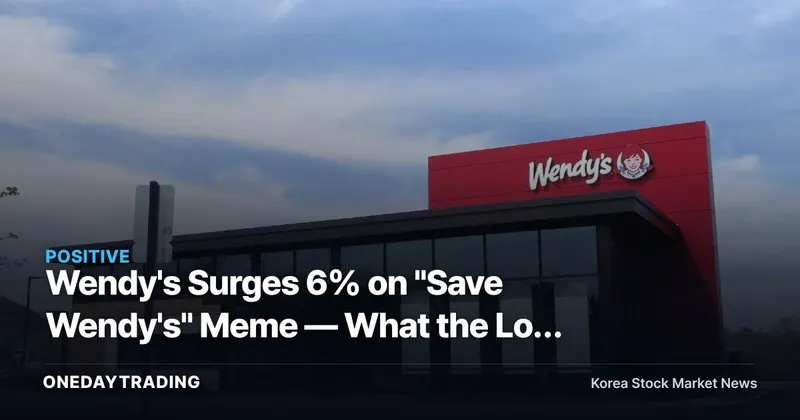
Shares of U.S. fast-food chain Wendy's (WEN) rose approximately 6% amid a social media-driven "Save Wendy's" meme campaign. The real story, however, is not the meme itself, but the value stock narrative it brought to light — namely, a low P/E ratio and a high dividend yield. Investors should separate the short-term buzz from the underlying fundamentals.
Why It Matters Now
Mature restaurant franchises like Wendy's are valued less as growth stocks and more as cash-flow plays anchored by dividends and franchise royalties. When a stock underperforms, the dividend yield rises mechanically and the P/E compresses. The central question of this rebound is whether the market interprets this as a genuinely undervalued stock or as a justified discount reflecting stalled growth.
A meme campaign can act as a positive catalyst for retail investor inflows and a sharp spike in trading volume — but as the GameStop episode demonstrated, event-driven supply-demand (order flow) reverses quickly if earnings don't support the move. Conversely, if the buzz translates into foot traffic and improved brand perception, there is a plausible path to same-store sales recovery as an earnings catalyst. For Korean investors, the key question is whether to approach this as a short-term thematic trade in a volatile U.S. small-cap or to take a medium-to-long-term view based on dividend cash flow.
Frequently Asked Questions
- Why is the P/E low? Softening restaurant demand and growth concerns have weighed on the share price, compressing the earnings multiple. It would be premature to call this an unconditional bargain.
- Why is the dividend yield high? The decline in the share price has shrunk the denominator, inflating the yield. Dividend sustainability must be verified separately using free cash flow and the payout ratio.
- How long will the meme effect last? Supply-demand (order flow) events are typically short-lived; without a change in earnings or guidance, the case for a sustained trend reversal is weak.
- Is there a direct impact on Korean markets? Direct linkage is limited, but this serves as a useful reference case for valuation debates surrounding domestic restaurant and franchise stocks.
Related Stocks and Sector Impact
- Wendy's (WEN) — The stock at the center of this story; same-store sales trends and dividend policy will be the primary drivers of price direction.
- McDonald's, Yum! Brands, and other U.S. restaurant stocks — They share the franchise royalty model and dividend stock profile, making them natural valuation comparables.
- Domestic restaurant and franchise-related stocks — Indirectly affected through market sentiment via shared variables: softening restaurant consumption and franchisee profitability.
- Consumer staples and domestic demand sectors — Disposable income levels and changes in dining-out frequency feed directly into revenue demand, creating co-movement with this space.
Key Investment Considerations
- Distinguish between meme-driven short-term supply-demand (order flow) and a fundamentals-based recovery; be mindful of volatility during surges in trading volume.
- Do not focus solely on the high dividend yield — assess dividend sustainability through the payout ratio and free cash flow.
- Verify whether the low P/E represents undervaluation or a growth discount by tracking same-store sales trends.
- For Korean investors, exchange rate risk and the time-zone gap in U.S. trading hours can magnify entry and exit risks in volatile U.S. small-cap names.
Outlook
The bull scenario is one where meme-driven brand awareness translates into higher foot traffic, same-store sales rebound, and a stable dividend supports a value stock re-rating. The bear risk is that softening restaurant demand persists, the buzz fades, the supply-demand (order flow) event reverses, and the low P/E proves to be a justified discount rather than undervaluation. The same-store sales figures and dividend guidance in the next quarterly earnings release will be the decisive factor separating these two scenarios.
This content was automatically summarized and analyzed based on the original news article. View original article (Yahoo Finance)