
Three-Line Briefing
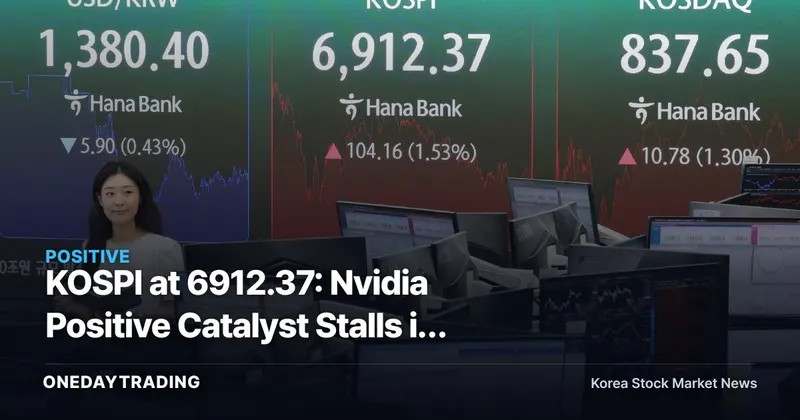
- The KOSPI closed at 6912.37 on August 27, up 104.16 points, or 1.53%, from the previous session.
- The early move toward the 7000 level was driven by Nvidia’s strong earnings, while the factor that trimmed the gains was the Bank of Korea’s benchmark interest rate hike.
- Kang Si-hyun’s view is clear. The market bought into AI semiconductor profits, but it has also started pricing in the pressure that higher rates place on multiples.
What Changes
The KOSPI at 6912.37 is not just a higher close; it is the price tag of Nvidia earnings and the Bank of Korea’s benchmark interest rate hike colliding on the same day. The core issue is that even if earnings expectations for semiconductor leaders remain alive, higher discount rates immediately pressure growth-stock valuations.
Nvidia’s strong earnings translate in the Korean market into the AI semiconductor supply chain, including Samsung Electronics and SK hynix. Strong GPU demand brings expectations for HBM, memory, packaging, and server investment. The KOSPI’s early move toward 7000 therefore reflected technology-stock earnings prospects first.
But the Bank of Korea’s benchmark interest rate hike forces the market to read the situation in a different language. When rates rise, the present value of future earnings falls, and high-multiple growth industry sectors feel the burden first. The KOSPI gave back part of its gains not because the positive catalyst disappeared, but because the market recalculated the discount rate called interest rates.
Numbers and Context
According to Maeil Business Newspaper’s securities coverage, the KOSPI closed on August 27 at 6912.37, up 104.16 points from the previous session. A 1.53% gain is a strong figure, but the path matters more: the index pulled back after approaching 7000 intraday. The intraday trajectory says more than the closing price about the conviction of foreign investors and institutional investors.
What the market has already priced in is AI demand from Nvidia. What it has not fully priced in is the possibility that the benchmark interest rate hike could affect both next-quarter earnings estimates and target multiples. If higher rates stabilize the exchange rate, that could support foreign investors’ supply-demand (order flow), but for domestic-demand and growth stocks, it brings offsetting pressure from higher funding costs and slower consumption.
Beneficiaries and Losers
- Samsung Electronics: Nvidia’s strong earnings raise expectations for AI server and memory demand. However, in a rate-hike environment, upward earnings revisions must overcome falling multiples for share-price momentum to continue.
- SK hynix: Its exposure to HBM and high-value-added memory makes the domestic read-through from Nvidia earnings the most direct. The key indicators to watch are AI memory shipments and pricing power.
- KB Financial Group: A benchmark interest rate hike can lift expectations for banks’ net interest margins. Conversely, if credit costs rise as well, much of the positive catalyst could be offset.
- Naver: A rate hike acts as a discount-rate burden for platform growth stocks. Valuation-adjustment pressure may move before advertising and commerce earnings do.
- LG Energy Solution: High rates weigh on investment sentiment for EVs and batteries. The key channel is higher funding costs across growth stocks, which pressure industry sector multiples.
Risk Check
- If the Bank of Korea’s benchmark interest rate hike is not a one-off, technology-stock multiples in the KOSPI may face further pressure.
- If the Nvidia earnings positive catalyst has already been largely reflected in share prices, the next driver will be confirmation of actual orders and shipments, not expectations.
- If higher rates lead to won strength, that may be favorable for foreign investors’ supply-demand (order flow), but it could weigh on translated earnings for exporters.
- The KOSPI 7000 level is a psychological resistance line. Breaking above it again will require both semiconductor earnings expectations and a more stable rate path.
One-Line Conclusion
AI semiconductors still lead the KOSPI’s advance, but while the Bank of Korea’s rate hike pressures multiples, the market will draw a sharper line between stocks (tickers) with confirmed earnings and those driven mainly by high expectations.
Frequently Asked Questions
Why did the KOSPI rise on August 27?
The KOSPI rose 104.16 points, or 1.53%, on August 27 as expectations for AI semiconductors flowed in following Nvidia’s strong earnings. Its early move toward 7000 was also driven by expectations for large-cap semiconductor stocks such as Samsung Electronics and SK hynix.
Why is the Bank of Korea’s rate hike a burden for the stock market?
The Bank of Korea’s benchmark interest rate hike raises the discount rate for equities, lowering the present value of future earnings. Industry sectors with substantial future-growth expectations already embedded in share prices, such as semiconductors, internet, and rechargeable batteries, may face multiple adjustments unless earnings improvements are confirmed.
How do Nvidia earnings affect Korean semiconductor stocks?
Strong Nvidia earnings are interpreted as a signal that AI server investment and demand for high-performance memory remain solid. Korean investors should monitor next-quarter memory prices, HBM shipments, and customer order trends for Samsung Electronics and SK hynix.
Samsung Electronics Through Real-Time Data
Samsung Electronics’ latest closing price was 266,000 won (+1.72% from the previous day), and its signal light, combining foreign investors and institutional investors supply-demand (order flow), news, and momentum, is 🟡 neutral · watch. Positive and negative signals are mixed, making this a period to monitor.
Recent related news is negative, with 7 positive catalysts and 8 negative catalysts.
※ Price and foreign investors/institutional investors supply-demand (order flow) data are provided by Korea Investment & Securities (KIS) and are as of the time of publication.
This content was automatically summarized and analyzed based on the original news article. View original article (Maeil Business Newspaper Securities)