
Three-Line Briefing
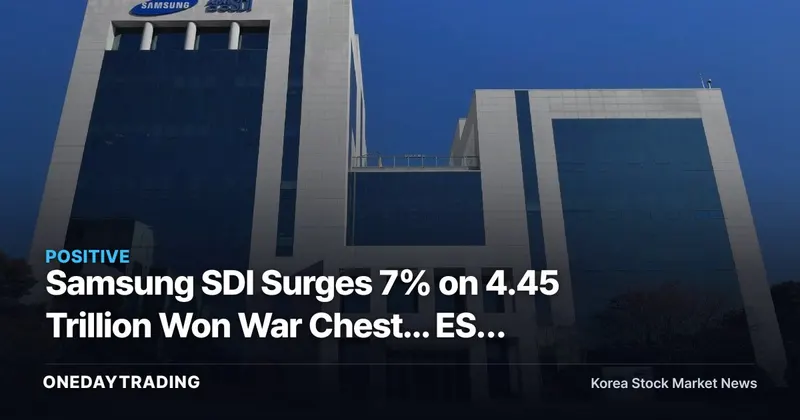
- Samsung SDI's sale of its Samsung Display stake brings in a cash inflow of 4.45 trillion won, prompting battery investors to recalculate the company's capacity for ESS expansion.
- According to Maeil Business Newspaper's securities coverage, Samsung SDI gained 7% intraday while L&F jumped 16%. What the stock price bought was not near-term earnings but the option value of North American ESS investment.
- ESS stands for Energy Storage System — industrial-scale demand that pairs batteries with power grids and renewable energy facilities to store electricity and supply it when needed.
What's Changing
The key to Samsung SDI's 4.45 trillion won cash conversion isn't the cash line on the balance sheet — it's the sequencing of investment. When the slowdown in EV battery demand drags on, companies either halt expansion or redirect capacity toward demand they can actually see. The market read this sale as the latter.
The battery cycle moves in the order of order backlog, utilization rate, and margin. With EVs slowing, ESS filling idle production lines lowers the fixed-cost burden first. But ESS doesn't guarantee high margins right away. Profitability follows only once falling cell prices, customer-specific certifications, and North American grid project timelines all line up.
L&F's 16% jump follows the same logic. Cathode material makers react first to signs that cell makers are resuming investment. But materials stocks face a wider lag between costs and selling prices than cell makers do. If lithium prices and long-term supply contract terms turn unfavorable, profit recovery lags even as shipments rise.
Numbers in Context
Three numbers stand out in this news. Samsung SDI expects 4.45 trillion won from the Samsung Display stake sale; its share price reacted with a 7% gain, and L&F's with a 16% gain. The magnitudes differ, but the direction is the same: the market re-priced its bottom-out expectations for the battery sector around the cash inflow and the prospect of ESS investment.
The key comparison points are LG Energy Solution, Ecopro BM, and POSCO Future M. For battery cell makers, the capacity to execute investment sets a floor under the stock; for materials makers, a recovery in customer utilization rates opens the ceiling on earnings. This isn't a phase of surging orders so much as one where companies with newly freed-up capital are the first to prepare for the next cycle.
Winners and Losers
- Samsung SDI: The expected 4.45 trillion won cash inflow expands its capacity to invest in North American ESS and battery equipment. Funding the move with internal cash rather than debt would let the company advance both investment speed and financial stability at once.
- L&F: Expectations for cell makers' ESS investment have stirred expectations for cathode material demand. Still, the actual benefit needs to be confirmed through shipment volumes to Samsung SDI, price adjustments, and raw material price trends.
- Ecopro BM: It stands to benefit alongside the broader re-rating of the battery materials value chain. If customer orders resume, expectations for improved utilization rates will be priced in first.
- POSCO Future M: Both its cathode and anode material businesses are sensitive to the battery equipment investment cycle. The key question is whether ESS cell expansion translates into materials contracts.
- LG Energy Solution: It serves as the benchmark for ESS market expansion. Samsung SDI's expanded investment capacity is both a sign of recovering sector demand and a variable that intensifies competition in the North American ESS market.
Risk Check
- There is no confirmed disclosure yet that the stake-sale proceeds will go directly into ESS investment — that still needs separate verification. A cash inflow and capital expenditure are not the same thing.
- Battery stocks tend to price in bottom-out expectations quickly. Samsung SDI's 7% and L&F's 16% gains could be followed by short-term profit-taking pressure.
- ESS is tied to grid investment and regulatory approval timelines. If customer projects slip, cell shipments and materials orders won't land in the same quarter.
- If raw material prices such as lithium turn volatile again, materials makers' margins could move opposite to rising shipment volumes.
Bottom Line
Samsung SDI's 4.45 trillion won war chest adds substance to the battery-sector bottom-out thesis, but the stock's next leg higher opens only once ESS investment disclosures and customer orders are confirmed in hard numbers.
Frequently Asked Questions
Why did Samsung SDI's stock price rise?
According to Maeil Business Newspaper's securities coverage, Samsung SDI is expected to receive a cash inflow of about 4.45 trillion won from selling its stake in Samsung Display. Investors interpreted this as funding that could expand its capacity to invest in North American ESS and battery equipment, driving Samsung SDI's share price up 7%.
How does ESS affect battery-sector earnings?
ESS is industrial demand that can offset the battery plant utilization rates lowered by slowing EV demand. If Samsung SDI expands its ESS investment, it would move not only cell shipments but also order expectations for cathode material, anode material, and equipment makers.
Will L&F's 16% surge hold?
L&F's 16% gain reflects the spillover of Samsung SDI investment expectations into the cathode material value chain. Whether it holds should be judged by whether actual supply contracts, customer utilization rates, and stabilizing raw material prices show up in next quarter's earnings.
Samsung SDI in Real-Time Data
Samsung SDI's most recent closing price was 515,000 won (+7.74% versus the previous session), and the composite signal combining foreign/institutional order flow with news and momentum reads 🟡 Neutral / Wait-and-see. With positive and negative signals mixed, this is a stretch to watch closely.
- ▼ Supply-demand (order flow) continuity — Foreign investors have been net sellers for 3 straight sessions (−16.6 billion won)
Recent related news skews negative, with 0 positive catalysts and 1 negative catalyst.
※ Price and foreign/institutional order-flow data are provided by Korea Investment & Securities (KIS) and reflect the time of publication.
This article is automatically summarized and analyzed content based on the original news report. View original (Maeil Business Newspaper Securities)