
Summary
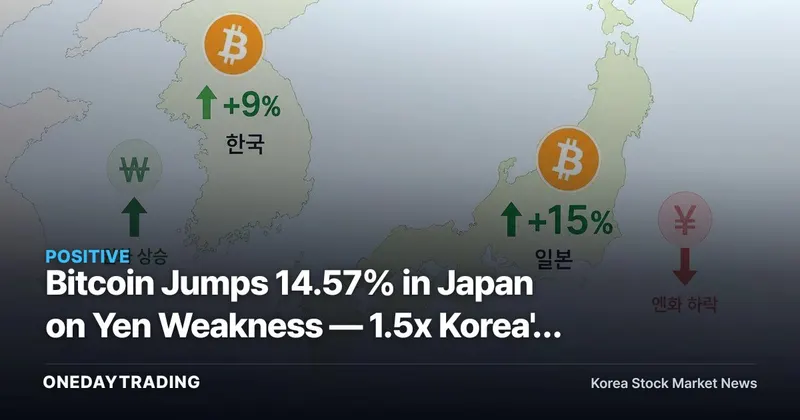
On the day Bitcoin rose, what moved more was not the coin but the currency. In July, BTC's gain on Japan's bitFlyer reached 14.57%, outpacing Upbit's 9.21% — a gap created by an optical illusion in nominal returns driven by yen weakness and won strength.
In Jeong Han-gyeol's view, this issue matters more than any Bitcoin price forecast. Korean investors who look only at the BTC/USD chart risk over- or underestimating their returns, and the market has entered a phase where the direction of the exchange rate determines the perceived return on domestic exchanges.
What Happened
Bitcoin also rebounded in July in dollar terms. On Binance, BTC traded around $66,492 on the 22nd, marking its first return above $66,000 in 34 days since June 17. Having fallen as low as $57,800 on the 1st, it has clawed back 14.44% from that low over 20 days.
But the same BTC posted very different scorecards depending on which currency it was measured in. According to TradingView, Japan's bitFlyer showed a 14.57% July gain versus 9.21% on Korea's Upbit. This doesn't mean Bitcoin's network value improved more in Japan alone. The yen-denominated price also captured the yen's weakness, while the won-denominated price was partly held back by won strength.
The exchange rate is what split the two. The won-dollar rate has fallen this month from 1,552 won to 1,480 won. As the won strengthens, the won-converted price gain on overseas assets shrinks. The yen-dollar rate, by contrast, rose from around 161 yen to 163.16 yen, pushing the yen's value down to its lowest level in 39 years and 7 months. The BTC that Japanese investors saw reflected both the coin's rise and the yen's decline combined.
Structural Backdrop
The Korean-side variable is supply-demand (order flow)-driven dollar selling. Currency-hedging flows from exporters and heavy industry firms entered the FX market and dragged the won-dollar rate down, and the phased conversion of the $26.5 billion raised through SK Hynix's ADR listing has also been cited as a factor behind won strength. For domestic BTC holders, even if the global coin price rises, a falling exchange rate erodes their won-denominated return.
Japan is the mirror image. A preference for dollars amid worsening Middle East tensions, the Takaichi administration's aggressive fiscal stance, and political pressure restraining the Bank of Japan from raising rates have all deepened yen weakness. Bitcoin looks like both a dollar-liquidity asset and a hedge against local currency depreciation at the same time. Japan's 14.57% gain is the result of a risk-asset rally overlapping with currency-defense demand.
Impact on Stocks (Tickers) and Industry Sectors
- Spot Bitcoin ETFs: The recent shift from outflows to net inflows is a factor supporting a floor under BTC's price. However, if ETF net inflows dry up, the rally will be hard to sustain on exchange-rate effects alone.
- Domestic crypto exchanges: The fact that the Upbit-based gain came in at only 9.21% shows that domestic investors' perceived returns are exposed to won strength. Trading value is more sensitive to volatility than to price itself.
- Japanese crypto exchanges: bitFlyer's 14.57% gain could stimulate hedging demand among Japanese retail investors. The longer yen weakness persists, the more sensitively BTC's local-currency price reacts.
- Semiconductors and risk assets: As sharp volatility in global semiconductor stocks has calmed, one interpretation is that BTC has regained relative appeal within risk-asset portfolios. Capital moves toward reward-per-unit-of-volatility rather than raw returns.
Bull vs. Bear Scenarios
The bull case is straightforward. If ETF net inflows continue, dollar-denominated BTC holds above $66,000, and yen weakness persists, the nominal price gain in the Japanese market could grow even larger. If declining exchange balances accompany this, it adds a supply-demand (order flow) narrative of a shortage of sell-side supply.
The bear case starts with the exchange rate. If the won-dollar rate falls further, Korean investors' won-denominated BTC returns will lag the dollar chart. Conversely, if the Bank of Japan signals a strong rate hike or dollar preference eases and the yen rebounds, Japan's excess return would disappear quickly. The portion of the gain that came from a weaker quote currency rather than BTC itself is also the portion most prone to a swift reversal.
Investor Action Points
- Track BTC/USD and BTC/KRW separately: The dollar price alone isn't enough for a domestic investment decision. Watch whether the won-dollar rate falls further below 1,480 won.
- Check ETF fund flows weekly: The recent shift to net inflows is the key basis for the price rebound. If net inflows slow, the quality of the recovery above $66,000 weakens.
- Watch whether the yen-dollar rate holds around 163 yen: The excess return in the Japanese market is a function of yen weakness. Bank of Japan statements and shifts in fiscal-expansion policy are direct variables to watch.
- Confirm a stable hold above $66,000: More important than the recovery itself after 34 days is whether trading volume and ETF inflows both hold up above this level.
This article was automatically summarized and analyzed based on the original news report. View original (Maeil Business Newspaper – Securities)