
At a Glance
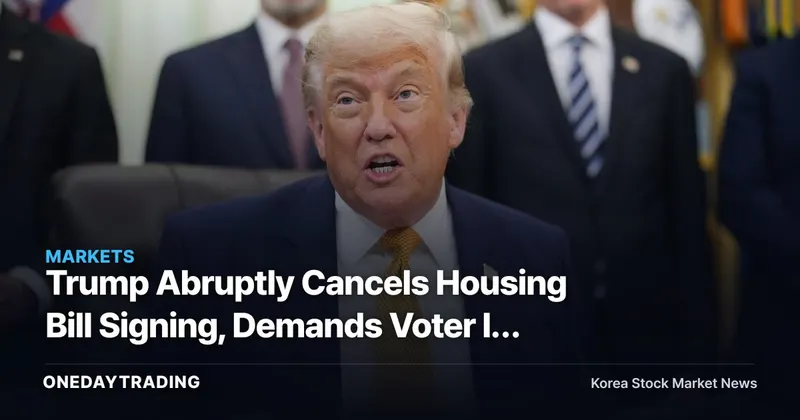
President Trump abruptly canceled the signing ceremony for a bipartisan bill aimed at stabilizing housing prices roughly an hour before the Capitol Hill event, demanding that a voter ID provision be added to the legislation. While framed as housing policy on the surface, the move is fundamentally a political bargaining chip, and the key takeaway is that the bill's passage timeline has become uncertain. From an investment perspective, this is a policy variable for the U.S. housing supply and construction-related industry sector, and in the near term it reads less as a directional signal than as an expansion of uncertainty.
Why It Matters Now
Housing affordability bills typically include incentives to boost supply, streamlined permitting, and financial or tax support. If such policies were implemented, U.S. housing starts and new-home sales volume would likely increase, creating a trading volume opportunity for homebuilders — but at the same time, rising supply that pushes down selling prices would cut both ways for margins. As such, the bill's direction is difficult to characterize as a uniform positive catalyst for homebuilder stocks.
What matters more in this case is the political gridlock created by the canceled signing. Voter ID is a sharply divisive issue between the two parties, so folding it into the housing bill significantly raises the risk that the entire bill could stall. Markets tend to react first to uncertainty over passage and timing rather than to the substance of the policy itself, so the related industry sector could remain sensitive to policy headlines for some time.
Direct exposure for Korean investors is limited, but the U.S. housing market is worth watching indirectly, given its broad downstream links to appliance, furniture, and building-materials exports as well as global demand for lumber and cement.
Frequently Asked Questions
- Why was the signing canceled? Because President Trump demanded an additional voter ID provision be added to the bill, using it as political bargaining leverage.
- Will the bill collapse? Its collapse is not a foregone conclusion, but its passage timeline could be delayed depending on how negotiations over the voter ID provision play out.
- Will housing prices be affected immediately? Since the bill is still pre-implementation, the near-term real-world impact is limited, though receding policy expectations could weigh on market sentiment first.
- Is this an unconditional negative catalyst for homebuilder stocks? A supply-expansion plan is positive for trading volume but a burden on selling prices, so it's hard to call it a one-sided positive catalyst.
Impact on Related Stocks and Sectors
- U.S. homebuilders If policy expectations recede due to delays in the bill, it could affect new-home sales and housing-start momentum. However, the supply expansion itself could pressure margins, making the impact two-sided.
- Building materials, cement, and lumber U.S. housing-start volume is a key driver of upstream demand, so the demand outlook could swing depending on how the bill unfolds.
- Appliances and furniture New-home move-ins typically drive durable-goods replacement and new purchases, so delays in housing-supply policy could push back the timing of this demand recovery.
- Korean export-related stocks Companies supplying building materials and appliances to the U.S. have indirect exposure to the pace of the U.S. housing market's recovery, so it's worth monitoring how the policy progresses.
Investment Considerations
- Policy headlines themselves can be short-term noise, so investors should be wary of overcommitting before the actual bill vote and implementation schedule are confirmed.
- Since expanded housing supply creates a trade-off between trading volume and margins for homebuilders, treating it as a simple beneficiary story risks misjudgment.
- U.S. mortgage rates and data on new housing starts and existing-home sales are more direct drivers of share prices than the policy itself.
- Since the connection to Korean listed companies is indirect, it makes sense to check each company's share of U.S.-derived revenue before gauging the impact.
Overall Outlook
The optimistic scenario is that negotiations eventually produce some version of the bill that passes, expanding U.S. housing supply and gradually reviving downstream demand for construction, building materials, and appliances. Conversely, if the political standoff over voter ID drags on, the bill could stall indefinitely, causing policy expectations to fade and leaving the related industry sector more dependent on mortgage rates and macro indicators. Key data points to watch include the upcoming congressional vote schedule, the trajectory of U.S. mortgage rates, and monthly new-home starts and sales figures — the direction of these real-world indicators, more than the policy itself, is likely to determine how individual stocks move.
This article is automatically summarized and analyzed based on the original news report. Read original (CNBC)