
Summary
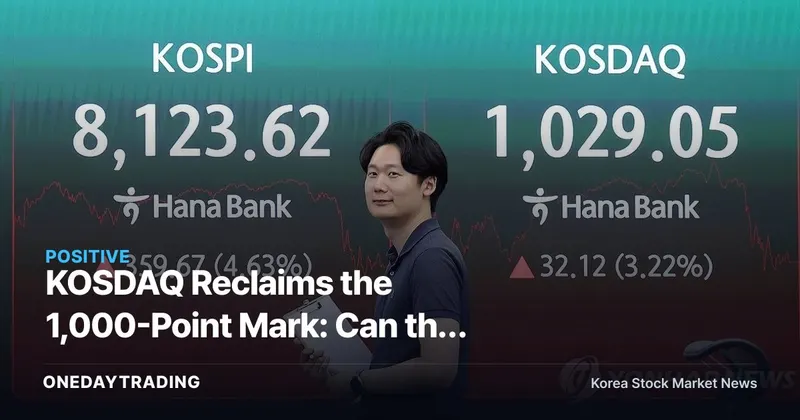
After a prolonged slump that left it among the worst-performing major global stock markets, the KOSDAQ index has once again reclaimed the 1,000-point mark — the so-called "Cheonsdaq" milestone. The move is being read as the combined result of a rebound in large-cap growth stocks such as secondary batteries and biotech, together with improving supply-demand (order flow) from retail investors and institutional investors. Still, for this to develop into a sustained uptrend, the challenges of earnings and foreign investor capital remain.
How It Unfolded
The KOSDAQ market had long underperformed significantly relative to the KOSPI and major overseas markets such as the U.S. and Japan. Secondary battery materials stocks and pharmaceutical and biotech stocks, which dominate the upper ranks of market capitalization, weakened in tandem and weighed down the entire index, which at one point slid to around 700 points — cementing its reputation as a neglected market.
Recently, however, the trend has shifted. Expectations of technology licensing-out deals among large-cap biotech stocks, talk of a bottom in the secondary battery cycle, and buying flows into new growth themes such as robotics and artificial intelligence drove the index to ratchet up its level quickly. Bargain hunting by retail investors, along with a partial return of institutional investors who had previously trimmed their positions, also provided momentum for the rebound.
As a result, the KOSDAQ once again broke through 1,000 points — both a psychological resistance line and a symbolic turning point — earning back the "Cheonsdaq" label. Opinion in the market is divided over whether this is merely a technical rebound or the early stage of a trend reversal.
Structural Background
The KOSDAQ's long-running slump is not unrelated to a structural limitation: its index composition is excessively concentrated in two high-volatility sectors, secondary batteries and biotech. Whenever the business cycles of both industry sectors turn down simultaneously, the entire index has repeatedly proven vulnerable. At the same time, with capital flowing into KOSPI large caps and U.S. Big Tech, small- and mid-cap growth stocks were relatively sidelined — another reason for the accumulated discount.
This rebound is largely a function of the renewed appeal of the valuations of these concentrated stocks, combined with expectations of rate cuts and a recovery in risk appetite. Whether the "Cheonsdaq" can hold therefore ultimately depends on whether earnings improvement at the sector bellwethers is confirmed in the actual numbers.
Impact on Stocks and Sectors
- Secondary battery materials: Given their large weight in KOSDAQ market capitalization, talk of a cyclical bottom and expectations of recovering EV demand will steer the index's direction.
- Pharmaceuticals and biotech: If technology licensing-out deals and clinical-trial momentum revive, this becomes a key pillar driving the index's upside momentum.
- Robotics, AI, and semiconductor materials/parts/equipment: As direct beneficiaries of capital flowing into new growth themes, they see expanding trading value and volatility.
- Small- and mid-cap growth stocks broadly: If risk appetite recovers, they may show relative strength versus the KOSPI.
Bullish vs. Bearish Scenarios
In the bullish scenario, full-fledged rate cuts, sustained risk appetite, and an earnings rebound at the sector bellwethers combine to bring foreign investor capital back into the KOSDAQ. In that case, the "Cheonsdaq" could serve as a springboard for a sustained step-up in levels. In the bearish scenario, by contrast, secondary battery and biotech earnings fall short of expectations and global risk aversion intensifies. If supply-demand (order flow) once again concentrates in KOSPI large caps, 1,000 points would remain a short-term high and volatility alone could increase.
Action Points for Investors
- Prioritize checking the earnings and guidance of the secondary battery and biotech sector bellwethers over the index level itself.
- Monitor supply-demand (order flow) indicators to gauge whether foreign investors and institutional investors keep net-buying the KOSDAQ.
- Given that this is a high-volatility market, control risk through staggered buying and position sizing.
- For stocks crowded into a theme, lower entry risk by approaching on pullbacks rather than chasing.
This article is content automatically summarized and analyzed based on an original news report. View original (Yonhap News, Securities)