
Key Takeaways
Game cheats and boosting are more than customer complaints: they are operational risks that drive users away, increase detection and enforcement costs, and undermine game companies’ long-term profitability.
The 0.48% investigation referral rate reported by Yonhap News Agency on September 7, 2026, indicates that the bottleneck lies in enforcement coordination rather than detection capabilities. Even when game companies suspend accounts, cheats and bots return if their developers and distribution networks remain active.
What Happened
Illegal programs are software tools that automate player inputs or repetitive tasks, undermining fair competition and in-game economies. Boosting refers to a third party taking control of an account for payment to raise its rank or achievements.
According to data obtained from the Game Rating and Administration Committee and the Korean National Police Agency by People Power Party lawmaker Yoon Yong-keun, the committee investigated 70,537 cases involving cheats, bots, and other illegal programs from 2020 through June 2026, detecting violations in 42,251 cases. During the same period, it investigated 37,530 boosting cases and detected violations in 28,611.
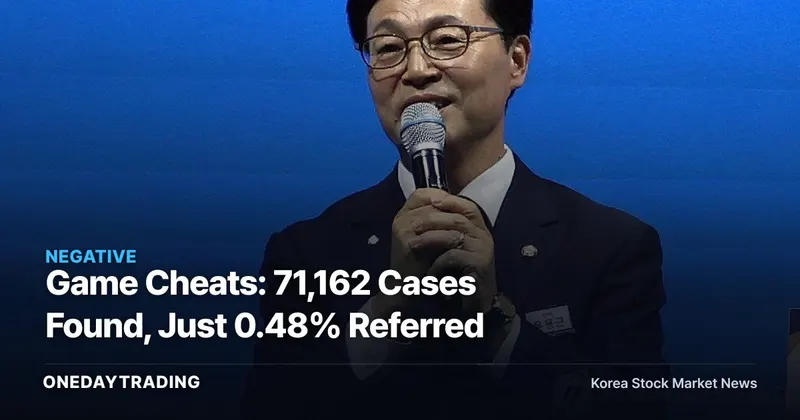
The two categories produced a combined 71,162 detected cases. However, just 339 were referred for investigation: 186 involving illegal programs and 153 involving boosting. That represents 0.48% of detected cases. More than 98.7% of illegal-program cases were handled through corrective or cooperation requests with limited legal force.
Background and Context
Detection is not the technological bottleneck. Game companies can identify behavioral patterns, abnormal inputs, and client tampering to block accounts, but they lack the authority to investigate sales organizations or shut down development and distribution servers. Unless the committee’s detection data is connected with police records on case intake, arrests, and penalties, the same suppliers can return using different accounts and addresses.
The damage extends beyond games themselves. Police data show that 60,348 game-related fraud cases involving direct online transactions were reported from 2020 through July 2026. Losses increased roughly 9.7-fold, from 6.4 billion won in 2020 to 62.3 billion won in 2025, reaching a cumulative 121.4 billion won from 2020 through 2025. As account trading and item purchases expand, security incidents translate into refund costs and declining customer trust.
Market and Stock Impact
- Take-Two Interactive: GTA 5 recorded 16,692 detected boosting cases, the highest among the games reviewed. If repeat violations persist, Rockstar Games may need to expand its detection staff and server monitoring, while legitimate users may spend less time and money in GTA Online because of unfair gameplay.
- Netmarble: Seven Knights 2 recorded 1,547 detected boosting cases. In collectible games, trust in progression resources and ranking competition underpins spending incentives. Widespread boosting therefore diminishes the value of the time and products paid for by legitimate users.
- Nexon: MapleStory was linked to 868 boosting cases. In MMORPGs, where the value of characters and items accumulates over long periods, abnormal gameplay distorts the supply of in-game currency and increases operational burdens.
- Game security ecosystem: Stronger coordination with law enforcement would initially increase game companies’ evidence-preservation and reporting workloads. Conversely, broader disruption of development and sales networks could lower repeated detection and account-enforcement costs while protecting legitimate-user retention.
Investor Watchpoints
- Investors should monitor the ratio of detected cases referred for investigation that the committee discloses from 2026 onward. A meaningful rise above 0.48% would signal a shift from simple removal toward supply-chain investigations.
- Investors should assess user metrics alongside live-service revenue trends in the next earnings releases from Take-Two Interactive, Netmarble, and Nexon. If stronger security measures prove effective, improved user retention may become visible before the associated cost benefits.
- Investors should watch whether National Assembly Culture, Sports and Tourism Committee discussions on the Game Industry Promotion Act produce concrete provisions for interagency case management and sanctions against repeat sellers.
- A decline in gaming fraud losses from 62.3 billion won in 2025 would serve as a supporting indicator of renewed confidence in payment and account-trading environments.
Outlook
In the optimistic scenario, the committee’s detection data is connected with police investigations and authorities expand efforts to disrupt development and distribution networks. This would allow game companies to move beyond endless account-level enforcement and protect the fairness of live services and user lifetime value.
The downside scenario is equally clear. If the investigation referral rate remains low, a higher number of detected cases will still fail to raise the cost of supplying illegal programs sufficiently. If tougher regulation expands only game companies’ monitoring obligations without dismantling sales networks, short-term operating expenses will rise first. Before looking at next quarter’s user metrics, investors should examine the committee’s investigation referral rate and the police’s actual arrest count.
Frequently Asked Questions
How many game-cheating cases have been detected?
From 2020 through June 2026, the committee detected 42,251 cases involving cheats, bots, and other illegal programs, along with 28,611 boosting cases. The combined total was 71,162, averaging more than 10,000 annually.
Which game recorded the most boosting cases?
GTA 5 ranked first with 16,692 cases from 2020 through June 2026. League of Legends recorded 5,757, Seven Knights 2 had 1,547, and MapleStory had 868.
How does enforcement against illegal programs affect gaming stocks’ earnings?
During the initial enforcement phase, spending on detection systems, personnel, and evidence management may increase. If authorities also disrupt development and distribution networks, restored fairness could improve user retention and payment confidence, creating a path toward lower long-term operating costs.
Jae-ho Yoon, One Day Trading Editorial Board Member
This article was automatically summarized and analyzed from the original news report. View the original article (Yonhap News Agency, Industry)