
At a Glance
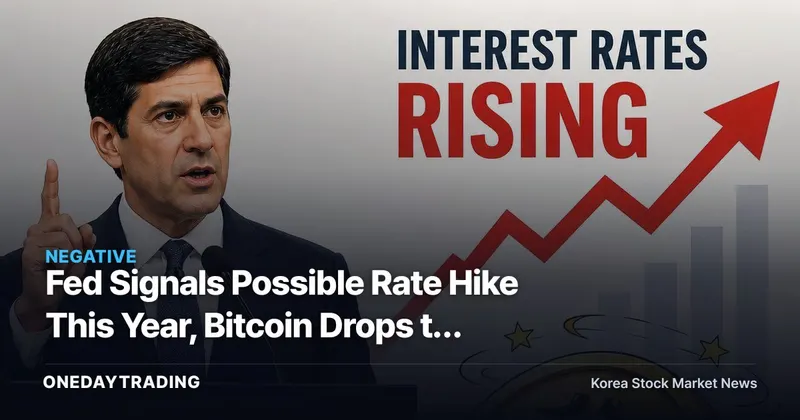
At the first FOMC meeting under new Fed Chair Kevin Warsh, known for his hawkish leanings, half the committee members projected at least one more rate hike this year, and Bitcoin retreated to around $64,000. The key takeaway isn't simply a drop in crypto prices — it's a signal that discount rates across the board for non-yielding risk assets could rise again. This connects not just to Bitcoin and Ethereum, but also to growth stocks and the domestic stock market, which is sensitive to exchange-rate swings.
Why It Matters Now
The direction of interest rates directly affects the pricing mechanism of assets without cash flows, like Bitcoin. Since cryptocurrencies pay no dividend or interest, their valuation depends almost entirely on liquidity and expected returns. When the market had been pricing in rate cuts this year and a rate hike suddenly becomes possible, the discount rate that reduces the present value of future returns rises, risk appetite contracts, and selling emerges first in the most volatile assets. This is the backdrop behind Bitcoin's sharper short-term decline.
The fact that this was the new chair's first meeting adds to the uncertainty. Markets had grown accustomed to the previous dot plot and rhetoric, so half the committee leaning toward further hikes suggests the monetary policy path could be reset. In that scenario, U.S. government bond yields and the dollar would likely strengthen, and capital could shift out of risk assets into safe havens and cash.
For Korean investors, two pathways matter. The first is won weakness driven by dollar strength and shifts in foreign investor supply-demand (order flow); the second is a simultaneous rise in valuation pressure on growth stocks such as Nasdaq names and semiconductors. Because the crypto market often acts as a leading indicator of global risk appetite, this can't simply be dismissed as crypto-only news.
FAQ
- Why is Bitcoin sensitive to interest rates: Because it's an asset with no interest or dividend, its value is driven by liquidity and expected returns. When rates rise, the opportunity cost of holding it increases, adding to selling pressure.
- Is a rate hike this year confirmed: No. Only half the committee projected at least one hike, and the actual decision depends on future inflation and employment data — it should be viewed as one possible scenario, not a certainty.
- What does this have to do with the domestic stock market: U.S. rate and dollar strength indirectly affect the KOSPI and KOSDAQ through won weakness, foreign investor supply-demand (order flow), and higher discount rates for growth stocks.
- Does the new chair's stance matter: If hawkish rhetoric intensifies, market expectations could be reset, increasing volatility — which gives significant weight to the messaging from his first meeting.
Related Stocks and Sector Impact
- Bitcoin and cryptocurrencies: As the risk assets most sensitive to interest rates and liquidity, they are directly exposed to short-term volatility. In periods of rising discount rates, they tend to see the earliest and steepest declines.
- Crypto exchange and infrastructure stocks: When trading value contracts, fee-based revenue can slow, giving these stocks high sensitivity that tends to move in tandem with crypto prices.
- Banks and financial stocks: Rising rates can boost expectations for improved loan-deposit margins, offering relative upside. However, asset-quality concerns during an economic slowdown work in the opposite direction.
- Semiconductors and growth stocks: Rising discount rates reduce the value of long-term growth, which can weigh on valuations — making these stocks inversely sensitive to the rate path.
- Exporters: A stronger dollar and weaker won can be favorable for translated earnings, but the key variable remains whether global demand slows.
Points to Watch for Investors
- The dot plot and committee remarks are not final. Watch whether the upcoming U.S. CPI and employment data releases reinforce the rate-hike scenario.
- Monitor the U.S. 10-year government bond yield, the dollar index, and the won-dollar exchange rate together to gauge the direction of risk appetite.
- Crypto volatility is amplified by leverage and liquidations, so bear in mind that a short-term sharp drop (plunge) may be unrelated to any actual change in fundamentals.
- Keep the next FOMC schedule and minutes release date on your calendar, and track whether the new chair's messaging remains consistent.
Overall Outlook
The optimistic scenario is that this hawkish signal turns out to be a temporary recalibration of expectations — if inflation continues to ease, hike concerns would fade and risk assets could rebound. Conversely, if subsequent data confirm the likelihood of a hike, dollar and rate strength could persist longer, adding further pressure on crypto and growth stocks. Ultimately, the key variables are the incoming data and the consistency of the new chair's messaging, so rather than committing to either outcome, a more sensible approach is to confirm the data first and calibrate the intensity of one's response accordingly.
This article was automatically summarized and analyzed based on the original news report. View Original (Maeil Business Newspaper - Securities)