
Summary
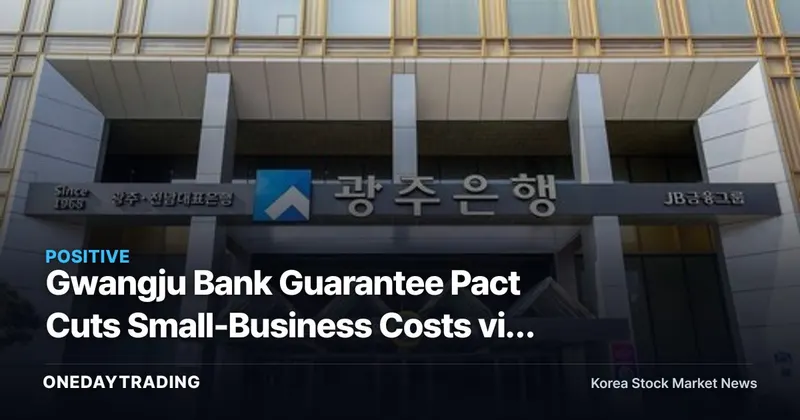
Gwangju Bank’s recovery-focused integrated refinancing guarantee agreement with the Gwangju Credit Guarantee Foundation is more than a simple loan switch; it restructures local small businesses’ high-interest debt into guaranteed loans. For investors, the key issue is how delinquency rates and risk-weighted assets change after refinancing, rather than Gwangju Bank’s new loan volume.
Lower interest costs can improve borrowers’ cash flow, but the bank does not shoulder all the risk. The guarantee institution’s coverage ratio, the credit ratings of refinanced borrowers, fees and provisioning policies will determine the actual impact on earnings.
How the Deal Unfolded
Gwangju Bank signed a business agreement with the Gwangju Credit Guarantee Foundation for a recovery-focused integrated refinancing guarantee program. The agreement aims to consolidate loans that local small businesses are repaying across multiple financial institutions and ease their financial and repayment burdens.
Under the integrated refinancing guarantee, the foundation guarantees repayment for borrowers meeting specified requirements, while the bank converts existing high-interest, multiple-debt obligations into new guaranteed loans. Borrowers can simplify their monthly principal-and-interest payments, and the bank can reduce part of its losses in the event of default through the guarantee.
However, signing the agreement alone does not immediately mean higher earnings for Gwangju Bank. The actual effect will depend on the scale of refinancing, the average interest-rate reduction, guarantee-fee burden and how the potential deterioration of existing loans is reflected in the books.
Structural Background
Local small businesses face volatile revenue and limited collateral, so changes in the benchmark interest rate and market rates are passed through to their costs faster than at large corporations. When multiple working-capital loans have different maturities and repayment dates, monthly cash flow can become unstable, and a single gap in revenue can lead to delinquency.
This agreement changes the debt structure first rather than waiting for rates to fall. Refinancing at still-high rates reduces borrowers’ interest costs, but if guarantees are concentrated among vulnerable borrowers, the bank’s management and post-loan monitoring burden could increase. The market has already priced in expectations for policy cooperation by regional financial institutions; the variable less reflected in prices is the quality of the refinanced portfolio.
Stock (Ticker) and Industry Sector Impact
- JB Financial Group: As Gwangju Bank’s parent, it could benefit from broader regional customer reach and higher fee income if refinancing volumes rise. However, a switch to lower rates could compress net interest margins, and earnings contribution will remain limited unless guaranteed-loan growth outpaces any reduction in provisions.
- Gwangju Bank: Converting existing multiple debts into a single repayment structure could make delinquency management easier. Conversely, if refinanced customers’ credit risk is higher than expected, residual unguaranteed exposure and management costs will remain a burden.
- Regional-bank industry sector: Links with regional credit guarantee foundations give regional banks a channel to differentiate themselves from commercial banks. If such agreements are repeated beyond the Gwangju area, competition among policy-finance platforms will intensify, but expanding rate competition alone would deepen margin sacrifice.
- Guarantee and policy-finance ecosystem: Guarantee institutions can strengthen support for small businesses, but must continuously monitor revenue and repayment data to prevent moral hazard from renewed borrowing after refinancing.
Bullish vs. Bearish Scenarios
The bullish scenario is one in which refinancing continues, borrowers’ monthly payments decline and actual delinquency rates fall below those of existing small-business loans. In that case, Gwangju Bank could expand guaranteed assets while controlling provisioning pressure, and JB Financial Group could retain its regional-finance premium.
The bearish scenario is one in which lax guarantee screening brings in a large number of vulnerable borrowers and weak revenue persists after refinancing. If delinquency rates rise again, losses not covered by guarantees and collection costs will emerge. In particular, if net interest margins deteriorate faster than expected, balance-sheet growth will not translate into shareholder returns.
Even if rates decline, new loan volume could stagnate if refinancing demand falls. Conversely, demand may increase while rates remain high, but worsening repayment capacity could create a conflict between policy objectives and bank soundness.
Investor Action Points
- At the next earnings releases from Gwangju Bank and JB Financial Group, check the outstanding balance, new loan volume and share of guaranteed loans under the integrated refinancing program.
- Assess whether small-business loan delinquency rates and the non-performing loan ratio improve before and after the agreement. Success should not be judged by balance growth alone.
- Check whether the guarantee ratio and fee, as well as the average credit rating of refinanced borrowers, are disclosed. Even at the same refinancing scale, capital requirements vary with the risk-sharing structure.
- Monitor the Bank of Korea Monetary Policy Board’s rate decisions alongside local small-business revenue indicators. If rates and revenue deteriorate simultaneously, the guarantee’s benefits could be offset.
Frequently Asked Questions
What is Gwangju Bank’s integrated refinancing guarantee?
It is a program that uses guarantees from the Gwangju Credit Guarantee Foundation to convert small businesses’ existing loans into a single guaranteed loan. Its goal is to reduce repayment burdens and interest costs spread across multiple financial institutions.
Is this agreement immediately a positive catalyst for JB Financial Group’s share price?
The agreement alone does not determine earnings. Improved shareholder value will depend on evidence of lower delinquency rates, reduced provisions and protection of net interest margins, rather than the refinancing balance itself.
When can investors assess the effects?
The first checkpoint is the next quarterly earnings report, when the scale of refinancing and soundness indicators may be disclosed. Subsequent rate decisions and regional revenue trends will determine repayment performance.
JB Financial Group Key MetricsAs of 2026-09-03
| Period returns | 1 week +12.50% 1 month +16.45% |
|---|---|
| Trading value · Trading volume | 106억원 · 33만 1,772주 |
| Supply-demand (order flow) | Foreign investors +8억 net buying Institutional investors +51억 net buying |
Price and supply-demand (order flow) data are real-time values from Korea Investment & Securities (KIS); supply-demand and news-tone aggregates are calculated by One-Day Trading.
Supply-Demand and Momentum Assessment🟢 Buyers in control
Foreign investors, institutional investors and momentum are positive, warranting attention.
- ▲Dual-sided buyingForeign investors +8억 · institutional investors +51억 buying together
- ▲Trend alignmentShort- and medium-term upward alignment (today +3.1% · 1 week +12.5% · 1 month +16.5%)
Upcoming Dates to Watch
- 09.10Futures and options simultaneous expirationMediumQuadruple witching — watch for volatility and supply-demand (order flow) disruptions
- 09.16FOMC policy-rate decisionHighU.S. Federal Reserve policy announcement — direction of rates and the dollar
- 10.08Index-options expirationLowKOSPI200 options expiration
- 10.22Bank of Korea Monetary Policy BoardHighBenchmark interest rate decision meeting
This article is automatically summarized and analyzed based on the original news report. View original (Yonhap Securities)