
An upward revision to a growth forecast is not a simple numerical adjustment — it is a signal that simultaneously moves both corporate earnings outlooks and the path of monetary policy. The fact that the Bank of Korea's Governor personally raised the possibility of an upgrade is read as reflecting policymakers' judgment that domestic demand and exports, sluggish until now, are bottoming out. This widens the room for upward revisions to earnings estimates in the economically sensitive export, materials, and financial industry sectors, while cutting both ways for bonds and growth stocks through the prospect of a slower pace of rate cuts.
Three-Line Briefing
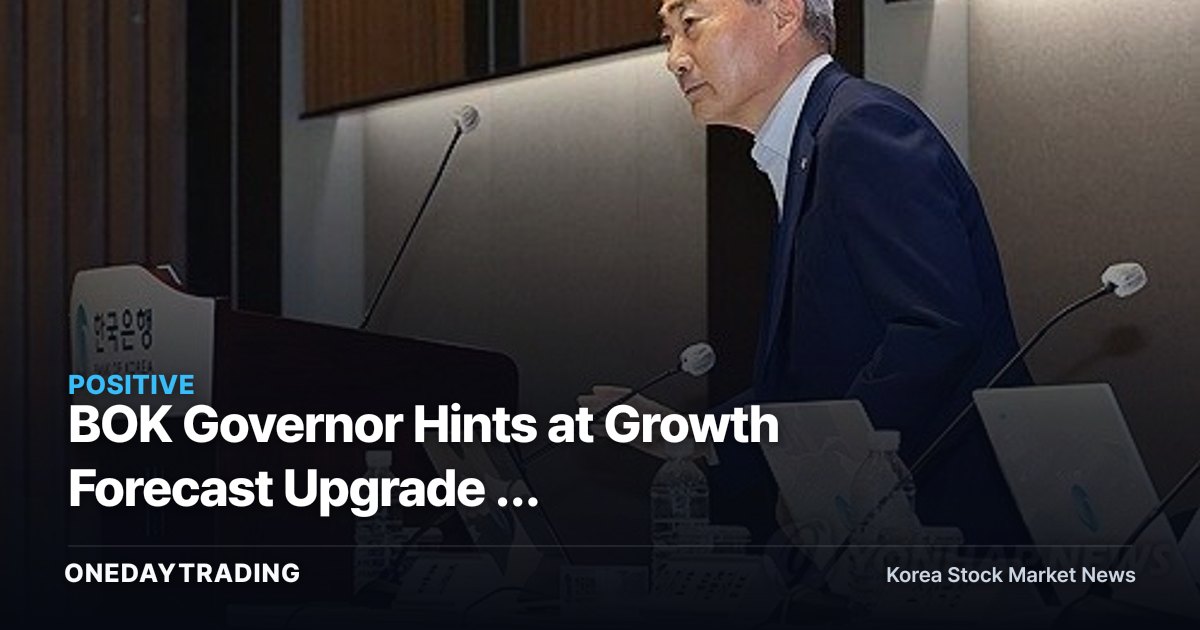
- On the 19th, Bank of Korea Governor Hyun Song Shin referred to the possibility of revising upward this year's growth forecast of 2.6% that was presented last month.
- Improving growth expectations are a factor that supports the floor for corporate earnings outlooks and KOSPI valuations.
- That said, a growth recovery could serve as grounds for delaying rate cuts, creating winners and losers across industry sectors.
What Changes
The crux of an upgraded forecast is its directional signal. When the central bank raises its growth projection, it has the effect of telling the market in advance that upcoming quarterly GDP and export figures may come in better than the existing scenario. Because analysts typically use the BOK's forecast as a macro input in their earnings-estimate models, an upgraded forecast can, with a time lag, feed through into upward revisions of listed companies' operating profit consensus.
In particular, given Korea's high dependence on exports, the backdrop to a growth upgrade is likely to involve a demand recovery in flagship products such as semiconductors and automobiles. If the growth driver comes from external demand, large-cap stocks with heavy export exposure benefit; if it is accompanied by a recovery in domestic demand, retail and financial names share in the upside.
Reading the Numbers and Context
The baseline of 2.6% is above the potential growth rate, so a further upgrade from there would mean the economy is recovering beyond its potential level. However, the Governor's remarks are at the stage of mentioning a possibility rather than a confirmed revision, and an actual change to the figure must be confirmed at the next revised economic outlook release. The center of gravity among beneficiary industry sectors will shift depending on the size of the upgrade and whether its basis is external or domestic demand.
Beneficiary and Adversely Affected Stocks
- Samsung Electronics & SK hynix: Direct beneficiaries if the key driver of the growth upgrade is a recovery in semiconductor exports. Rising shipment prices and volumes act as leverage on earnings.
- Hyundai Motor & Kia: Beneficiaries of top-line growth in an export-led recovery. However, the direction of the exchange rate is a variable that determines margins.
- KB Financial & Shinhan Financial Group: A growth recovery leads to stronger loan demand and improved asset quality, and a delay in rate cuts is favorable for defending net interest margins.
- Retail and domestic-demand consumer stocks: Beneficiaries when a parallel recovery in domestic demand is assumed. If the recovery comes from external demand alone, the tangible benefit is limited.
Risk Check
- If the growth recovery becomes grounds for delaying the timing of rate cuts, it could weigh on high-valuation growth stocks.
- The Governor's remarks are merely a mention of a possibility; if the actual size of the upgrade falls short of expectations, the burden of having priced it in is exposed.
- If the export recovery is concentrated in the single category of semiconductors, the spread of warmth across the broader index may be limited.
- Uncontrollable variables such as external demand, exchange rates, and raw-material prices could shake the realization of the forecast.
Bottom Line in One Sentence
The signal of a growth upgrade is a favorable factor that props up the floor of KOSPI earnings outlooks, but the benefit by industry sector is expected to be differentiated depending on the path of rate cuts and the external-versus-domestic composition of the recovery.
This article is content automatically summarized and analyzed based on the original news report. View original (Yonhap News)