
3-Line Briefing
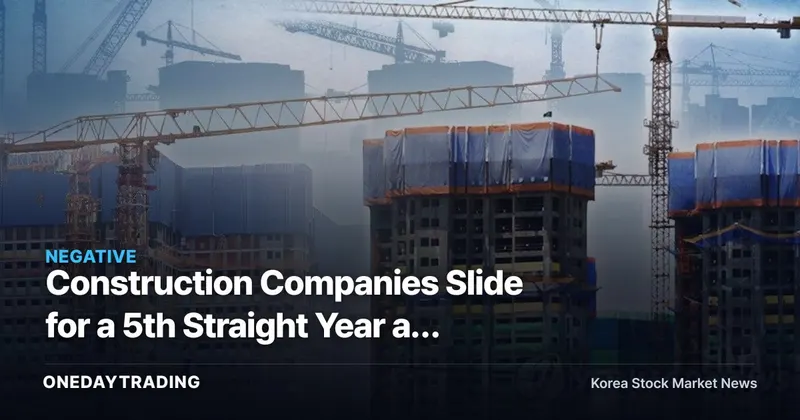
- An analysis shows that construction companies' profitability, stability, growth, and activity indicators have all deteriorated together over the past five years.
- All four indicators turning down at once points to a structural weakening across the entire industry sector, not a one-off construction-cost issue.
- Investors should focus first on financial-health metrics and trends in unsold inventory and PF contingent liabilities, rather than individual order-win headlines.
What's Changing
The construction industry has an inherent lag typical of order-based businesses. Even when new orders decline, revenue tends to hold up for a while, and earnings deteriorate even later. This analysis, however, found that four pillars — profitability, financial health, growth, and activity — have all declined together. That goes beyond a mere slowdown in housing sales and reads as a signal that both cost structures and financing conditions have worsened at the same time.
In fact, over the past few years, builders have been unable to fully pass on rising costs for key raw materials such as ready-mix concrete and rebar, as well as higher labor costs, into selling prices and construction costs, while rising funding rates have also increased the burden of project-financing (PF) contingent liabilities. The fact that the growth indicator turned down as well means the volume of new orders needed to offset this burden has itself shrunk — leaving open the possibility that industry restructuring arrives before any short-term earnings recovery.
Reading the Numbers in Context
The key point of this analysis isn't any single indicator but the fact that all four moved together. If profitability alone were weak, it could be narrowed down to a cost-management issue; if growth alone slowed, it could be chalked up to weak order intake. But stability and activity deteriorating as well means cash turnover itself has slowed. When construction is delayed and unsold units pile up after completion, assets that aren't booked as revenue simply sit on the balance sheet. If this pattern has persisted for five years running, it's hard to conclude that the industry's overall health has recovered just because of one or two quarters of improved earnings headlines.
Stocks to Watch: Winners and Losers
- Major builders such as Hyundai Engineering & Construction, GS Engineering & Construction, DL E&C, and Daewoo Engineering & Construction: directly affected by the sector-wide diagnosis of weakening financial health, with share-price performance likely to diverge based on each company's PF contingent-liability exposure and unsold-inventory management.
- HDC Hyundai Development Company: mid-to-large builders with high exposure to housing are more sensitive to the burden of unsold inventory and funding costs.
- Ready-mix concrete, cement, and other building-materials sectors: should be viewed as an indirect risk, since weaker finances at ordering companies could lead to delayed payment collection or reduced order volumes.
- Construction-related REITs and financial firms with PF loan exposure: weakening financial health at builders could feed back as a burden on loan-quality management.
Risk Check
- Since this analysis covers the full five-year trend, whether a recent earnings rebound at individual companies signals a broader turnaround for the industry needs to be reconfirmed with next quarter's results.
- If the government's housing-supply measures or SOC budget allocation shift direction, order volumes themselves could increase.
- The timing and scale of PF contingent liabilities becoming realized varies by company, so judging the entire sector by a single yardstick could lead to misjudgment.
- If interest rates decline, easing the funding-cost burden, financial-health indicators could be the first to improve.
Bottom Line
All four indicators turning down together means the industry's weakened condition isn't a temporary blip, but since the pace of recovery could change with interest-rate direction and supply policy, investors should sort the wheat from the chaff company by company using next quarter's financial statements and unsold-inventory data.
Hyundai E&C in Real-Time Data
Hyundai E&C's most recent closing price was 109,900 won (-2.40% from the previous day), and the composite signal combining foreign/institutional supply-demand (order flow) with news and momentum reads 🟢 Buy-leaning. Foreign investors and institutional investors are positioned positively, making the stock (ticker) worth watching.
- ▲ Dual buying — foreign investors +200 million won and institutional investors +500 million won, buying in tandem
Recent related news is mixed, with 1 positive catalyst and 1 negative catalyst.
※ Price and foreign/institutional supply-demand (order flow) data are provided by Korea Investment & Securities (KIS) and reflect the time of publication.
This article was automatically summarized and analyzed based on the original news report. Read the original (Yonhap News Agency, Securities)