
Summary
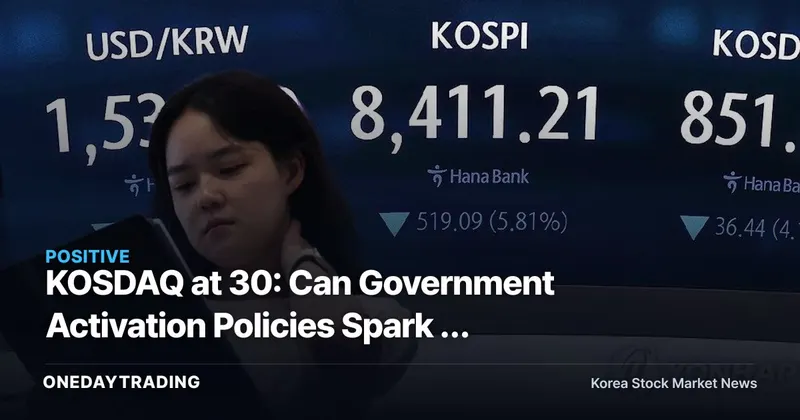
As KOSDAQ approaches its 30th anniversary on July 1, the index has continued to lag amid KOSPI's bull run. Government-signaled market activation policies are cited as a potential catalyst to shift supply-demand (order flow) and market sentiment, but the critical question is whether policy expectations can translate into actual capital inflows — a process that likely requires a concurrent recovery in earnings among large-cap growth stocks.
Background
The domestic equity market has seen KOSPI post steep gains led by large-cap stocks, while KOSDAQ's upside momentum has been notably weak. With foreign investors and institutional investors concentrating capital in top market capitalization blue chips and large-cap semiconductor and financial stocks, KOSDAQ — home to a large number of small- and mid-cap growth stocks — has been described as a blind spot in supply-demand (order flow).
Against this backdrop, the government is reviewing policy measures aimed at restoring confidence and boosting trading activity in the KOSDAQ market. Coinciding with the symbolically significant 30th anniversary milestone, discussions are also underway on structural reforms including tighter listing maintenance requirements, attracting quality technology companies, and eradicating unfair trading practices.
Since its launch in July 1996, KOSDAQ has served as a key fundraising channel for growth industries such as biotech, secondary batteries, and gaming. However, due to its structural characteristics — high individual stock volatility and a heavy reliance on retail investors — the market has repeatedly failed to deliver stable, index-level gains even during broader bull markets.
Structural Context
KOSDAQ's underperformance is not simply a matter of market sentiment; it is rooted in the composition of the market itself. Secondary battery materials stocks, which carry significant index weight, have seen earnings depressed by slowing EV demand and weakness in metal prices, while biotech stocks remain sensitive to the interest rate environment and clinical trial uncertainty. In short, the industry sectors that make up KOSDAQ's sector bellwethers are precisely those facing macro headwinds in the current environment — and this is the core reason for the index's sluggishness.
By contrast, the forces driving KOSPI higher have been an improving semiconductor cycle and expectations around the corporate value-up initiative. In an environment where growth stock discount rates are elevated, capital naturally gravitates toward large-cap stocks with more visible earnings, and policy momentum alone is unlikely to reverse this structural tilt in the near term.
Stock (Ticker) and Industry Sector Implications
- Secondary Battery Materials: As the industry sector dominating KOSDAQ's top market capitalization rankings, it stands to benefit most in terms of index rebound momentum if activation policies improve supply-demand (order flow) — but this requires a prior recovery in downstream EV demand and lithium prices.
- Biotech / Pharmaceuticals: A sector highly sensitive to technology licensing deals and clinical trial momentum; a combination of increased trading activity and interest rate stabilization could open room for valuation re-rating.
- Semiconductor Materials, Parts & Equipment: Semiconductor equipment and materials companies listed on KOSDAQ can expect a trickle-down effect when the capex cycle recovers for large-cap semiconductor stocks on KOSPI.
- Brokerage: An increase in KOSDAQ trading value directly feeds into brokerage commission revenues, making it a clear earnings beneficiary for exchanges and securities firms.
- Gaming / Internet: With high dependence on retail investor supply-demand (order flow), a revival in market activity could amplify volatility while delivering an outsized short-term rebound in this sector.
Bull vs. Bear Scenarios
The bull scenario envisions policies translating into increased trading activity and restored institutional confidence, while the sector bellwethers in secondary batteries and biotech simultaneously confirm an earnings trough. In this case, prolonged underperformance could flip into a perceived undervaluation discount, drawing capital back into KOSDAQ in a rotation. The bear scenario, conversely, sees policies remaining declaratory without follow-through, with continued fundamental weakness among bellwether industry sectors — in which case any short-term rebound built purely on policy expectations carries meaningful reversal risk. KOSDAQ's characteristically high retail investor weighting and volatility are factors that amplify the magnitude of moves in either direction.
Investor Action Points
- Track the timing and specifics of the government's activation policy announcement — including listing requirement changes, tax incentives, and institutional capital inflow incentives — to distinguish rhetoric from implementation.
- Monitor KOSDAQ daily trading value and whether foreign investors and institutional investors turn to net buying as primary signals of improving supply-demand (order flow).
- Track quarterly earnings for secondary battery materials stocks along with lithium and precursor prices, and watch technology licensing and clinical trial disclosures for biotech sector bellwethers as fundamental checkpoints.
- Follow the KOSDAQ 150 index and its relative strength (RS) versus KOSPI to gauge whether the underperformance gap is narrowing.
This article is an auto-summarized and analyzed piece based on the original news report. View original article (Yonhap News — Securities)