
3-Line Briefing
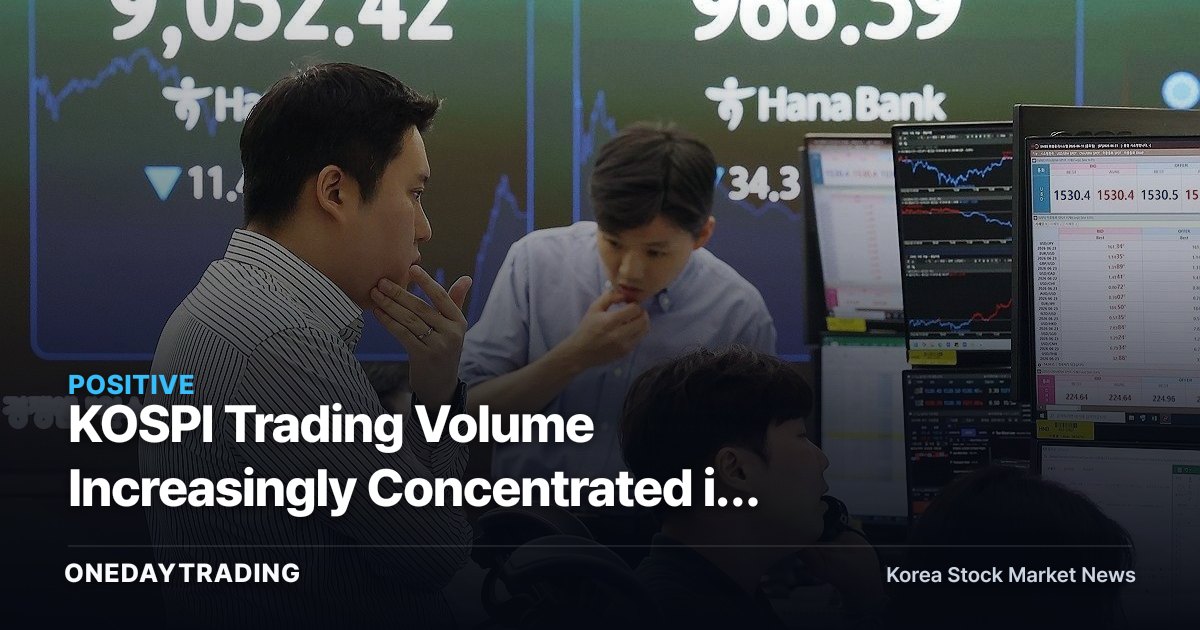
- This month, the share of KOSPI trading volume accounted for by Samsung Electronics and SK Hynix has expanded noticeably, intensifying the concentration.
- Demand for high-bandwidth memory (HBM) used in AI servers, along with expectations of a recovery in the memory cycle, is the key force concentrating buying into these two stocks (tickers).
- An index advance that depends on a handful of large caps is both a sign of a bull market and, at the same time, a double-edged dynamic that amplifies volatility and concentration risk.
What's Changing
The essence of this phenomenon is not simply that the two stocks (tickers) have risen sharply, but that the market's capital and attention are concentrating into a single sector — and within it, into just two names. What matters for investors is that the rising share of trading volume more tightly binds the overall direction of the KOSPI to the semiconductor cycle and to foreign-investor order flow. In other words, even passive investors holding the index are effectively betting on the memory cycle.
The reasons for the intensifying concentration are clear. As Nvidia-driven demand for AI accelerators pushes memory specifications higher, HBM has established itself as a high-value-added product, and a structure has formed in which SK Hynix has seized the lead in this market while Samsung Electronics plays catch-up. Foreign and institutional investors are choosing these two stocks (tickers) as the most direct channel through which to capture the AI tailwind in the Korean market, and this is reflected in their rising share of both trading value and trading volume.
Conversely, this also means the sidelining of the rest of the market. As order flow rotates out of secondary batteries, biotech, and small- and mid-cap growth stocks and into semiconductors, a differentiated market — in which the felt experience varies widely by stock even as the KOSPI rises — becomes entrenched.
The Numbers in Context
Samsung Electronics and SK Hynix are already known to account for more than 30% of KOSPI market capitalization, and if their share of trading volume and trading value rises in tandem, the index's intraday moves become increasingly dictated by the bid-ask quotes of these two stocks (tickers). Because the semiconductor cycle is tied to specific variables — DRAM and NAND spot prices, HBM supply contracts, and the data-center investment cycle — the trading concentration can be read as a signal that market expectations for these indicators are being rapidly priced in.
Beneficiaries and Losers
- SK Hynix: The benefit of an early lead in the HBM market is the most direct. Because its share of HBM supply to customers drives revenue and margins higher, expectations for the cycle are immediately reflected in its trading and share price.
- Samsung Electronics: HBM catch-up works alongside a recovery in foundry and commodity memory. However, given its broad business portfolio, the leverage from a single memory-driven momentum is relatively diluted.
- HBM back-end equipment makers such as Hanmi Semiconductor: With bonding-equipment demand directly tied to HBM capacity expansion, they are positioned to receive the trickle-down effect of increased investment in the two stocks (tickers).
- Materials and component suppliers: Higher memory utilization rates lead to demand for front-end materials and inspection equipment, but with pricing power dependent on large customers, the scope of the benefit may be limited.
- Sidelined sectors (small- and mid-cap growth stocks): The more order flow concentrates in semiconductors, the more these names are exposed to trading vacuums and rising volatility — placing them in the loser bracket.
Risk Check
- Valuation burden: When expectations are priced in ahead of time, any shortfall of actual HBM contracts and earnings versus those expectations can deepen the correction.
- Reversal of the concentration: If foreign buying stalls or profit-taking emerges, the shock to the index can be amplified precisely because of the elevated trading share.
- Industry variables: Weakness in DRAM spot prices, a slowdown in data-center investment, and changes in U.S. export controls on China could shake the assumptions underpinning memory demand.
- Index distortion: Even if strength in the two stocks (tickers) lifts the KOSPI, the felt return can vary widely depending on which stocks one holds.
Bottom Line
The trading concentration into the two semiconductor giants reflects the market's strong conviction in the AI memory cycle, but it also means the KOSPI has become more sensitive to a handful of stocks and to foreign-investor order flow. An approach that checks the gap between expectations and reality — by monitoring HBM supply-contract disclosures, quarterly earnings guidance, and DRAM price trends — is needed.
Samsung Electronics Through Real-Time Data
Samsung Electronics' latest closing price is 354,000 won (-2.34% from the prior day), and the signal light — which combines foreign and institutional order flow with news and momentum — is 🔴 Caution. With foreign investors, institutional investors, and momentum all negative, caution is warranted at this time.
- ▼ Dual-Engine Selling — foreign investors −899.5 billion won · institutional investors −501.6 billion won in joint selling
- ▲ 52-Week Position — 94% within the upper 52-week range — in new-high territory
- ▲ News Flow — 29 positive catalysts vs. 9 negative catalysts — positive catalysts in the lead
Recent related news, at 29 positive catalysts and 9 negative catalysts, is favorable.
※ Price and foreign/institutional order-flow data are provided by Korea Investment & Securities (KIS) and are as of the time of publication.
This article is content automatically summarized and analyzed based on the original news. View original (Yonhap News, Securities)