
Key Summary
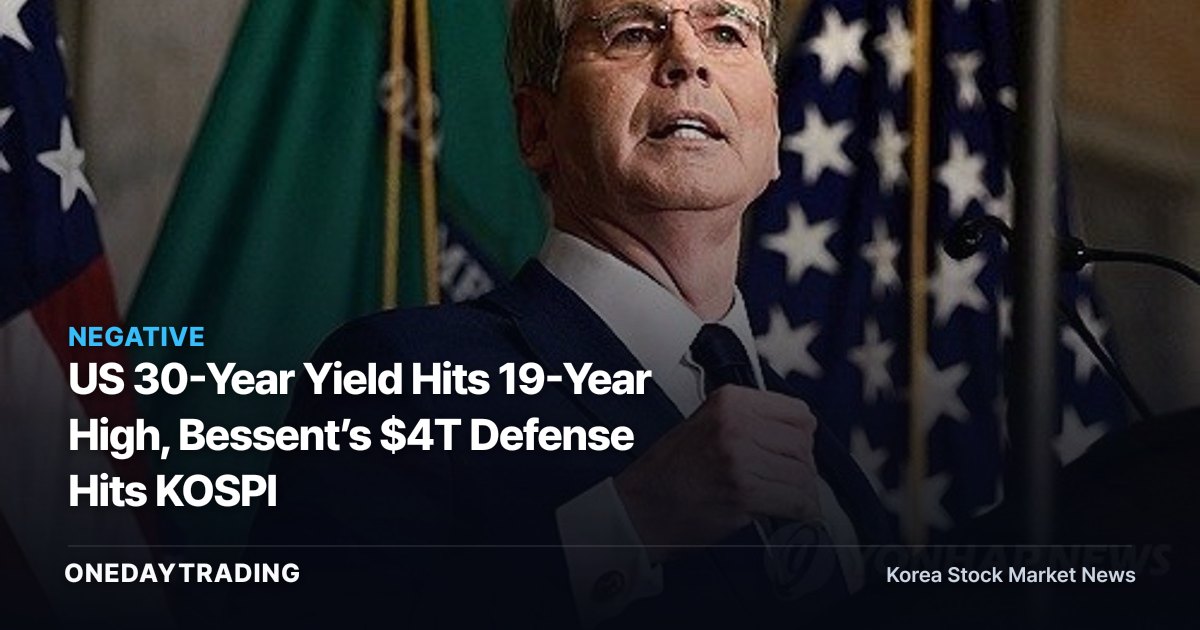
US Treasury yields are undergoing repricing more than panic. Despite US Treasury Secretary Scott Bessent’s denial, the fact that the 30-year yield reached a 19-year high matters more. This is not just a bond story—it is a KOSPI multiples story.
A defense plan to raise long-term purchases to as much as $4 billion per operation from September 10 has been announced, but its effect is likely to be limited unless fiscal deficits and Treasury supply ease.
What Happened
In a Reuters interview on August 30, Bessent sought to ease concerns about turmoil in the US Treasury market. He said the US bond market was holding up better than any other global peer market this year and explained that the surge in long-term yields was inconsistent with economic fundamentals.
The problem is that the market is already signaling different numbers. During August, the US 30-year yield rose to a 19-year high, while total US public debt surpassed $40 trillion on August 19. With Treasury supply increasing, investors are demanding higher compensation.
Expanding the Treasury’s long-term purchases is a measure that can temporarily suppress prices, not a solution that changes the structure. Purchases beginning September 10 may calm long-term yields, but without a change in inflation and the deficit path, it will be difficult to bring down the upper bound of yields sustainably.
Background and Context
The key factor is interest rates. When US 10-year and 30-year yields rise, the risk-free rate increases, first weighing on multiples in industry sectors with a large share of future earnings, such as growth stocks and semiconductors. The Korean market is particularly sensitive to US long-term yields. Foreign investors assess supply-demand (order flow) together with the exchange rate and interest-rate mix, not earnings alone.
Conversely, higher rates can support banks and insurers through net interest margins and investment income. But if rates rise too quickly, mark-to-market losses on bond holdings grow, while real estate and REITs face higher funding costs. This is why rising rates do not affect every industry sector in the same direction.
Impact on the Market and Stocks
- Samsung Electronics, SK hynix: Rising US long-term yields weigh on valuation before earnings. Even if AI expectations hold, higher discount rates can make the stock-price response more muted.
- KB Financial, Shinhan Financial Group: If rate levels stay high, expectations for NIM improvement remain alive. But if rates are sticky rather than surging, investors must also watch bond valuations and the cost of capital.
- Hyundai Motor: A stronger dollar can be favorable for translated earnings. However, if a global slowdown arrives at the same time, exporters will not enjoy a simple benefit.
- S-Oil, SK Innovation: If oil prices and inflation fall together, refiners may show relative strength. This news centers on rates rather than oil, but the two variables ultimately connect through the same inflation path.
- REITs and construction: Borrowing costs rise first. If government-bond yields do not fall, it will be difficult to hold up on dividend appeal alone.
Investor Checkpoints
- Watch whether the Treasury’s long-term purchases on September 10 actually push down the 30-year yield. The rate reaction after execution matters more than the announcement.
- If the US 10-year yield exceeds 4.8%, pressure on KOSPI growth-stock multiples will intensify again. Conversely, a move below 4.6% could trigger a short-term relief rally.
- If the KRW/USD exchange rate tops 1,390 won, foreign net buying may slow. The Korean market is most vulnerable when rates and the exchange rate rise together.
- The next US CPI release, Federal Reserve remarks and Bank of Korea Monetary Policy Board schedule are the links to watch. If inflation fails to ease, Bessent’s defense will be needed more often and on a larger scale.
Outlook
The bullish scenario is straightforward. If long-term purchases stabilize liquidity and inflation slows faster than expected, the risk premium on long-term yields will shrink. KOSPI would then have room for multiple recovery led by semiconductors and growth stocks.
The risk is clearer. If fiscal deficits and Treasury supply continue, yields will reflect supply realities more than policy messaging. In that case, the market will react not to Bessent’s words but to the 30-year yield and dollar level.
Frequently Asked Questions
Why do US Treasury yields affect the Korean market immediately?
US Treasury yields serve as the benchmark discount rate for assets worldwide. When yields rise, the present value of stocks falls even with the same earnings, and industry sectors with a large share of future earnings—especially semiconductors and internet companies—are hit first.
Korea has a high export share and a large proportion of foreign capital. As a result, KOSPI volatility increases when US rates and the KRW/USD exchange rate move at the same time.
Will Bessent’s Treasury purchases really push down yields?
They can in the short term. Long-term purchases can reinforce liquidity and ease excessive spikes in 30-year and ultra-long-term yields.
But if deficits and supply remain unchanged, the effect will be limited. To lower yields structurally, the inflation and fiscal paths ultimately must change together.
What should Korean investors check now?
First, the US 10-year and 30-year yields. Second, the results of the Treasury’s purchases after September 10. Third, whether the KRW/USD exchange rate settles in the 1,390-won range.
If all three deteriorate at once, differences across Korean industry sectors will widen further. The relative strength of rate-sensitive stocks and growth stocks will weaken first.
KOSPI Index IndicatorsAs of 2026-09-01
| Period trend | 1 week +1.51% 1 month +21.53% |
|---|
Index, commodity and exchange-rate data are based on global markets and reflect values at publication.
Samsung Electronics Key IndicatorsAs of 2026-09-01
| Period return | 1 week +1.36% 1 month -0.76% |
|---|---|
| Trading value · trading volume | 1.9716 trillion won · 7.63 million shares |
| Supply-demand (order flow) | Foreign investors +4 billion won net buying Institutional investors −594.5 billion won net selling |
| Recent news tone | Positive catalyst 7 · Negative catalyst 8 |
Price and supply-demand data are real-time values from Korea Investment & Securities (KIS); supply-demand and news-tone figures are calculated by One Day Trading.
Upcoming Dates to Watch
- 09.10Simultaneous futures and options expiryMediumQuadruple witching — watch for volatility and supply-demand (order flow) disruptions
- 09.16FOMC policy-rate decisionHighUS Federal Reserve monetary-policy announcement — direction of rates and the dollar
- 10.08Index options expirationLowKOSPI200 options expiration
- 10.22Bank of Korea Monetary Policy BoardHighBenchmark interest rate decision meeting
This article is automatically summarized and analyzed from the original news report. View original (Yonhap Securities)