
Three-Line Briefing
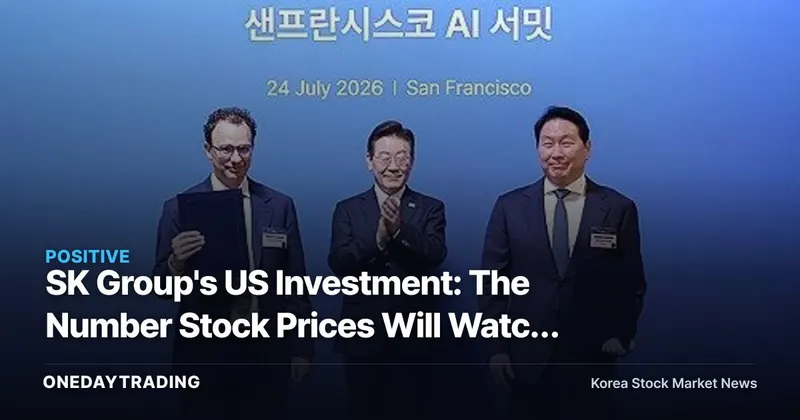
- SK Group's US investment is a variable now being tested for a policy premium following the August 20, 2026 dinner between Chairman Chey Tae-won and President Lee Jae-myung.
- Based on Yonhap News industry reporting, the key focus of the dinner is what level of government cooperation Chairman Chey confirmed regarding the US investment.
- Investors should not view SK's stock price simply as a reaction to meeting news, but should separate it into whether investment scale, timing, funding source, and US policy conditions are disclosed.
What Changes
The August 20 dinner between SK Group Chairman Chey Tae-won and President Lee Jae-myung is not an event that immediately adds hard earnings numbers to SK Group's stock price. What this news signals is the possible link between policy and capital expenditure. If US investment makes it onto the table between the president and a business group chairman, the market will re-price SK Group's US investment plans not as an individual company's capex issue, but as part of a trade and industrial policy package.
US investment refers to the strategy of Korean companies putting capital into production, R&D, and supply chain facilities within the United States, which is directly tied to tariffs, subsidies, and securing local customers. In SK Group's case, investor attention is split between holding company SK, the semiconductor axis SK hynix (000660), and the energy/battery affiliates. However, the Yonhap report only conveyed the fact of the dinner and interest in whether US investment was discussed — it did not disclose the investment amount, target businesses, or agreement language.
So the initial reaction could be limited. What the market has already priced in is the pressure on Korean conglomerates to localize in the US. What has not yet been fully priced in is how much the government can lower SK Group's investment costs through tax, financial, and diplomatic channels. If policy support lowers costs, the multiple is defended; if investment obligations grow without support, free cash flow concerns will surface first.
Numbers and Context
The one confirmed number in this report is the meeting date: August 20, 2026. The more important numbers remain blank — the US investment amount, the execution year, who within SK Group bears the burden, and the conditions of any US government incentives are all missing. The more numbers that remain blank, the more sensitive the stock price becomes to confirmation rather than expectation.
From an interest-rate perspective, this news is not trivial either. Large-scale overseas investment is affected by borrowing costs and the exchange rate. If the won's weakness persists, dollar-denominated investment costs weigh more heavily on won-based financial statements. Conversely, if US-based customers and production sites are confirmed, valuation may give more weight to long-term supply stability than to short-term costs.
Stocks to Watch: Winners and Losers
- SK (034730): As SK Group's holding company, it is the primary party to the US investment discussion. If government cooperation is confirmed, it could reduce the group portfolio discount, but if the funding burden comes into focus, the holding company discount could widen instead.
- SK hynix (000660): Expectations are tied to the reshaping of the semiconductor supply chain and responsiveness to US customers. However, the actual benefit needs confirmation that the US investment target is directly linked to memory chips or AI infrastructure.
- SK Innovation (096770): On the energy/battery axis, discussion of US localization could draw investor interest. The key question is whether existing investment burdens and profitability improvement are explained together, rather than new investment alone.
- Samsung Electronics (005930): Not a direct party to the SK Group news, but if the US-investment framework for Korean conglomerates strengthens, the policy sensitivity of the entire semiconductor industry sector increases.
Risk Check
- Yonhap News' industry report conveyed the fact of the dinner but did not confirm the outcome of any US investment discussion or agreement details.
- If the investment scale is announced before the support conditions, the market will discount cash outflow before growth.
- If US policy conditions change, the effect of local investment could tilt toward cost burden rather than tax benefits or subsidies.
- Because financial burdens differ across SK Group affiliates, the holding company and the semiconductor/energy affiliates will not necessarily see the same stock price reaction.
Bottom Line
The dinner between Chey Tae-won and Lee Jae-myung is a signal that opens the door to a policy premium for SK Group's US investment, but for the stock price reaction to be sustained, the investment scale, funding source, and US incentives must be confirmed with actual numbers in the second half of 2026.
FAQ
Why does SK Group's US investment matter for the stock price?
SK Group's US investment is linked to establishing an overseas production base, serving US customers, and mitigating trade risk. However, the same investment becomes a valuation-defending factor if it comes with government support, while it becomes a cash-flow burden if capex increases without support.
What should investors watch for after the Chey Tae-won–Lee Jae-myung dinner?
The key thing to confirm after the August 20, 2026 dinner is whether the US investment discussion actually translates into policy cooperation. Investors should check, in order: the investment amount, the execution timing, who within SK Group bears the burden, and the conditions of US-side incentives.
Will SK hynix directly benefit as well?
SK hynix's benefit grows larger if the US investment target is directly linked to the semiconductor supply chain or serving AI customers. Since the current report does not disclose the scale of semiconductor investment, the capex direction should be confirmed in upcoming disclosures and earnings calls.
SK (034730) in Real-Time Data
The most recent closing price of SK was 568,000 won (+3.09% versus the previous session), and the signal light combining foreign investor/institutional investor supply-demand (order flow) with news and momentum is 🟡 neutral / wait-and-see. Positive and negative signals are mixed, making this a range worth monitoring.
- ▼ Double-sided selling — foreign investors −700 million won · institutional investors −200 million won, selling in tandem
Recent related news has been favorable, with 1 positive catalyst and 0 negative catalysts.
※ Price and foreign/institutional investor supply-demand (order flow) data are provided by Korea Investment & Securities (KIS), as of the time of publication.
This article is automatically summarized and analyzed based on the original news report. View original (Yonhap News Industry)