
At a Glance
The key message for investors from Huawei and Xiaomi unveiling foldable phones on the same day is not the arrival of two new devices, but a shift in the basis of competition. Foldable phones combine portability with a large display through a folding screen, and the contest is now moving beyond form factors to in-house processors, Chinese-made memory and cost control for premium devices.
With Apple expected to unveil its first foldable iPhone, Chinese manufacturers are moving first to test premium demand. For related stock valuations to continue rising, actual shipments, semiconductor performance and component costs must support the technical claims made at the launch events.
Why It Matters Now
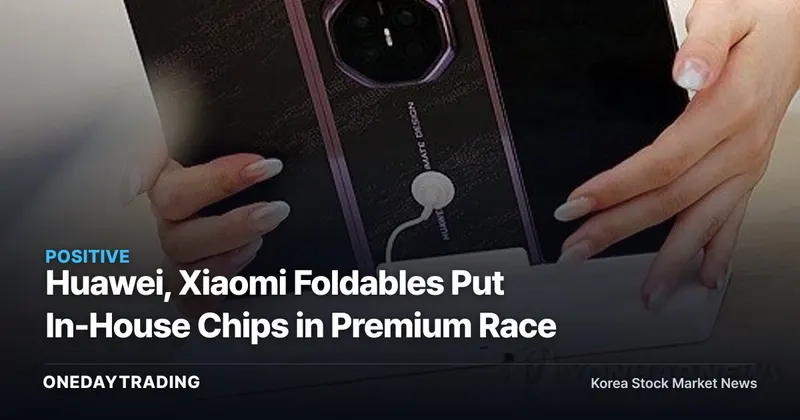
According to Yonhap News Agency’s Sept. 7 summary of reports from Reuters and Bloomberg, Huawei unveiled the Mate XT2, a new trifold device that folds twice. It is priced from 19,999 yuan to 24,999 yuan, equivalent to approximately 4 million-5 million won. The initial preorder allocation sold out on Aug. 31, and official sales begin Sept. 12.
The pricing shows that Huawei has positioned the Mate XT2 as an ultra-premium product intended to project technological leadership rather than target mass-market replacement demand. The preorder sellout demonstrates initial interest, but the size of the allocation was not disclosed, leaving insufficient evidence to assess the absolute scale and durability of demand. Sales momentum after Sept. 12 will provide the first real test.
Xiaomi unveiled its midsize Xiaomi 18 Fold on the same day. CEO Lei Jun said the project began two years ago and underwent 20 months of research and development. The strategy is to put Xiaomi’s premium foldable technology and brand competitiveness to the market test before Apple unveils its product.
Key Issues
- Processor: The Mate XT2 is powered by the Kirin 9050 Pro, the first chip to use logic-folding technology. The Xiaomi 18 Fold is reportedly set to feature Xiaomi’s internally developed Xring O3 processor, though the final specifications require separate confirmation.
- Memory: Xiaomi’s new device is reportedly expected to use LPDDR6 memory from China’s ChangXin Memory Technologies. If its inclusion is confirmed, the scope of self-sufficiency in China’s smartphone supply chain would extend from application processors to memory.
- Pricing and costs: Huawei acknowledged cost pressures from a sharp gain (surge) in memory costs and the adoption of new technologies. Even with a high selling price, simultaneous increases in the cost of complex hinges, large displays and memory could limit margin improvement.
- Market expansion: Counterpoint Research expects Apple’s vast premium user base to help it secure foldable market share while also stimulating demand for competitors’ products.
Impact on Related Stocks and Sectors
- Xiaomi: If its in-house processor is deployed in a flagship foldable phone, Xiaomi could reduce its reliance on third-party chips and accumulate data for product differentiation. The path from this news to earnings depends not on the announcement itself, but on the balance among sales volume, chip performance and manufacturing costs.
- Apple: With Chinese manufacturers unveiling new foldables first, Apple’s design and user experience will face direct comparisons immediately after launch. Conversely, if Apple’s entry increases interest among premium customers, it could broaden the demand base for the entire foldable-phone market.
- Samsung Electronics: New products from Chinese manufacturers and Apple’s anticipated entry are converging in the foldable-phone market pioneered by Samsung Electronics. Market expansion is positive, but as the form factor becomes less distinctive, factors that determine overall product quality—such as thickness, durability and the software experience—will become increasingly important.
Investor Considerations
- A preorder sellout should not be interpreted as proof of final demand. The preorder allocation, cancellation rate and shipment volume after official sales begin have not been disclosed.
- Adopting an in-house chip is a starting point for technological independence, not evidence of profitability. Cost control would improve if the company can secure performance and power efficiency while maintaining mass-production yields, but no relevant figures have been disclosed.
- The reported use of Xiaomi’s Xring O3 and LPDDR6 remains unconfirmed. Until the manufacturer confirms the final specifications and actual supply, it is difficult to price a shift to Chinese-made semiconductors into valuations as an established fact.
- If memory prices continue to rise, margins could remain under pressure despite ultra-premium selling prices. Unless production volumes increase sufficiently, it will be difficult to absorb the costs of complex foldable structures through economies of scale.
Overall Outlook
What is clear today is that Chinese smartphone manufacturers are combining foldable designs with in-house semiconductors to target the premium market. What remains unproven is whether that combination can translate into large-scale shipments and stable profits. Three hurdles remain along the path from materials, components and chips to finished products and ultimately earnings: confirmed specifications, sales volume and costs.
If official Mate XT2 sales sustain the preorder momentum and Xiaomi proves the real-world adoption and performance of its in-house chip and Chinese-made memory, the case for revaluing China’s smartphone supply chain will strengthen. Conversely, if sales momentum slows, ultra-premium foldables may remain limited products that showcase technology rather than expand the market. Investors should examine next-quarter shipment data, manufacturers’ confirmed specifications and comments on memory costs before following share-price movements.
Frequently Asked Questions
What are the Huawei Mate XT2’s price and sale date?
The launch price ranges from 19,999 yuan to 24,999 yuan, equivalent to approximately 4 million-5 million won. The initial preorder allocation sold out, and official sales in China begin Sept. 12, 2026.
Which semiconductors will the Xiaomi 18 Fold use?
It is reportedly expected to feature Xiaomi’s internally developed Xring O3 processor and LPDDR6 memory from ChangXin Memory Technologies. Both are reported, anticipated specifications, so their actual adoption must be verified through the manufacturer’s final specifications.
Is Apple’s foldable iPhone a negative catalyst for competitors?
Viewed solely in terms of market-share competition, it would put pressure on established manufacturers, but it could also serve as a catalyst for expanding the overall market. If Apple’s premium customers adopt foldables, product awareness could rise and demand for comparisons with devices from Huawei, Xiaomi and Samsung Electronics could also increase.
This article was automatically summarized and analyzed based on the original news report. View the original article (Yonhap News Agency Securities)