
Three-Line Briefing
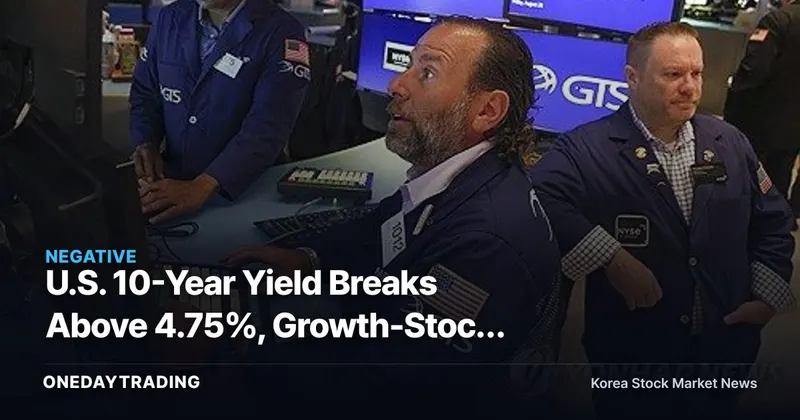
- The U.S. 10-year government bond yield climbed above 4.75% intraday on August 31 local time, reaching its highest level in 19 months since January 2025.
- According to CME FedWatch, the probability of a 0.25 percentage point rate hike by the Federal Reserve on September 16 rose to 64.2% on August 31, up from 41.4% a week earlier.
- For Korean investors, this is not just a U.S. bond-market issue. It is a signal to recalculate growth-stock valuations, the won-dollar exchange rate, and the relative strength of banks and insurers.
What Changes
The U.S. 10-year yield breaking above 4.75% raises the discount rate for industries in the Korean market that rely on pulling future earnings forward. What that really means is not simply lower bond prices, but a higher baseline for the multiples the stock market applies. Platform stocks such as NAVER and Kakao tend to have rate sensitivity priced in before their earnings recovery shows up.
U.S. Treasury yields are the global reference price for risk assets. When the 10-year yield rises, investors demand a lower price-to-earnings ratio for the same earnings. In particular, some AI software, internet, and biotech names with cash flows far in the future see their present value take a bigger hit when long-term rates rise.
By contrast, banks and insurers become relatively defensive. When rates stay elevated, banks have a stronger case for protecting net interest margins, while insurers get expectations of better returns on reinvested assets. That said, if higher U.S. rates spill over into a sharp rise in the won-dollar exchange rate, foreign investors' supply-demand (order flow) can turn shaky, making it hard for financials to avoid the broader market's downside pressure.
Reading the Numbers in Context
Based on reports from Yonhap News and Bloomberg, the U.S. 30-year yield was trading at 5.26% on August 31, up 5bp. The 5-year yield also rose to its highest level since early 2025, showing that the selling was not confined to long-duration bonds. What matters more is that long-term yields stayed elevated even with a technical buying factor from month-end bond index rebalancing.
The triggers for this rate move were oil and the Federal Reserve. After President Donald Trump mentioned the possibility of further attacks on Iran, international oil prices rose by nearly 3% intraday. If oil prices push inflation expectations back up, the U.S. CPI on September 11 and the FOMC on September 16 become not just calendar events, but events that force a re-rating of stock multiples.
Beneficiaries and Losers
- KB Financial Group: In a prolonged high-rate environment, expectations rise that net interest margins can be defended. However, if an economic slowdown turns into higher credit costs, the rate benefit fades quickly.
- Shinhan Financial Group: For banks, the path of the benchmark interest rate and deposit funding costs matters more than a rise in long-term yields. The key question is whether domestic market rates follow after the September FOMC.
- Samsung Life Insurance: Higher long-term yields support the case for improved investment returns at insurers. But a sharp rate spike also increases mark-to-market losses on bond holdings.
- NAVER: Even if advertising and commerce recover, platform stocks face valuation pressure first when discount rates rise. If the U.S. 10-year yield stays above 4.75%, the hurdle for a growth-stock rebound gets higher.
- Kakao: This is a phase where investor sentiment and valuation sensitivity matter more than earnings improvement. If rate increases and regulatory risk remain in place at the same time, a simple bargain-hunting case is not enough.
Risk Check
- If the August jobs data shows wage pressure running hotter than expected, the odds of a Federal Reserve hike will rise further, and the valuation burden on Nasdaq and KOSDAQ growth stocks will increase.
- If the September 11 CPI comes in below market expectations, this bond selloff could partially reverse. In that case, there would be room for a short-term rebound in platforms and biotech.
- If higher international oil prices widen beyond Middle East risks into supply disruptions, inflation, rates, and the exchange rate will all move at once.
- If the won-dollar exchange rate spikes, foreign investors face a larger foreign-exchange loss risk on Korean stocks, and KOSPI supply-demand (order flow) can change in a single day.
Bottom Line
A U.S. 10-year yield of 4.75% gives banks and insurers a relative edge, but until the CPI and FOMC pass, it acts as a rate barrier that blocks multiple expansion for Korean growth stocks.
Frequently Asked Questions
Why is the U.S. 10-year government bond yield rising?
The U.S. 10-year government bond yield moved above 4.75% intraday on August 31 local time. Based on Yonhap News reporting, concerns over inflation from rising international oil prices and the possibility of a September rate hike by the Federal Reserve were both reflected in the move.
Which stocks benefit from higher U.S. rates?
In the Korean market, banks such as KB Financial Group and Shinhan Financial Group, along with insurers such as Samsung Life Insurance, have a relatively clear benefit case. When rates stay high, expectations for net interest margins and investment returns improve, but if the economy slows and credit costs rise, the effect weakens.
Why is a rise in U.S. Treasury yields negative catalyst for growth stocks?
Growth stocks are valued more on future cash flows than on current earnings. If the U.S. 10-year yield stays above 4.75%, the discount rate used to convert future earnings into present value rises, increasing the valuation burden on high-multiple stocks such as NAVER and Kakao.
U.S. 10-Year Yield IndicatorAs of 2026-09-01
| Trend | 1W +0.42% 1M +2.04% |
|---|
Index, commodity, and exchange-rate data are based on global market standards and reflect values at the time of publication.
KB Financial Group Key MetricsAs of 2026-09-01
| Return | 1W +6.25% 1M +3.52% |
|---|---|
| Supply-Demand | foreign investors −8.1 billion won net selling institutional investors +16.2 billion won net buying |
| Recent News Tone | positive catalyst 3 · negative catalyst 7 |
Price and supply-demand data are real-time values from Korea Investment & Securities (KIS), and the supply-demand and news-tone aggregates are calculated by OneDayTrading.
Upcoming Events
- 09.10Futures and Options ExpiryModerateQuadruple witching — watch for volatility and supply-demand (order flow) distortions
- 09.16FOMC Policy Rate DecisionHighU.S. Federal Reserve monetary policy announcement — rate and dollar direction
- 10.08Index Options ExpiryLowKOSPI200 options expiry
- 10.22Bank of Korea Monetary Policy Board MeetingHighbenchmark interest rate decision meeting
This article is automatically summarized and analyzed based on the original news report. View original (Yonhap News Securities)