
Summary
All three major U.S. indices opened lower under broad selling pressure in technology stocks. The implication goes beyond a simple weak open: capital concentrated in U.S. Big Tech may be entering a profit-taking phase — a dynamic that directly impacts near-term supply-demand (order flow) for Korea's semiconductor and hardware export stocks, whose revenue is tied to the U.S. IT cycle.
What Happened
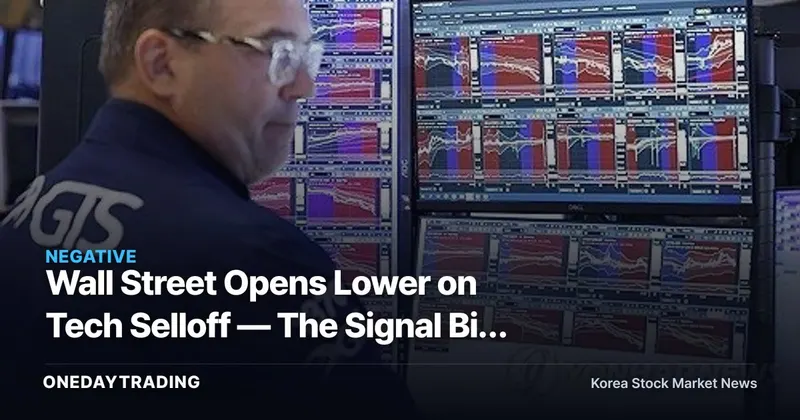
The Dow Jones, S&P 500, and Nasdaq all opened simultaneously in negative territory. The decline was led by the technology sector, which had been the primary engine of recent index gains; concentrated selling there dragged the broader market lower.
Technology stocks had powered a significant portion of index gains during the recent bull run. With market capitalization and return contributions heavily concentrated in a handful of large-cap tech names, selling pressure in those stocks now moves the entire index with heightened sensitivity.
Since this is weakness from the open, it remains to be seen whether the trend will persist through the closing price. That said, the fact that tech stocks absorbed selling pressure from the very first tick signals a wariness among investors feeling the burden of elevated valuations.
Structural Background
Much of the recent U.S. equity rally has leaned on AI investment expectations and the earnings of a handful of Big Tech names. As prices have risen sharply, valuation pressure has accumulated alongside them, creating an environment where even minor doubts about the rate path or earnings guidance can trigger a wave of profit-taking.
The domestic market has a strong correlation with U.S. technology stocks. Semiconductor and IT hardware stocks in particular have revenue tied to U.S. Big Tech capital expenditure and end demand — meaning a correction in New York tech has repeatedly translated into a drag on investment sentiment across KOSPI and KOSDAQ IT sectors by the following trading session.
Stock and Sector Implications
- Samsung Electronics & SK Hynix: Memory demand is directly linked to U.S. Big Tech's AI data center investment. Weakness in U.S. tech stocks can fan concerns over a slowdown in AI capital expenditure, adding near-term pressure to supply-demand (order flow).
- Semiconductor Materials, Parts & Equipment (e.g., Hanmi Semiconductor): HBM and advanced packaging investment expectations are already priced into share prices. If AI investment momentum falters, valuation reversion could be relatively steep.
- IT Hardware & Components: With U.S. Big Tech capital expenditure as the primary demand driver upstream, these stocks react sharply to any signals of reduced investment.
- Brokerage Stocks: A deterioration in global risk appetite weighs on trading value and equity-related revenue, creating indirect downside pressure.
Bull vs. Bear Scenarios
The bear case is straightforward. If profit-taking accelerates while capital remains concentrated in Big Tech, the depth of the correction and volatility will increase, exposing highly correlated Korean IT export stocks to similar weakness. The bull case, however, also has merit. If this decline proves to be a healthy pullback that cools an overheated stretch — and the fundamentals of earnings and AI demand remain intact — then quality IT stocks that have sold off sharply may instead present a staged-buying opportunity. The key variable is whether the selling represents a transient supply-demand (order flow) event or the beginning of a sustained re-rating driven by earnings and rate concerns.
Investor Action Points
- Monitor the closing price of major U.S. tech stocks such as Nvidia and track the Philadelphia Semiconductor Index (SOX) at the close to assess whether this is merely a weak open or a genuine trend reversal.
- Watch upcoming Big Tech earnings releases to confirm whether data center and AI-related capital expenditure guidance is maintained.
- Track the USD/KRW exchange rate alongside foreign investor supply-demand (order flow) — in a rising exchange rate environment, factor in the currency-gain buffer that export stocks receive.
- During periods of elevated volatility, consider a defensive approach by rotating toward stocks (ticker) with high earnings visibility over theme stocks carrying heavy valuation pressure.
Samsung Electronics: Live Data Snapshot
Samsung Electronics's most recent closing price is ₩339,500 (−5.30% vs. prior session). The signal — a composite of foreign investor and institutional investor supply-demand (order flow) along with news and momentum — reads 🔴 Caution. Foreign investors, institutional investors, and momentum are all negative, warranting caution at this time.
- ▼ Order Flow Continuity — foreign investors net selling for 6 consecutive sessions (−2.014 trillion won)
- ▼ Double-Barreled Selling — foreign investors −2.014 trillion won · institutional investors −1.209 trillion won, selling in tandem
- ▲ 52-Week Position — 89% of 52-week range — near 52-week high territory
Recent related news: 22 positive catalyst items · 20 negative catalyst items — net favorable.
※ Price and foreign investor/institutional investor supply-demand (order flow) data are provided by Korea Investment & Securities (KIS) and are current as of the time of publication.
This article is auto-summarized and analyzed content based on the original news source. View Original Article (Yonhap News Finance)