
Summary
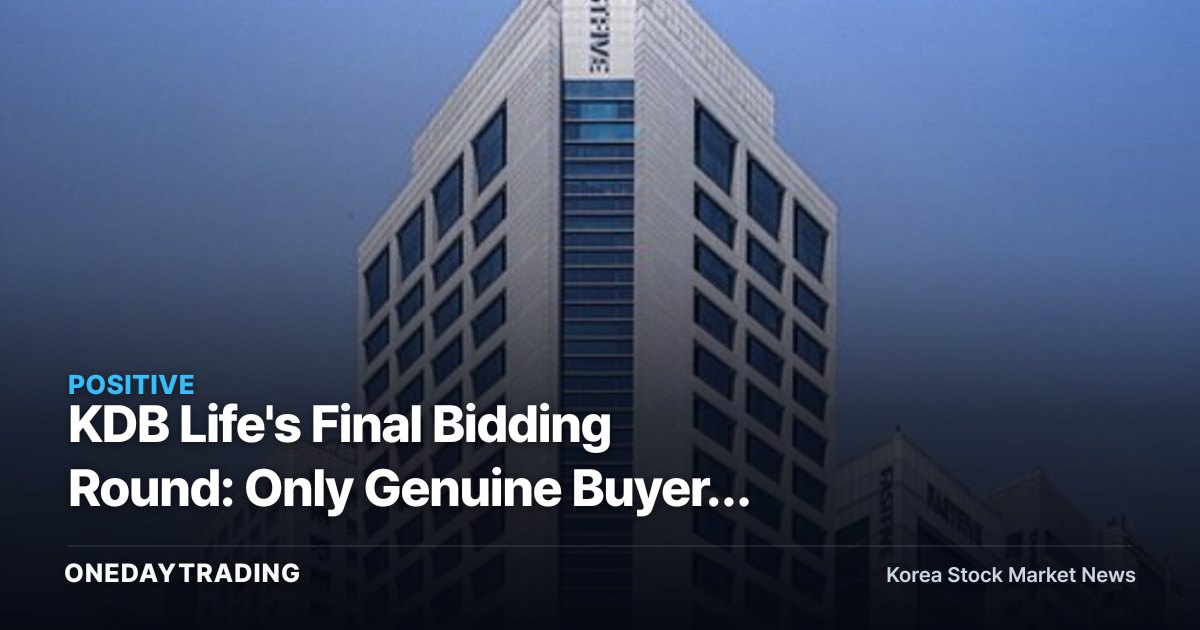
The trillion-won sale battle for KDB Life is moving into the final bidding round. What this really signals isn't the price of an insurance license — it's that the field has narrowed down to only those bidders capable of shouldering the capital burden.
For Korea Investment Holdings, it's a chance to fill the last gap in its non-banking portfolio. Conversely, if the price and the scale of additional capital injection balloon, what shareholders end up buying isn't growth potential but dilution risk.
The Story So Far
KDB Life is a life insurer in which Korea Development Bank (KDB) holds a 99.66% stake. KDB acquired the company in 2010 during the restructuring of the Kumho Asiana Group, and has attempted to sell it since 2014 — failing to find a new owner across six previous rounds.
This marks the seventh attempt. In earlier rounds, Korea Investment Holdings and the Taekwang Group emerged as frontrunners, and the field expanded further at the preliminary bidding stage as major life insurers such as Samsung Life, Hanwha Life, and Kyobo Life also entered the fray. But the final bidding round is where actual numbers are put on the table — expressing interest and having genuine intent to acquire are two different things.
The key reason past deals fell through was always capital, not price. Hana Financial Group was selected as the preferred bidder in 2023 but walked away after due diligence cited the burden of additional capital funding. This time as well, it isn't the headline price tag of a trillion-won sale that will determine the actual transaction value, but the cost of normalizing solvency and the product portfolio after the acquisition.
Structural Backdrop
Insurance M&A is a function of interest rates. When rates are high, both the valuation of an insurer's bond holdings and the profitability of new policies come under pressure at the same time. In that environment, acquirers don't look at the contractual service margin alone — they discount for capital-raising needs, liability duration, and the cost of reorganizing sales channels all at once.
What the market has already priced in is deal fatigue surrounding KDB Life's sale. What hasn't been fully priced in yet is who will actually put a number down in the final bidding round. Major life insurers may be participating to defend market share and take a closer look at the asset portfolio. Korea Investment Holdings, on the other hand, has no insurance subsidiary of its own, giving it a clear rationale rooted in business-structure transformation.
Impact on Stocks (Tickers) and Industry Sector
- Korea Financial Holdings: Having no insurance affiliate gives it the most direct rationale for acquiring KDB Life. Attaching long-duration insurance liabilities and invested assets to its securities-centered earnings structure could build in resilience across interest-rate cycles.
- Samsung Life: Even preliminary participation serves a price-discovery function. Its involvement may be more about strategic due diligence — gauging rivals' cost structures and the target's value — than a genuine intent to acquire.
- Hanwha Life: The logic of scale defense applies amid the reshaping of the life insurance industry. However, given the significant overlap with its existing insurance portfolio, any synergy would depend on strict price discipline.
- Insurance industry sector: If KDB Life's final price is set low, the valuation benchmark for other sale targets such as Lotte Non-Life Insurance and Yebyul Non-Life Insurance could also decline. Conversely, if competition heats up, sellers' price expectations will rise.
Bullish vs. Bearish Scenarios
The bullish scenario is one where KDB lowers the capital burden somewhat and the final bidding round retains candidates with clear strategic motives, such as Korea Investment Holdings or Taekwang. In that case, Korea Financial Holdings could command a premium for its entry into insurance, and the insurance M&A market would re-price in the likelihood of the deal actually closing.
The bearish scenario is one where major life insurers withdraw after due diligence and competition in the final bidding round weakens. With fewer bidders, KDB's negotiating leverage in the sale diminishes, and concerns over additional capital injection would be the first thing priced into the acquirer candidate's stock. Given KDB Life's history of six failed attempts, the market is likely to keep discounting the deal right up until the final signature this time as well.
Investor Action Points
- Watch for next week's list of final-round bidders. What matters more than the five candidates in the preliminary round is how many actually submit a price.
- For Korea Financial Holdings, the method of capital raising matters more than the acquisition price itself. The cost borne by shareholders will differ depending on whether it's funded through cash, subordinated debt, or a paid-in capital increase.
- For Samsung Life and Hanwha Life, focus on the effect of limiting competition rather than their genuine intent to acquire. Whether they stay the course to the end will set the ceiling on the insurance sale price.
- Watch interest rates alongside solvency indicators. A decline in rates is favorable for insurer valuations, but unless the capital-regulation burden eases, the acquisition premium won't last long.
Korea Financial Holdings: A Real-Time Data Snapshot
The most recent closing price for Korea Financial Holdings was 206,500 won (+13.65% from the previous session), and the composite signal light — combining foreign investor and institutional investor supply-demand (order flow) with news and momentum — reads 🟡 Neutral / Wait-and-see. With positive and negative signals mixed, this is a segment worth monitoring.
Recent related news skews negative, with 0 positive catalysts and 2 negative catalysts.
※ Price and foreign/institutional investor supply-demand (order flow) data are provided by Korea Investment & Securities (KIS) and reflect the time of publication.
This article is automatically summarized and analyzed content based on the original news report. View original (Maeil Business Newspaper, Securities)