
3-Line Briefing
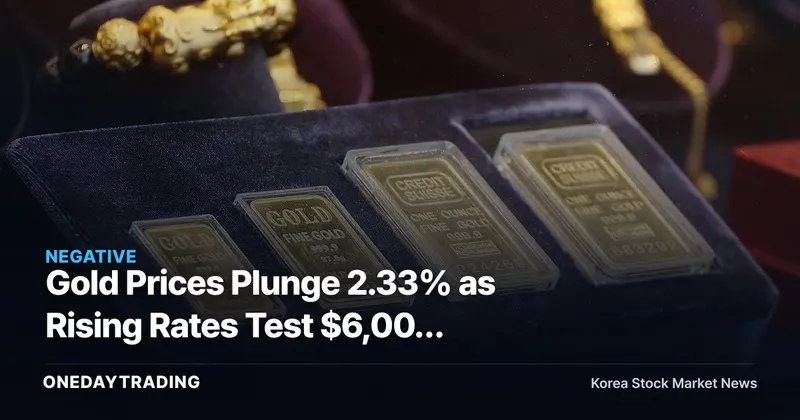
- New York gold prices fell 2.33% in one day as global government-bond yields surged.
- Rising rates reduce gold’s relative appeal because it pays no interest, while a stronger dollar can also alter realized returns for won-based investors.
- The year-end $6,000 gold forecast is a conditional scenario requiring lower rates and continued central-bank and ETF demand.
What Is Changing
The key point behind the gold-price decline is not that demand has disappeared. Rather, it signals that the market is once again viewing government bonds offering higher yields than gold as more attractive. Because gold generates neither cash flow nor interest, its opportunity cost rises when real rates increase. This adjustment is closer to a case where the rate path pulled prices down first than to a supply shock in gold itself.
After gold’s sharp gain (surge), substantial expectations had already been priced in. Central-bank purchases, geopolitical uncertainty and avoidance of dollar assets lifted gold’s safe-haven premium, but a further rise in government-bond yields can offset part of that premium. Conversely, if rates fall again, inflows into gold ETFs and futures positions could recover simultaneously. The relationship between rates and gold prices is not a fixed formula; it reflects changing capital priorities.
For Korean investors, the won-dollar exchange rate adds another layer. Since international gold is traded in dollars, a weaker won can reduce the size of a domestic gold-price decline or even push prices higher. However, even if global gold rebounds, a rapid strengthening of the won can limit returns on domestic gold ETFs and gold-related products. International prices and the exchange rate must be viewed together.
Putting the Numbers in Context
New York gold prices fell 2.33% alongside a sharp rise in global government-bond yields. One day’s move alone cannot establish that the long-term trend has ended, but it clearly shows that rate sensitivity has returned to the forefront. The report’s year-end $6,000 forecast should be read not as a simple extension of current prices, but as an upside scenario premised on falling rates and stronger safe-haven demand.
If rates remain elevated for longer than the market expects, gold’s relative holding cost could increase and slow the pace of gains. Conversely, if government-bond yields turn lower, gold’s non-interest-bearing weakness would diminish and the likelihood of renewed inflows would rise. In particular, a recovery in net ETF inflows accompanied by physical demand matters more than a rebound in the futures market alone.
Beneficiary and Vulnerable Stocks
- Korea Zinc: Because refining precious metals including gold and silver feeds into earnings, investors should check metal prices, treatment charges and the exchange rate together. Higher gold prices are a positive catalyst, but estimating earnings from a single metal price can create significant error.
- Physical gold and gold ETFs: Products that directly track international gold prices immediately reflect this 2.33% correction. If the won-dollar exchange rate rises, losses measured in won may be partly cushioned.
- Exporters benefiting from a stronger dollar: If the dollar strength that weakened gold persists, companies such as automakers and semiconductor manufacturers with high dollar-revenue exposure could see a positive translation effect on revenue. This is an indirect exchange-rate effect, not a direct gold-related benefit.
Risk Check
- Further increases in U.S. and major-country government-bond yields could increase valuation pressure on gold.
- If gold ETF funds shift to net outflows, central-bank purchases alone may struggle to support prices in the short term.
- If the won quickly turns stronger, a rebound in international gold prices may not fully translate into domestic investment returns.
- If the $6,000 outlook becomes an overcrowded market consensus, even a modestly higher-than-expected rate level could trigger heavier profit-taking.
Bottom Line
The 2.33% drop in gold prices shows a repricing of rates more than the end of the uptrend. If government-bond yields turn lower and ETF net inflows continue, the $6,000 scenario can regain traction; but if high rates persist, gold will struggle to reclaim its previous high on safe-haven status alone.
Frequently Asked Questions
Why does gold fall when rates rise?
Because gold pays no interest, its opportunity cost rises when government-bond yields increase. The stronger real rates and the dollar become at the same time, the easier it is for funds to move from gold into bonds and dollars.
Under what conditions is a year-end $6,000 gold price possible?
The case for the upside forecast strengthens if government-bond yields decline while central-bank purchases and net gold ETF inflows expand together. If rates stay high or ETF funds shrink, the timing of the forecast could be delayed.
How should Korean investors view gold prices and the exchange rate?
International gold prices are denominated in dollars, while domestic products are valued in won, so the won-dollar exchange rate must be monitored as well. Even if gold rises, continued won strength can leave domestic returns below the gain in international prices.
Korea Zinc Key MetricsAs of 2026-09-02
| Period returns | 1 week -13.99% 1 month +15.69% |
|---|---|
| Trading value · trading volume | 18.3 billion won · 15,402 shares |
| Supply-demand (order flow) | Foreign investors +3.4 billion won net buying (3 consecutive days) Institutional investors −10.8 billion won net selling |
| Recent news tone | Positive catalyst 0 · Negative catalyst 1 |
Price and supply-demand data are real-time values from Korea Investment & Securities (KIS); supply-demand and news-tone figures are calculated by One Day Trading.
Supply-Demand and Momentum Assessment🟡 Neutral · Watch
Positive and negative signals are mixed, indicating a period to monitor.
- ▲Supply-demand continuityForeign investors’ net buying for 3 consecutive days (+3.4 billion won)
Upcoming Dates to Watch
- 09.10Futures and options simultaneous expirationNormalQuadruple witching — watch for volatility and order-flow disruption
- 09.16FOMC policy-rate decisionHighU.S. Federal Reserve policy announcement — direction of rates and the dollar
- 10.08Index-options expirationLowKOSPI200 options expiration
- 10.22Bank of Korea Monetary Policy BoardHighMeeting to decide the benchmark interest rate
This article is automatically summarized and analyzed based on the original news report. View original (Yonhap News Agency)
。