
Key Takeaways
Reports that 95% of online wholesale market trading took place among a limited group of participants signal that subsidy-driven transactions expanded before real innovation in agricultural distribution took hold.
What matters for investors is not transaction-value growth itself. If the government reduces incentives and discloses trading volumes and unit prices, the purchasing costs and margin structures of food-material distributors, major hypermarkets, and catering companies will need to be recalculated.
What Happened
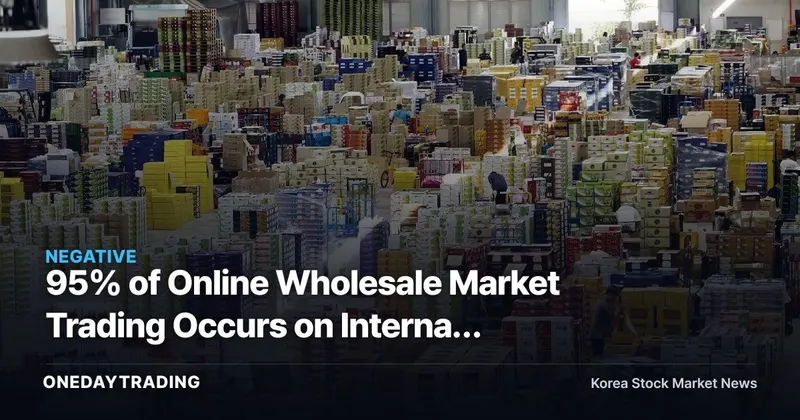
The online wholesale market introduced by the Ministry of Agriculture, Food and Rural Affairs to lower agricultural distribution costs is designed to connect producers and buyers through a digital marketplace and reduce intermediate distribution stages. According to Maeil Business Newspaper, online wholesale market transaction value has increased, but 95% of transactions appear to have been repeated among specific participants, raising questions about the effectiveness of the system.
The key issue is price discovery. For an online wholesale market to function properly, many sellers and many buyers must compete under transparent conditions. But if transactions accumulate within a closed network of relationships, platform transaction value can grow while it remains difficult to verify whether this has actually led to lower agricultural prices or narrower distribution margins.
The government is reportedly reviewing adjustments to the system, including a phased reduction in incentives and disclosure of trading volumes and unit prices. The policy materials described a digital transition, but the data showed a trading structure that has not yet moved sufficiently toward a competitive market.
Background and Context
Agricultural distribution is structured around price markups through producer collection, wholesale, intermediate wholesale, and retail stages. Consumers feel the impact through grocery inflation, while food and restaurant companies face it through raw-material costs. Lower distribution costs can provide a buffer for consumer inflation and create a pathway for companies to reduce procurement costs.
Still, moving online does not automatically reduce costs. If incentives paid to grow platform transactions were used to cover the cost of shifting transactions rather than to drive price competition, trading volume could fall once subsidies are withdrawn. By Park Sera's standard, the quality of transaction data matters more than the policy announcement itself.
Impact on the Market and Stocks
- CJ Freshway: In catering and restaurant food-material distribution, changes in agricultural procurement costs directly affect gross profit margin. Expanded disclosure of online wholesale market unit prices could improve purchasing leverage, but it would also increase pressure to disclose distribution margins.
- Hyundai Green Food: For institutional catering and food-material supply businesses, raw-material cost control is central to protecting margins. If transparent wholesale prices become a benchmark, price-adjustment discussions with major customers will become more data-driven.
- E-Mart: For hypermarkets, fresh-food price competitiveness drives store traffic. If online wholesale prices genuinely decline, procurement costs could ease, but much of the benefit may be absorbed by competition to lower consumer prices.
- Lotte Shopping: Supermarket and hypermarket channels are highly sensitive to agricultural prices. If government unit-price disclosure functions like a standard price, differences in procurement capability among retailers will become clearer.
- Food and restaurant industry sector: Lower raw-material costs would be positive for margins. Conversely, if online wholesale trading declines after incentives are reduced, reliance on existing wholesale networks will persist and the pace of cost improvement will slow.
Investor Checkpoints
- Investors should check whether the scope of transaction volumes and unit prices disclosed by the government is sufficient by item and region. If only average unit prices are disclosed, it will be difficult to judge whether real price competition is occurring.
- Whether online wholesale market transaction value and transaction counts hold up after incentives are reduced will be the first validation metric. If trading drops when subsidies are cut, it would mean organic demand was weak.
- Investors should watch food-material distributors' gross profit margins next quarter. They need to confirm whether lower agricultural procurement costs are offset by higher SG&A expenses or customer price cuts.
- Investors should monitor both the agricultural, livestock, and fisheries components of consumer inflation and the intensity of fresh-food promotions at major hypermarkets. The speed at which lower wholesale prices pass through to consumer prices will determine the policy's success.
Outlook
The optimistic scenario is straightforward. If the government discloses trading volumes and unit prices by item, and trading is sustained even after incentives are reduced, the online wholesale market could become the reference ledger for agricultural prices. In that case, large buyers would gain a basis for lowering procurement costs, while food-material distributors could defend themselves through scale and data capabilities.
The risks also need to be assessed numerically. If the reported standard that 95% of transactions were formed within a limited relationship network persists, the market is closer to a subsidized transaction channel than a competitive platform. In that case, the government's incentive cuts could shrink trading before they reduce distribution costs. Investors should look beyond the policy name and focus on the next disclosed data: the actual number of buyers, item-level unit prices, and transaction retention after subsidies are reduced.
Frequently Asked Questions
Why is it a problem that 95% of online wholesale market trading is concentrated?
Reports that 95% of online wholesale market trading was concentrated among specific participants suggest that price competition may not have occurred sufficiently. If many sellers and buyers are not competing, it is difficult to prove that higher transaction value is reducing agricultural distribution costs.
Is the agricultural online wholesale market a positive catalyst for distribution stocks?
It is partly positive for hypermarkets and catering companies because it gives them a basis for lowering procurement costs. However, for food-material distributors such as CJ Freshway, unit-price disclosure could weaken margin negotiation power, so the impact will vary within the industry sector.
What should investors in food-material distribution stocks watch?
Investors in food-material distribution stocks should check whether gross profit margin and agricultural procurement costs move together in the next earnings results. If online wholesale market trading volume remains stable even after the government reduces incentives, changes in the procurement structure could be reflected in actual profits and losses.
CJ Freshway Based on Real-Time Data
CJ Freshway's recent closing price is 24,750 won (+1.02% versus the previous day), and the traffic-light signal combining foreign investors/institutional investors supply-demand (order flow), news, and momentum is 🟡 neutral·watchful. Positive and negative signals are mixed, making this a period to monitor.
- ▲ Supply-demand (order flow) continuity — foreign investors net bought for 4 consecutive days (+0 billion won)
- ▲ Trend alignment — Short- and medium-term upward alignment (today +1.0% · 1 week +3.3% · 1 month +11.5%)
Recent related news is negative, with 0 positive catalyst items and 1 negative catalyst item.
※ Price data and foreign investors/institutional investors supply-demand (order flow) data are provided by Korea Investment & Securities (KIS) and are current as of publication.
This article is automatically summarized and analyzed based on the original news report. View original article (Maeil Business Newspaper Economy)