
3-Line Briefing
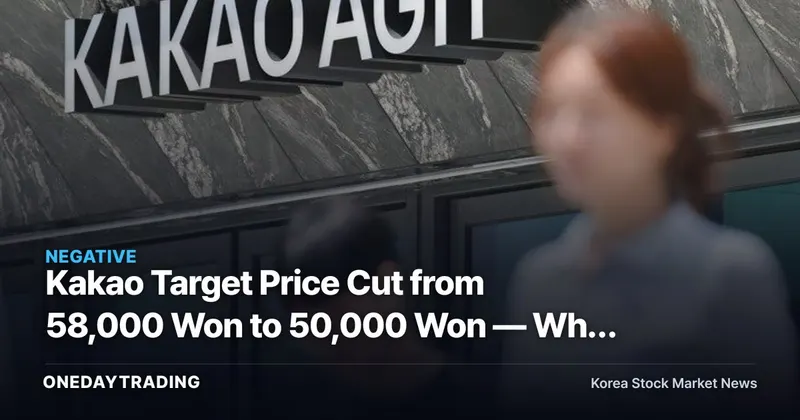
- Hana Securities cut its target price for Kakao from 58,000 won to 50,000 won, a 14% reduction.
- The rationale is that the valuation premium built on the single KakaoTalk platform could be diluted after the spin-off.
- The target price was lowered, but the buy rating was maintained — meaning the firm's view on the core business fundamentals hasn't changed.
What's Changing
In a report published on the 24th, Hana Securities lowered its target price for Kakao from 58,000 won to 50,000 won, a 14% cut. The rationale isn't earnings — it's corporate structure. The logic is that if Kakao splits into separate entities through a spin-off, the integrated valuation that has rested on advertising, commerce, content, and finance all sitting atop the single KakaoTalk platform could come under pressure.
A spin-off is a structure in which existing shareholders receive shares in the newly created company in proportion to their existing stake, splitting the firm into a holding company and an operating company. The market's wariness toward this structure is straightforward. Kakao has long defended its multiple through a platform premium that simultaneously lifted ad rates and commerce conversion on top of its "national messenger" traffic infrastructure. Once the company is split, it becomes harder to demonstrate that synergy through a single set of financial statements, and investors end up re-rating each business unit separately using its own industry sector multiple. That's the source of the risk: advertising gets marked down to a media-stock multiple, commerce to a retail-stock multiple, and the financial subsidiary to a financial holding company multiple.
Even so, Hana Securities kept its buy rating in place while lowering the target price. The firm's view is that while the spin-off issue may change how Kakao is valued, it hasn't impaired KakaoTalk's domestic messenger market share or the earnings power of its core advertising and commerce businesses. That's the backdrop behind the simultaneous target price cut and buy-rating maintenance.
Numbers in Context
The key point is that the 14% cut from 58,000 won to 50,000 won stems from a re-rating of the premium, not a change in earnings estimates. Brokerages typically lower target prices because of downgraded earnings forecasts or a higher discount rate, but this is a case where a shift in corporate structure shook the multiple itself. In other words, it signals a change not in the outlook for Kakao's operating profit strength, but in the market's calculus over what multiple to apply.
This trend isn't unique to Kakao. It echoes the recurring holding-company discount debate that resurfaces whenever a major Korean holding company or conglomerate undergoes a split or restructuring. It's a dilemma: the more a business is broken apart, the more transparent each unit's earnings become, but the thinner the story supporting the integrated premium grows.
Stocks to Watch — Winners and Losers
- Kakao — The direct subject of the 14% target price cut. As the spin-off blueprint takes shape, its advertising and commerce segments face growing pressure to be re-rated on separate multiples.
- KakaoBank — If Kakao is restructured into a holding company and operating company, changes in its largest-shareholder structure could bring the stake-valuation method and overhang concerns into focus.
- KakaoPay — As a fintech subsidiary, it's another name where a potential reshuffling of the equity relationship tied to the parent's spin-off structure is being discussed.
- Naver — As Kakao's largest same-sector rival, Naver could see its relative advantage highlighted for retaining an integrated platform premium while Kakao's multiple is discounted for spin-off risk.
Risk Check
- If the final structure of the spin-off has not yet been confirmed, today's concern over a shrinking premium is a scenario risk, not a realized loss.
- Since the buy rating was maintained despite the target price cut, sturdier-than-expected core earnings could instead be read as an undervalued buying opportunity.
- The size of the holding-company discount varies with market conditions, share buyback policy, and dividend policy, making it difficult to prejudge uniformly.
- Depending on how the equity structure of listed subsidiaries such as KakaoBank and KakaoPay is reorganized, the parent's and subsidiaries' share prices could move in opposite directions.
Bottom Line
The target price cut is an adjustment stemming from the spin-off changing how Kakao is valued, not from its fundamentals — and since the buy rating was maintained, it's worth separating the assessment of core business competitiveness from corporate-structure risk.
Frequently Asked Questions
Why was Kakao's target price lowered?
Hana Securities cut Kakao's target price by 14%, from 58,000 won to 50,000 won, on the 24th. The rationale is that the valuation premium sustained by KakaoTalk could shrink after the spin-off.
How does the spin-off affect Kakao's share price?
If the company splits into a holding company and an operating company, its advertising, commerce, and finance units get re-rated on separate industry sector multiples. The logic behind this target price cut is that the premium it enjoyed as an integrated platform could fade.
Why is the rating still a buy despite the lower target price?
Hana Securities lowered the target price while keeping the buy rating. This is seen as reflecting the view that while the spin-off may change the valuation method, it hasn't impaired the earnings power of the core, KakaoTalk-based business itself.
Kakao by the Numbers: Real-Time Data
Kakao's most recent closing price was 35,800 won (0.00% versus the previous day), and the composite signal combining foreign and institutional order flow with news and momentum reads 🔴 Caution. Foreign investors, institutional investors, and news flow are all negative, so caution is warranted right now.
- ▼ Twin-sided selling — foreign investors −51.3 billion won and institutional investors −45.3 billion won selling in tandem
- ▼ 52-week position — near the 52-week low, at the 9th percentile
- ▼ News flow — 1 positive catalyst vs. 3 negative catalysts — negative catalysts dominate
Recent related news comprises 1 positive catalyst and 3 negative catalysts, skewing negative.
※ Price and foreign/institutional order-flow data are provided by Korea Investment & Securities (KIS) and reflect the time of publication.
This article is automatically summarized and analyzed based on the original news report. View original (Maeil Business Newspaper, Securities)