
Summary
A blackout affecting 248 households is not a number that will move KEPCO's earnings. What it really signals is that grid reliability during heatwave season has emerged as a new variable for the stock.
The market typically looks first at electricity rates and international energy prices. But when distribution-grid outages recur, the narrative shifts down from interest rates and oil prices to capital investment, maintenance, and demand for power equipment.
What Happened
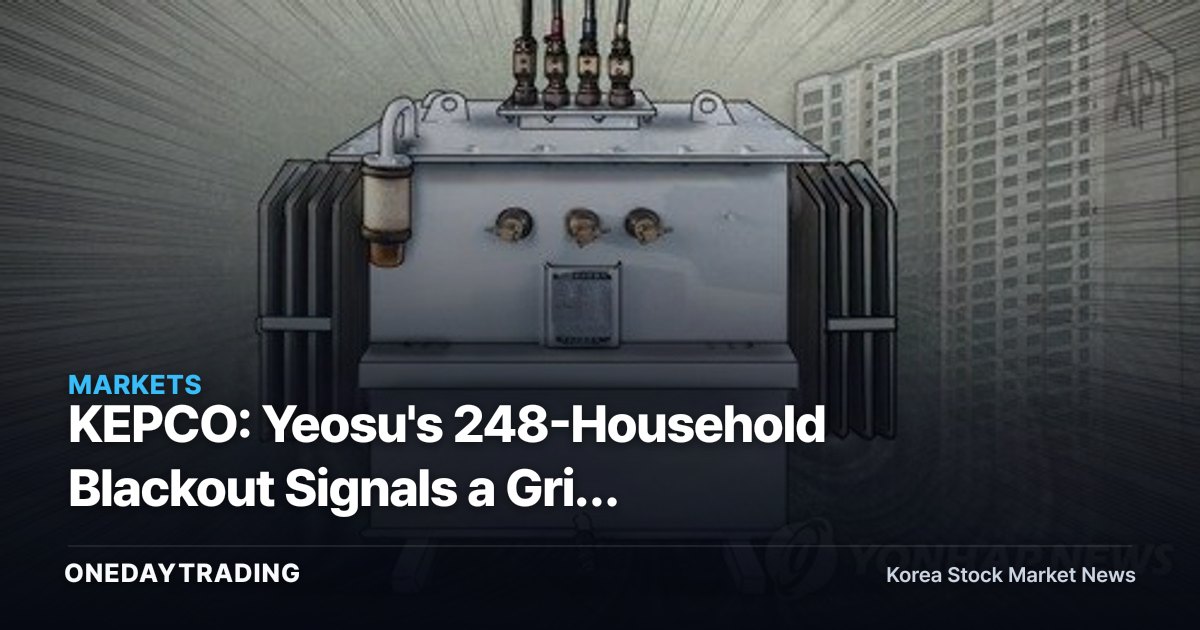
According to Yonhap News, a power outage occurred around 6:59 p.m. on the 30th in the Ungcheon-dong area of Yeosu, South Jeolla Province. The damage affected 248 households. The timing matters: 7 p.m. still carries residual cooling demand and is a peak period for residential electricity use.
This report alone does not confirm the cause of the outage, the time of restoration, or whether equipment failure was involved. It would therefore be premature to attribute responsibility to any specific facility or company. Still, a residential blackout occurring during a summer heatwave phase could reignite discussion around grid investment.
For Korean investors, this news reads less like a disaster report and more like an industry signal. A single blackout is unlikely to register as a cost item, but when incidents of the same type accumulate, priorities shift for distribution automation, transformer replacement, and grid-reinforcement budgets.
Structural Backdrop
Power grids are less visible than power plants, but bottlenecks often surface at the distribution level. When cooling load concentrates in specific time windows, aging equipment, underground lines, transformer capacity, and protection relay systems are all tested simultaneously. If electricity rates fail to keep pace with rising power demand, utilities must balance investment against financial stability.
Interest rates matter here. Grid investment is long-term capital expenditure, and higher rates increase the burden on projects with long payback periods. For KEPCO, that's cost pressure; for power equipment makers, it's an order opportunity. What the market has already priced in is the power equipment supercycle. What remains underpriced is how quickly domestic distribution-grid maintenance translates into actual orders.
Stock (Ticker) and Industry Sector Impact
- KEPCO: The earnings impact of the 248-household blackout itself is limited. However, if heatwave-season outage complaints increase, pressure for distribution-grid reinforcement and safety-related capital spending could grow.
- LS ELECTRIC: Tied to demand for switchgear, power automation, and grid control systems. What matters more than the near-term news is whether actual KEPCO orders and private industrial-complex power investment actually increase.
- HD Hyundai Electric: Could see attached expectations for transformer demand. However, the profitability structure differs between domestic low-voltage/distribution issues and the overseas ultra-high-voltage transformer boom.
- Hyosung Heavy Industries: Favorable for power-equipment order momentum. But a single localized blackout provides insufficient grounds to raise earnings estimates.
Bullish vs. Bearish Scenarios
In the bullish scenario, the heatwave and rising power demand become justification for expanded distribution-grid investment. If the government and KEPCO move up outage-prevention budgets and orders increase for transformers, circuit breakers, and distribution automation equipment, order visibility improves across the power-equipment value chain.
In the bearish scenario, this incident turns out to be a one-off. If the cause is simple equipment malfunction or a localized issue, the impact on listed companies' earnings will be minimal. Since power equipment stocks (tickers) have already priced in a degree of high expectations, the news reaction won't last long unless an actual increase in orders is confirmed.
Investor Action Points
- Investors should check KEPCO's future distribution-grid investment plans and summer-related outage announcements. The key figures are budget size, order volume, and restoration time.
- For power equipment stocks (tickers), order announcements should be viewed separately from the growth rate of order backlogs. It is the timing of revenue recognition — not the theme — that ultimately validates the stock price.
- Peak power demand and reserve margins during the heatwave period should be monitored together. The higher the demand peak, the stronger the case for grid reinforcement.
- Don't lose sight of interest rate direction. Long-term capital investment more easily earns a higher multiple when the discount rate declines.
KEPCO by the Numbers (Real-Time Data)
KEPCO's most recent closing price was 33,050 won (-0.15% day-over-day), and the sentiment gauge combining foreign/institutional investor supply-demand (order flow) with news and momentum reads 🟡 Neutral / Wait-and-see. With positive and negative signals mixed, this is a range to watch.
- ▼ Trend Alignment — Short- and medium-term downtrend alignment (intraday -0.1% · 1 week -2.5% · 1 month -13.6%)
- ▼ 52-Week Position — Near the 52-week low, at the 3% mark
Recent related news skews favorable, with 1 positive catalyst and 0 negative catalysts.
※ Price and foreign/institutional investor supply-demand (order flow) data are provided by Korea Investment & Securities (KIS), as of the time of publication.
This article was automatically summarized and analyzed based on the original news report. View original (Yonhap News, Industry)