
At a Glance
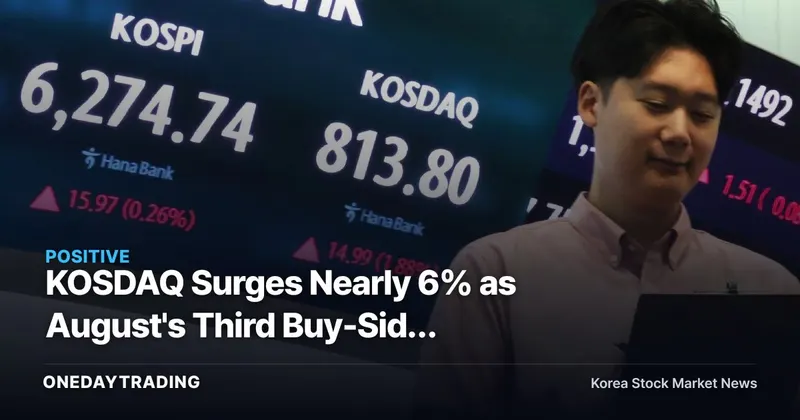
On a day when KOSPI moved roughly 1%, KOSDAQ jumped nearly 6%. What this really signals isn't the size of the index gain, but the speed of supply-demand (order flow).
The fact that a buy-side sidecar was triggered for the third time in August means the KOSDAQ rebound has spread well beyond simple bargain hunting. Still, a sidecar isn't a stamp of approval for a positive catalyst — it's also a warning that price discovery has tilted heavily to one side in a short span of time.
Why It Matters Now
KOSDAQ's near-6% surge has a different character than KOSPI's move. Large-cap stocks are heavily influenced by earnings, exchange rates, and foreign investors' passive fund flows. KOSDAQ, by contrast, is packed with growth stocks, biotech, battery materials, and software names that are highly sensitive to shifts in discount rates. The moment the market starts pricing in relief on rate pressure, valuation multiples move first, and leading stocks tend to pop faster on KOSDAQ than on KOSPI.
A sidecar is a mechanism that temporarily suspends the effect of program trading orders when the market moves too fast. Repeated buy-side sidecars mean selling panic has eased, but they also mean the density of chasing buy orders has intensified. The fact that this is the third activation in August alone raises two questions for investors: has the market already priced in rate cuts and a recovery in risk appetite, or has liquidity rushed in ahead of any confirmed improvement in earnings?
The key is the gap between KOSPI and KOSDAQ. If KOSDAQ climbed nearly 6% while KOSPI stayed around 1%, it's better read not as the whole market gaining strength, but as money concentrating in the higher-beta corner of risk assets. In this kind of market, it's essential to separate stocks (tickers) whose earnings estimates are rising in tandem with their share prices from those that are merely oversold. The former can defend their multiples even after a rebound, while the latter tend to be the first sold off if rates or the exchange rate reverse.
FAQ
- Is a buy-side sidecar a positive catalyst? In terms of short-term supply-demand (order flow), yes. But the mechanism itself is designed to slow the pace of overheating. What matters more than the activation itself is subsequent trading value and whether the rallying stocks (tickers) are backed by earnings.
- Why is KOSDAQ stronger than KOSPI? With a higher weighting of growth stocks, KOSDAQ is more sensitive to shifts in rate expectations. When the odds of a lower discount rate rise, stocks whose distant future profits get pulled forward into present value tend to react first.
- How should the third activation in August be interpreted? It signals a strong directional bias in supply-demand (order flow), but it also means volatility has increased. Repeated activations within the same month amplify both upward momentum and the risk of a pullback.
- How should the approach to individual stocks (tickers) change? Rather than focusing on theme names, investors should first check for catalysts that can be confirmed with hard numbers — next-quarter revenue, clinical trial schedules, new orders, or client purchase orders.
Related Stocks (Tickers) and Sector Impact
- KOSDAQ growth stocks. As rate expectations ease, long-term earnings tend to be valued more highly. However, stocks without earnings that rallied purely on multiple expansion can reverse just as quickly.
- Biotech. This is a sector where expectations around clinical trials and licensing deals get priced in ahead of confirmation. In a sidecar-driven market, funds may flow toward companies with upcoming positive-catalyst events, but overheating before data confirmation raises binary risk.
- Battery materials. Given how sharply these stocks had fallen, the rebound momentum could be substantial. But unless EV demand and material prices recover together, a gap will remain between the share-price rebound and an actual earnings recovery.
- Software/AI theme stocks. These names are prone to growth-rate re-ratings. The gap could widen between companies backed by real revenue conversion, client expansion, and cost discipline versus those simply grouped into the theme.
- Brokerage industry sector. Rising KOSDAQ trading value is positive for brokerage commissions. However, if the pickup in volatility spills over into margin-lending burdens, the benefit to brokerage earnings will be limited.
Investment Considerations
- Whether trading value holds up. What matters more than a single day's sharp gain (surge) is whether trading value stays elevated over the following three to five trading sessions. If supply-demand (order flow) cools, KOSDAQ could swing more violently than KOSPI.
- Interest rates and the exchange rate. A growth-stock rebound is sensitive to discount rates. If domestic rate-cut expectations reverse or the won weakens further, both foreign investors and leveraged funds could pull back simultaneously.
- Earnings estimates. If share prices rise first and profit forecasts fail to follow, valuation burden will remain. Investors should watch for revenue growth and narrowing operating losses in the next earnings season.
- Margin debt balances. In a sharp-rally market, retail investors' leverage tends to build up quickly. If the pace of margin debt growth outstrips the index's rate of gain, even a small correction could trigger heavier selling.
Overall Outlook
This KOSDAQ surge is a positive sign of revived risk appetite. With KOSPI's gain limited while KOSDAQ jumped nearly 6%, and a third buy-side sidecar triggered in August, the market appears to be front-running the possibility of falling rates and a re-rating of growth stocks. For this phase to be sustained, it will need more than simple theme rotation — trading value, earnings estimates, and net buying from foreign and institutional investors all need to move together.
The trigger for the opposite scenario lies in rates and the exchange rate. If rate-cut expectations retreat or the won weakens again, KOSDAQ's multiple expansion will be tested immediately. What to watch next isn't the index peak, but the trading value that remains after the sidecar, earnings releases from KOSDAQ's leading stocks, and the level of the KRW/USD exchange rate. What the market has already priced in is the rebound. What has not yet been confirmed is the profit.
This article is automatically summarized and analyzed content based on the original news report. View Original (Maeil Business Newspaper, Securities)