
Summary
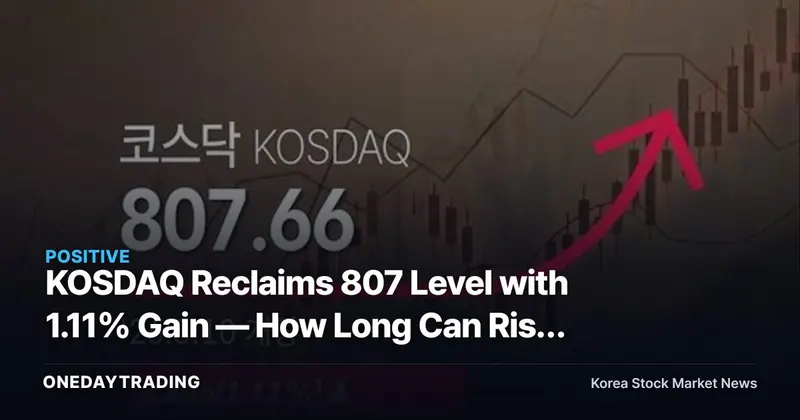
The KOSDAQ opened up 8.85 points, or 1.11%, at 807.66. What this figure really signals isn't the index level itself, but the market's judgment that the discount-rate burden on growth stocks has eased for now.
Still, it's too early to read the recovery above the 800 line as a full trend reversal. The KOSDAQ is a market that responds more to expected earnings and liquidity than to actual earnings. If rates and the exchange rate turn upward again, today's gains could quickly be reversed.
What Happened
According to Yonhap News, the KOSDAQ index opened at 807.66, up 8.85 points from the previous trading day. That's a gain of 1.11%. What matters here isn't simply a positive open, but the fact that trading resumed above the 800 level.
The 800 line on the KOSDAQ acts as a psychological boundary for investors. Above this line, buying logic returns to stocks (tickers) that pull distant future profits into present value — loss-making biotech names, battery materials, robotics, and gaming. Below it, the market demands cash flow before growth.
This morning's strength looks less like an earnings surprise at any individual company and more like a signal of recovering risk appetite. The KOSDAQ is more sensitive to interest rates than the KOSPI, which is dominated by large exporters. When expectations build that the discount rate will fall, multiples get reassigned even to companies whose profits haven't been fully confirmed yet.
Structural Background
The question is what this rally has already priced in. What the market has already bought is the expectation of a rate peak-out and a rebound from growth stocks' recent declines. What it hasn't fully priced in yet is earnings confirmation. Companies with slowing revenue growth, lingering convertible-bond burdens, or biotech firms that must keep burning R&D cash will be selected against again if their earnings strength fails to catch up with the index.
KOSDAQ's strength starts with interest rates, flows down into valuations, and ultimately separates the leading stocks within each industry sector. When the discount rate falls, the sectors with the longest duration of expected profits — biotech, semiconductor equipment, and battery materials — react first. But in the next stage, only companies whose order backlogs, clinical trials, customer orders, and mass-production schedules are confirmed with hard numbers hold onto leadership.
Impact on Stocks and Sectors
- Biotech: As expectations build for easing rate pressure, the present value of long-term clinical-trial value rises. However, companies without clear cash runway or upcoming clinical trial events will struggle to keep pace with the index rally for long.
- Semiconductor equipment: This is typically the first area to attract trading value when the KOSDAQ's growth premium recovers. The real beneficiaries should be confirmed through resumed customer capex and equipment order announcements.
- Battery materials: A sense of oversold conditions can spark a rebound. But unless EV demand and material prices recover together, share prices won't be able to keep up with expectations on earnings.
- Gaming/internet: Platform-type companies with light cost structures are sensitive to falling discount rates. New-title revenue rankings and the recovery of the advertising cycle will determine whether the rebound has staying power.
- KOSDAQ index-tracking products: The 1.11% opening gain could spur short-term momentum buying. However, an index-based approach has the drawback of diluting earnings differences across industry sectors.
Bullish vs. Bearish Scenarios
The bullish scenario is straightforward. If upward pressure on interest rates eases and won weakness settles down, KOSDAQ multiples could recover further. In that case, the market may give more momentum to mid-cap growth stocks nearing an earnings turnaround than to large-cap KOSDAQ names with more stable earnings.
The trigger for the bearish scenario is interest rates and the exchange rate. The growth-stock rebound rests on the premise that the discount rate is falling. If government bond yields or the won-dollar exchange rate rise again, foreign investors and institutional investors will be the first to trim positions in richly valued stocks (tickers). On days when the KOSDAQ rallies, companies that remain unprofitable or still face potential financing needs deserve an even more clear-eyed look.
Action Points for Investors
- Watch whether the KOSDAQ holds above 807.66 during the session. Staying above the opening price signals continued risk appetite; falling below it signals short-term selling pressure.
- Watch where trading value concentrates — biotech, semiconductor equipment, or battery materials. The breadth of leading sectors matters more than the index gain itself.
- Keep an eye on the next moves in interest rates and the exchange rate. The KOSDAQ rebound isn't explained by corporate news alone — it depends heavily on shifts in the discount rate.
- Simple theme stocks without earnings releases or order announcements should be candidates for reduced exposure. Even on a day when the index rises 1.11%, the risk in companies with weak cash flow doesn't disappear.
This article was automatically summarized and analyzed based on the original news report. View original (Yonhap Infomax)