
Three-Line Briefing
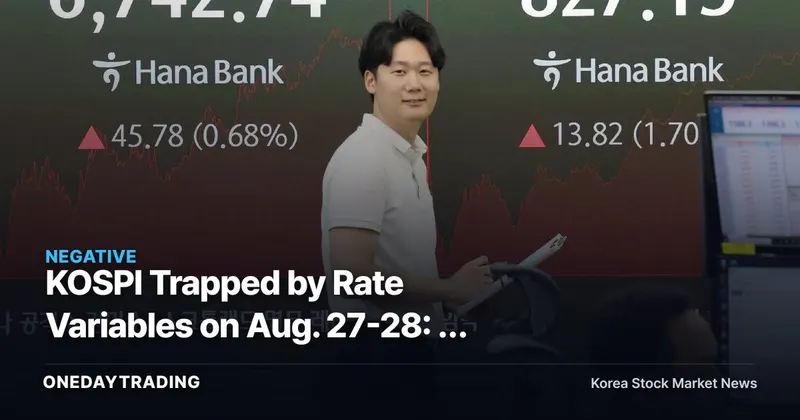
- The KOSPI overcame an intraday sharp drop (plunge) of around 4% to finish up 0.6%, but this rebound looks more like position adjustment ahead of rate events than a trend reversal.
- Whether the Bank of Korea tightens further on Aug. 27 is a variable that could simultaneously affect the won, foreign investors’ supply-demand (order flow), and the relative strength of financials versus growth stocks.
- The U.S. Jackson Hole speech on Aug. 28 could reset the benchmark for global discount rates, potentially renewing multiple pressure on semiconductors, internet stocks, and rechargeable battery names.
What Changes
The key to the KOSPI’s sharp drop (plunge) and rebound is not the index itself, but the discount rate. A market that recovered from an intraday loss of around 4% to end 0.6% higher did not prove strong underlying resilience; it was closer to the result of selling and short covering colliding ahead of the Bank of Korea event on Aug. 27 and the U.S. Jackson Hole event on Aug. 28.
Additional tightening means a central bank choosing to further restrict liquidity through a benchmark interest rate hike or hawkish wording. If the Bank of Korea sends a hawkish signal on Aug. 27, it may help defend the won, but it would weigh on valuations for domestic-demand stocks and high-PER growth names. Conversely, if the bank holds rates and uses dovish language, the stock market may feel relief, but if won weakness resumes, foreign investors’ supply-demand (order flow) can shift within a single day.
The Jackson Hole remarks on Aug. 28 are the bigger variable. The direction of U.S. monetary policy feeds into long-term yields, and long-term yields in turn feed into the multiples of Korean growth stocks. Even if earnings expectations remain intact for semiconductors and internet names, rising rates reduce the present value of profits far in the future. What the market has already priced in is fatigue from range-bound trading. What it has not fully priced in is how quickly a single central-bank remark can change the leading industry sector.
Viewing the Numbers in Context
According to Maeil Business Newspaper’s securities coverage, the domestic stock market saw the KOSPI suffer an intraday sharp drop (plunge) of around 4% within its range-bound market, then move toward a 0.6% higher close. A market that produces both a sharp sell-off and a rebound in the same day is one with weak direction. It means buyers were not acting on conviction, but on a mix of oversold conditions and event-driven waiting.
In this phase, rates hit valuations first, then create industry sector rotation. When the probability of higher rates rises, banks gain support from expectations for net interest margins, while industry sectors with longer profit recovery periods, such as internet and biotech, face discount-rate pressure. If the exchange rate stabilizes, foreign investors gain a rationale to rebuild positions in large exporters such as Samsung Electronics and SK Hynix. But if the won becomes volatile, buying strength in the same stocks weakens in the face of foreign-exchange loss concerns.
Beneficiaries and Losers
- Samsung Electronics: A large-cap semiconductor stock that represents foreign investors’ supply-demand (order flow) in the KOSPI. Won stability and signals of lower U.S. rates need to appear together for memory-cycle expectations to translate into the stock’s multiple.
- SK Hynix: Even with AI memory expectations intact, a jump in long-term rates after Jackson Hole would compress its high-growth premium. Supply-demand (order flow) is strong, but the stock is sensitive to the discount rate.
- KB Financial Group: If the Bank of Korea maintains a tightening stance, bank stocks may benefit from net interest margin expectations. However, if concerns over an economic slowdown intensify, credit-cost pressure could offset the rate benefit.
- NAVER: When rates fall, expectations for a recovery in advertising and commerce can feed into multiple expansion. Conversely, if U.S. rates rise again, discount-rate pressure on growth stocks will be reflected first.
- Hyundai Motor: Won weakness is favorable for export profitability, but rising global rates pressure auto-financing demand and U.S. consumption. This is a phase where exchange rate benefits and demand slowdown risks are pushing against each other.
Risk Check
- If the Bank of Korea sends a strong additional-tightening signal on Aug. 27, the KOSPI rebound may be limited to a narrow advance led by financial stocks.
- If the Jackson Hole remarks on Aug. 28 support a prolonged period of high U.S. rates, multiple re-rating for semiconductors and internet stocks will be delayed.
- If the won turns weaker, foreign investors’ buying will slow due to concerns over foreign-exchange losses. The direction of the won-dollar exchange rate comes before the index.
- A 0.6% gain after an intraday sharp drop (plunge) of around 4% may be a recovery signal, but without trading value and foreign net buying, it remains only a technical rebound.
Bottom Line
The KOSPI has not revived; it is waiting for rate decisions. Only if the Bank of Korea stabilizes the won on Aug. 27 and Jackson Hole prevents a sharp rise in long-term rates on Aug. 28 can the rebound extend into a move led by large-cap growth stocks.
Frequently Asked Questions
Why are Aug. 27 and Aug. 28 important for the KOSPI?
Because the Bank of Korea’s decision on additional tightening on Aug. 27 and the U.S. Jackson Hole remarks on Aug. 28 could change the domestic stock market’s discount rate and exchange rate at the same time. The KOSPI rose 0.6% after an intraday sharp drop (plunge) of around 4%, but the quality of the rebound is hard to confirm before those two events.
Is additional tightening by the Bank of Korea a negative catalyst for the stock market?
A tightening signal from the Bank of Korea is generally a burden for growth stocks. However, if it stabilizes the won while also supporting expectations for bank net interest margins, financial stocks and large-cap exporters may show relatively defensive performance.
How would the Jackson Hole speech affect Samsung Electronics and SK Hynix?
If the Jackson Hole remarks point toward lower U.S. long-term rates, industry-cycle expectations for Samsung Electronics and SK Hynix will be reflected in their share prices more easily. Conversely, if signals of prolonged high rates are strong, valuation expansion will be limited even if expectations for AI and memory demand remain in place.
This article is automatically summarized and analyzed based on the original news report. View original article (Maeil Business Newspaper Securities)