
Key Takeaways
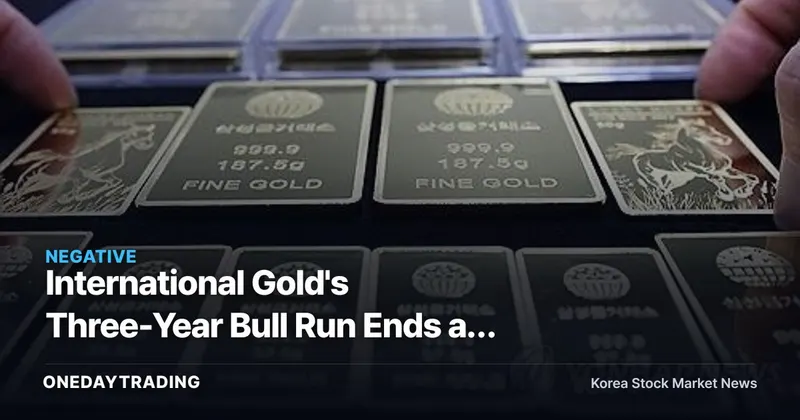
Gold's three-year bull run has hit the brakes. On the 24th (local time), international gold prices fell roughly 3% in a single day, giving up the $4,000-an-ounce level. Whether this is a simple correction or a genuine trend reversal will hinge on the Fed's monetary policy path and the direction of the dollar. Now is the time to also examine supply-demand (order flow) shifts in gold-sensitive precious-metals refining and resource stocks, as well as in areas that had attracted capital on safe-haven demand.
What Happened
The immediate trigger for this decline was renewed speculation about further rate hikes by the U.S. Federal Reserve, along with the resulting dollar strength. Gold is a non-yielding asset, so when real interest rates rise, the opportunity cost of holding it increases. As rate-hike expectations revive, interest-bearing assets like bonds and deposits become relatively more attractive, weakening the investment case for gold, which pays no interest.
Dollar strength is also a structural headwind for gold. Because international gold prices are quoted in dollars, a stronger dollar makes gold more expensive for investors in other currencies, curbing demand and putting downward pressure on prices. With rate-hike expectations and dollar strength working in tandem, it appears that accumulated profit-taking was also unleashed all at once.
Background and Context
Over the past three years, gold rallied sharply on the back of geopolitical instability, central bank buying, and inflation-hedge demand, breaking above $4,000 an ounce. Assets that have climbed to such levels in a short period tend to see amplified volatility when macro variables shift from favorable to unfavorable. This sharp drop (plunge) is best understood not as a sign of deteriorating fundamentals, but largely as a process of unwinding positions that had become excessively one-sided, triggered by shifting signals on rates and the dollar.
Impact on the Market and Individual Stocks
- Korea Zinc: Because its business model involves refining and selling precious metals such as gold and silver alongside base metals, falling precious-metals prices weigh on related revenue and margins. That said, zinc and lead account for a large share of its business, so it is hard to attribute earnings solely to the gold price variable.
- LS: Through subsidiaries such as LS MnM, the company has exposure to base- and precious-metals refining, making it sensitive to metal price cycles.
- Gold-related ETFs and gold-banking demand: Retail and institutional investors who had put money into gold as a safe-haven asset could face larger unrealized losses and redemption pressure.
- Financial stocks such as banks and brokerages: Stronger rate-hike expectations could be favorable from a lending-deposit margin perspective, raising the possibility of gains moving in the opposite direction from gold.
- Large-cap exporters: Dollar strength tends to translate into a weaker won, which can work in favor of exporters' price competitiveness.
Investor Checkpoints
- Watch Fed officials' remarks, the next FOMC meeting, and the rate path implied by the dot plot. If rate-hike expectations recede, gold could gain room to rebound.
- Track the U.S. Dollar Index and the won-dollar exchange rate level. Whether dollar strength cools off is the first signal of a bottom in gold prices.
- Monitor whether central banks continue buying gold and watch gold ETF fund flows to gauge the direction of physical and investment demand.
- For companies with precious-metals exposure, check quarterly earnings to see how metal selling prices and refining margins are reflected.
Outlook
On an optimistic view, this decline could be a healthy correction within an overheated bull market. If geopolitical risks resurface or rate-hike expectations fade, gold has room to recover its safe-haven demand. Conversely, if the Fed hardens its hawkish stance and dollar strength persists, a recovery above $4,000 could be delayed and downside volatility could increase further. Rather than focusing on short-term price direction, it is more reasonable to respond based on shifts in the two key drivers: real interest rates and the dollar.
Korea Zinc: A Real-Time Data Snapshot
Korea Zinc's most recent closing price is KRW 1,098,000 (0.00% vs. the previous day), and the composite signal combining foreign investors/institutional investors order flow with news and momentum is 🟢 Net-Buy Bias. With foreign investors, institutional investors, and news all positive, this stock (ticker) is worth watching.
- ▲ Supply-demand (order flow) continuity — foreign investors have been net buyers for 5 straight days (+KRW 1.3 billion)
- ▲ Dual buying — foreign investors +KRW 1.3 billion and institutional investors +KRW 300 million buying together
- ▼ Trend alignment — short- and medium-term downtrend alignment (today +0.0% · 1 week -12.9% · 1 month -23.2%)
Recent related news shows 2 positive catalysts and 0 negative catalysts, a favorable mix.
※ Price and foreign/institutional order flow data are provided by Korea Investment & Securities (KIS), as of the time of publication.
This article is automatically summarized and analyzed content based on the original news report. View Original (Yonhap News Agency, Securities)