
At a Glance
Saab's successful first flight of the Gripen F means Brazil's fighter program has moved beyond simple delivery and into the phase of validating training and weapons integration. For Korean investors, the key question is how KAI's FA-50 and KF-21, LIG Nex1's guided weapons, and Hanwha Aerospace's aero-engine and defense value chain will be compared on price and performance in the same export market.
The Gripen F is the two-seat fighter Saab of Sweden is supplying to the Brazilian Air Force. A two-seat aircraft is seen not just as a pilot-training platform, but as equipment that shows the completeness of an export package in dual-seat operations, conversion training, and mission-systems validation.
Why It Matters Now
The defense cycle can sometimes react more sharply to a single test flight than to a signed contract. A first flight does not immediately guarantee mass-production volumes, but it is a gateway for confirming whether the configuration and operating concept demanded by the customer air force have been transferred to the actual aircraft.
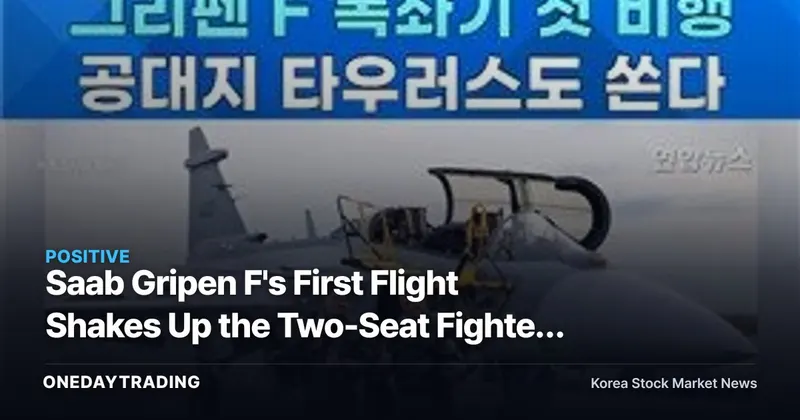
According to Yonhap News Industry coverage, Saab successfully carried out the test flight of the Gripen F two-seat fighter for delivery to the Brazilian Air Force. The same report also said the Taurus separation test was a success. In fighter exports, a separation test verifies whether a missile can safely detach from the aircraft and then move on to the launch and guidance phase.
The message this news sends to Korean defense stocks is simple. Export competition does not end with aircraft performance alone. To win follow-on orders, companies must be able to bundle training systems, weapons integration, and localization requirements for the customer country. If Gripen F validation continues, Saab's negotiating power could rise in next-generation light fighter and multirole fighter bids across Latin America, Europe, and Asia.
Key Points
- What the two-seat model means: The first flight of the Gripen F for the Brazilian Air Force is an event that confirms pilot conversion training and operational scalability. Compared with selling a single-seat fighter, it is closer to a package competition focused on lowering the customer country's fielding costs.
- Taurus separation test: The successful Taurus weapon separation test is part of attaching a long-range precision-strike option to the fighter platform. The more weapons are integrated, the stronger the aircraft maker's customer lock-in becomes.
- Comparison points for Korean companies: KAI is affected in aircraft exports, LIG Nex1 in guided weapons, and Hanwha Aerospace in the aerospace and ground-defense chain. Saab's progress is not a direct revenue positive catalyst, but a signal of rising competition intensity.
- Timing of orders: A successful test does not immediately turn into an order backlog. Customer-country evaluation, budget allocation, and mass-production schedules still have to be confirmed before they flow through to utilization and margins.
Impact on Related Stocks and Sectors
- KAI: In the aerospace defense export race led by the FA-50 and KF-21, Saab's Gripen family is a benchmark. If customer countries place more weight on two-seat training variants and weapons integration, KAI will need to prove package competitiveness rather than just aircraft pricing.
- LIG Nex1: The successful Taurus separation test signals that the integrated value of fighter jets and long-range guided weapons has increased. Exports of Korean air-to-ground and air-to-air weapons move together with platform adoption.
- Hanwha Aerospace: If global defense procurement increasingly evaluates aerospace platforms and ground weapons systems together, the room for negotiation widens for the engine, parts, and systems businesses. However, Saab's delivery progress should be seen not as a standalone positive catalyst for Korean companies, but as a sign of intensifying competition in defense tenders.
- Defense ETFs and the aerospace sector: News on fighter test flights and weapons validation can jolt supply-demand (order flow) in defense themes. However, theme buying can end in volatility if there are no actual contract announcements and delivery schedules.
Investment Notes
- Confirm actual orders: A successful test flight and revenue recognition are different events. In the next quarter's defense-company earnings, investors should separate new orders, backlog, and delivery-schedule changes.
- Starting point for margins: In aerospace defense, development and integration costs come first, and profit improves when production volumes build up. If customer-specific weapons integration expands, near-term costs can rise as well.
- Policy and budget variable: Defense contracts backed by national budgets, such as the Brazilian Air Force supply program, are affected by political and fiscal timetables. If budgets are delayed, deliveries and cash flow slip.
- Valuation pressure: Korean defense stocks are already in a range where export expectations are largely priced in. If new orders fall short of stock-price expectations, multiple compression can come first.
Overall View
The Gripen F's first flight and the successful Taurus separation test mean Saab has reduced technical risk by one step in the Brazilian Air Force project. The message for Korean defense stocks is twofold. Global demand for fighters and guided weapons remains alive, but customer countries now want completeness that bundles training variants, weapons, maintenance, and localization rather than an airframe alone.
The bullish scenario is one in which Korean companies use their FA-50 export experience and KF-21 development reference to lift package competitiveness. On the other hand, if competitors like Saab quickly accumulate test-flight and weapons-integration achievements, price competitiveness alone will not be enough in the next tender. Key indicators to watch are KAI's new aircraft order announcements, LIG Nex1's guided-weapon export contracts, and Hanwha Aerospace's order backlog in its aerospace and defense divisions.
Frequently Asked Questions
Why is the first flight of Saab's Gripen F important?
The first flight of Saab's Gripen F means the two-seat fighter for delivery to the Brazilian Air Force has entered the real flight-validation stage. In fighter exports, the two-seat model handles pilot training and mission transition, making it a core part of the customer country's operating system.
What does the successful Taurus separation test mean?
The successful Taurus separation test confirms whether a long-range strike weapon can safely separate from the fighter. If that validation continues, the fighter platform gains more weapon options, and for the customer country it becomes closer to securing operational capability than simply buying an aircraft.
Is this a positive catalyst or a negative catalyst for Korean defense stocks?
For Korean defense stocks, there is both the positive catalyst of confirming medium- to long-term demand and the burden of intensified competition. KAI, LIG Nex1, and Hanwha Aerospace are potential beneficiaries of the expanding export market, but the actual stock direction will strengthen if new orders and delivery schedules beat expectations, and come under correction pressure if they fall short.
Korea Aerospace Industries Key MetricsAs of 2026-08-30
| Period return | 1 week +2.38% 1 month +13.28% |
|---|---|
| Trading value · trading volume | 31.8 billion won · 237,790 shares |
| Supply-demand (order flow) | Foreign investors −6 billion won net selling Institutional investors −2.9 billion won net selling |
Price and supply-demand data are real-time values from Korea Investment & Securities (KIS), and the supply-demand and news-tone aggregation is OneDayTrading's own calculation.
Supply-demand · Momentum Assessment🔴 Caution
Foreign investors, institutional investors, and momentum are negative, so caution is needed for now.
- ▼Dual sellingForeign investors −6 billion won · institutional investors −2.9 billion won selling together
Upcoming Events to Watch
- 09.10Futures and options simultaneous expirationMediumQuadruple witching — watch for volatility and supply-demand (order flow) disruption
- 09.16FOMC policy rate decisionHighU.S. Federal Reserve monetary policy announcement — rate and dollar direction
- 10.08Index options expirationLowKOSPI200 options expiration
- 10.22Bank of Korea Monetary Policy BoardHighbenchmark interest rate decision meeting
This article is automatically summarized and analyzed based on the original news report. View original (Yonhap News Industry)