
Key Takeaways
McDonald's discontinuation of its Chungju Waxy Corn Cheese Croquette Burger is more than the simple end of a limited-time item. The Taste of Korea project has built brand equity through cumulative sales of 30 million units and the use of 1,000 tons of domestic agricultural produce, so this foreign-object complaint hits trust costs before it hits revenue.
In consumer goods, a quality incident damages repeat-purchase rates and campaign continuity more than any single quarter's earnings. For Korean investors, the point to watch is not McDonald's alone but the quality-control premium across the restaurant and food industry more broadly wherever local-ingredient marketing is used.
What Happened
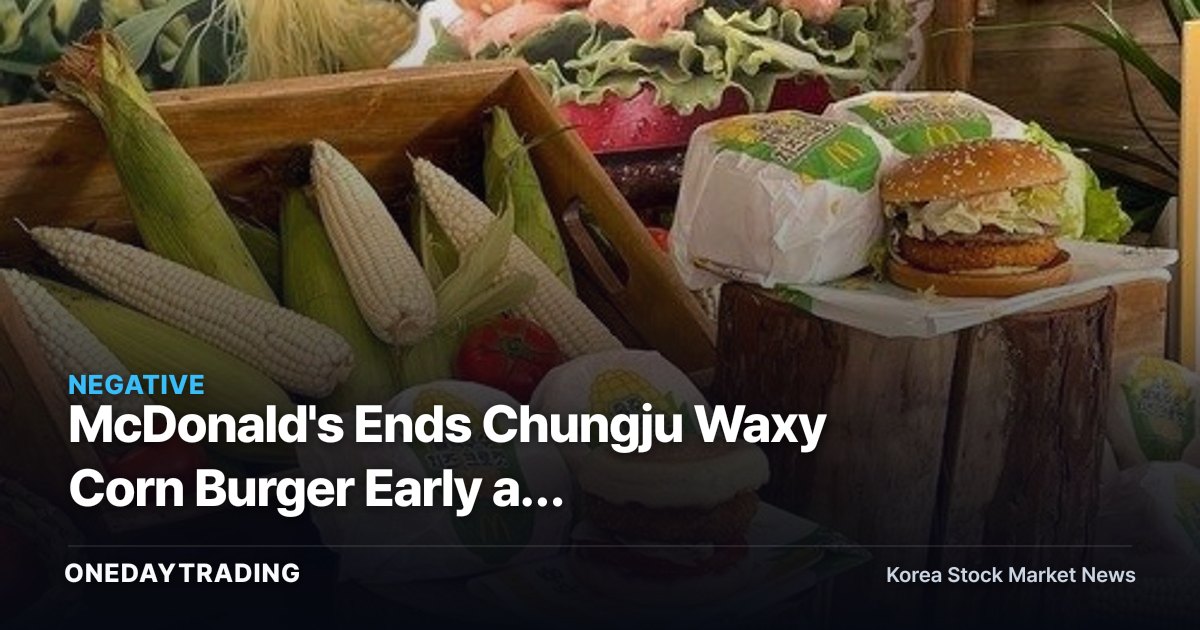
McDonald's Korea ended sales of its Chungju Waxy Corn Cheese Croquette Burger early after a string of consumer complaints about biting into stones in the product. The item was a limited-time menu that launched nationwide on July 9, a new product line featuring a cheese croquette made with waxy corn from Chungju, offered in both burger and muffin formats.
The menu item is the sixth product in McDonald's Korea's Taste of Korea project, which the company has run since 2021. Earlier installments of the project, which turn regional agricultural products into menu items, have surpassed 30 million units in cumulative sales and are reported to have used around 1,000 tons of domestic produce. This year, about 25 tons of Chungju waxy corn were secured as the raw material for the limited-run item.
The problem is that the scarcity value of a limited edition couldn't offset quality risk. Consumers may be forgiving of a new menu item's unusual texture, but they are not forgiving of the possibility of foreign objects. This is especially true for a product like a croquette, which mixes corn kernels, batter, and cheese — the more processing and raw-material sorting steps involved, the more control points there are that can fail.
Background and Context
The reason restaurant chains lead with regional agricultural products is clear. Price competition alone makes it hard to differentiate in the burger market, and local ingredients let a single menu name generate a story and search demand. A place-based keyword like Chungju waxy corn provides the rationale for a premium on a product priced at 7,900 won as a single item and 9,400 won as a set.
That said, local sourcing carries more variables than conventional raw-material procurement. As the chain of steps — purchasing at the source, pre-processing, freezing or further processing, and in-store cooking — lengthens, so does the cost of reducing quality variance. The key question here is not the number of complaints itself but whether the foreign-object risk consumers perceive spreads into a broader perception about the brand's safety.
Market and Stock (Ticker) Impact
- McDonald's: Korea operations likely make up only a limited share of global earnings, but reputational damage to a local-menu campaign weighs on brand trust more than on short-term revenue. Limited-time items are a tool for lifting average ticket size and visit frequency, and an early discontinuation cuts that effect short.
- Restaurant franchises: Companies that launch menu items in collaboration with regional agricultural producers now operate in an environment where they must explain their sorting and inspection systems before they can tell the raw-material story. The faster the pace of new product launches, the greater the expected cost of a quality incident.
- Food processing and raw-material supply chains: In the process of turning agricultural products into croquettes, sauces, and toppings rather than using them directly in a menu item, foreign-object sorting equipment and supplier management become sources of competitive advantage. Costs rise, but reducing incidents improves the stability of supply to large customers.
- Local co-prosperity marketing: A campaign that puts a place name front and center, as with Chungju waxy corn, benefits both farmers and the brand when it succeeds. Conversely, when a quality issue arises, the region's name is exposed along with it, raising the psychological barrier for the next collaboration.
Investor Checkpoints
- Watch how specifically McDonald's discloses its cause investigation, refund process, and prevention measures after ending sales. Consumer-goods stock (ticker) prices tend to react more to the speed and transparency of the response than to the incident itself.
- Watch whether the next Taste of Korea project launches on schedule. A delay in launch timing could signal that internal quality-inspection costs and approval procedures have been tightened.
- When assessing new-product marketing at domestic restaurant and food stock (ticker)s, it's worth checking raw-material procurement volumes, processing partners, and any history of recalls or discontinuations alongside the marketing itself. Buzz generates revenue, but a quality incident erases margin.
- How far consumer complaints spread across social media and portal search volume is another checkpoint. If the search-volume spike is temporary, the earnings impact should be limited; if it lingers as a brand-safety issue, discount and coupon costs may follow.
Outlook
In the optimistic scenario, the swift discontinuation and root-cause investigation contain the issue as a quality problem confined to a single limited-time item. In this case, McDonald's can keep the Taste of Korea project running while limiting brand damage by tightening its sorting and inspection procedures.
The risk runs the other way. If the perception hardens that complaints about biting into stones were a recurring problem, consumers will come to see local-ingredient menus as a source of uncertainty rather than freshness. In consumer goods, what the market buys is not the co-prosperity language in a press release but the repeated experience of safety at the counter. The next thing to watch is McDonald's official follow-up measures and whether its next regional-ingredient menu item launches at all.
This article is automatically summarized and analyzed content based on the original news report. View original (Yonhap News, Industry)