
Key Takeaways
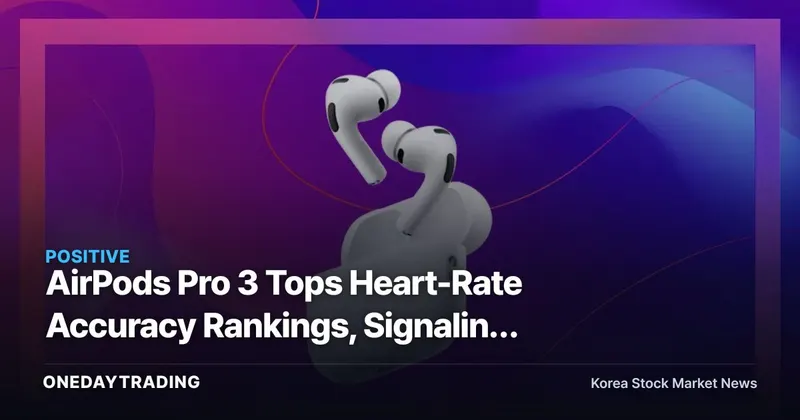
Comparison results have emerged showing that Apple's AirPods Pro 3 have surpassed professional sports watches and the latest smartwatches in heart-rate measurement accuracy. This is not merely the addition of a new feature, but a signal of structural change—health-tracking functions that had been tied to the wrist are now migrating to earbuds. For Apple, it is a card that strengthens device-to-device lock-in, while for the competing smartwatch camp, it becomes a pressure point that weakens differentiation.
What Happened
Apple's next-generation wireless earbuds, the AirPods Pro 3, are equipped with a sensor that measures heart rate from the ear, and assessments have found that they outperformed professional sports watches and major smartwatches in accuracy comparisons. The fact that blood flow inside the ear offers a more stable measurement environment than the wrist is cited as the reason behind this accuracy advantage.
The key point is the shift in measurement location. Until now, photoplethysmography (PPG)-based heart-rate tracking had been a signature feature of smartwatches, but as earbuds now deliver this at a comparable or even higher level, the center of gravity for collecting exercise and health data could shift.
Some go so far as to interpret this as wireless earbuds being able to replace part of smartwatch demand. That said, with watch-exclusive functions such as the display, calling, and payments still remaining, it is closer to a distribution of functions than a complete replacement.
Background and Context
Apple has been strengthening a strategy that bundles the watch, earbuds, and tablet around the iPhone to consolidate health data in one place. Distributing health functions across multiple devices makes it harder for users to leave the Apple ecosystem, while simultaneously lifting both the replacement cycle and the average spend per device.
The wearable health market is in a phase of structural growth driven by a rising number of people exercising and by population aging. As sensor accuracy emerges as a core purchasing criterion, the gap is widening between camps that have secured precision-measurement technology and those that have not.
Impact on the Market and Stocks
- Apple: By bringing earbuds too into the fold as a health hub, it strengthens ecosystem lock-in and the connection to services (fitness and health subscriptions). Hardware differentiation could lead to a path of expanding service revenue.
- LG Innotek: As a key Apple component supplier, it could benefit if demand for optical and sensor modules expands. However, the actual scale of the benefit hinges on whether it supplies the components in question and on their unit prices.
- Samsung Electronics: It occupies a dual position—competing in the same market with the Galaxy Watch and Buds while also supplying components to Apple. Intensifying competition in health sensors is both a burden and an incentive for technology investment.
- Garmin and other professional sports-watch players: If their core marketing point of accuracy superiority is shaken, defending premium pricing could become difficult.
Investor Checkpoints
- In Apple's next-quarter earnings, watch both the revenue growth rate of the Wearables, Home and Accessories segment and the growth momentum of services revenue.
- For domestic component stocks, monitor the share of Apple-bound revenue and the flow of disclosures and order wins related to new component adoption.
- Compare, with quarterly data, smartwatch shipment trends and whether the expansion of earbuds' health functions is eroding watch demand.
- Whether the scope of medical-device certification expands—if it extends beyond heart rate to blood pressure, body temperature, and the like, regulatory and certification timelines become a variable.
Outlook
The optimistic scenario is a picture in which health functions expand into earbuds, strengthening connectivity across Apple devices, and suppliers providing sensors and modules benefit from rising volumes. Conversely, Apple's hardware revenue already has high expectations priced into the stock, posing a valuation burden, and the use of health data comes with the uncertainty of personal-data and medical regulation. Component stocks, too, must be viewed with the understanding that the higher their dependence on a single customer, the more exposed they are to unit-price cuts and order fluctuations.
This article is content automatically summarized and analyzed based on the original news report. View original (Maeil Business Newspaper, Corporate)