
What Kpler’s 60% Figure Signals for Oil Prices
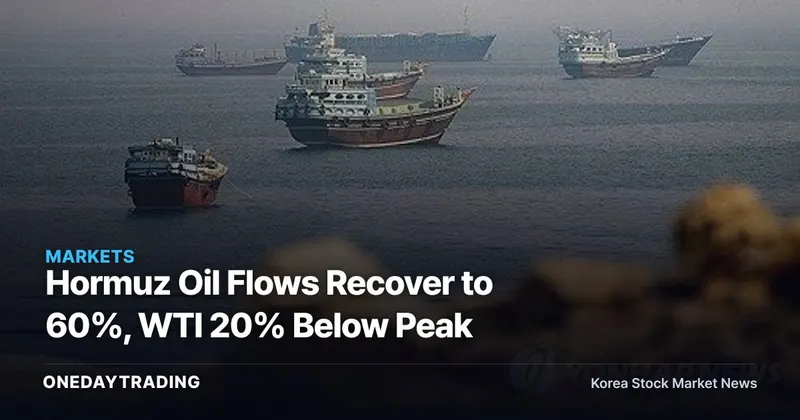
Kpler recorded an average of 9.36 million barrels of crude oil per day passing through the Strait of Hormuz this month. Reported by Yonhap News Agency on September 28, 2026, the figure does not mean the supply route has fully normalized. Instead, it shows that blockade risk and actual crude flows are moving differently. For Korean investors, the key question is not simply whether the strait is blockaded, but how much of its actual throughput has been restored.
Kpler’s data showed that this month’s average daily volume increased by 3.56 million barrels from August, reaching 60% of the 15 million barrels per day recorded before the U.S.-Iran military conflict. The implication is clear: although concerns about supply disruptions remain, the amount of crude reaching the market has recovered to its highest level since the conflict began.
The Gap Between Hormuz Crude Flows and WTI Prices
West Texas Intermediate (WTI) futures traded at $91–$95 per barrel on September 25, 2026. Yonhap News Agency cited a post-conflict peak of around $119 per barrel, putting prices on that trading day 20% below the high. The recovery in transit volumes therefore coincided with WTI trading below its peak.
Separating what has been confirmed from what has not makes the picture clearer. The recovery in crude flows is supported by data, but no end date for the blockade of the Strait of Hormuz has been confirmed. Oil prices have therefore already reflected recovering transit volumes, while the timing of when shipping-route risks will end must still be assessed separately.
IMO Rules and AIS Blind Spots
AIS is an automatic identification system through which ships transmit their location. The International Maritime Organization (IMO) requires tankers on international routes to keep AIS active and broadcast their positions, but permits the system to be switched off as an emergency measure when safety is threatened.
This exception creates a measurement limitation when interpreting transit volumes. The data does not show the exact number of tankers that passed through the Strait of Hormuz with AIS switched off. Because actual voyages may differ from observable voyages, it is too early to conclude from a single estimate that the shipping route has normalized.
What Aramco’s Spot Tender Reveals About Supply Routes
According to Argus Media, Saudi state-owned company Aramco has launched a spot tender for crude deliveries from September through November, with cargoes to be transferred offshore Oman. The confirmed details extend only to the delivery period and transfer method. Volumes and prices were not disclosed in the available information.
Before the U.S.-Iran military conflict, 90% or more of Iraq’s crude exports depended on the Strait of Hormuz. Changes in transit volumes are clearly relevant to Iraqi crude exports, but no figures were provided for the additional volumes transported separately by Saudi Arabia and Iraq. That leaves insufficient evidence to estimate each country’s contribution.
Price Signals for Refining and Shipping Investors
- Crude oil prices: Investors should consider both WTI’s decline from its post-conflict peak of around $119 per barrel and the recovery in Hormuz transit volumes. Declaring supply risk over based on either indicator alone would overlook the gap between prices and physical volumes.
- Refining and energy: Investment decisions should begin with actual crude inflows rather than references to a blockade. If transit volumes hold at current levels, the case for a recovering supply route will strengthen. If they fall again, the outlook will change.
- Shipping: The lack of precise data on AIS-dark voyages makes shipping-route risk difficult to quantify. Unobserved voyages should not be treated as evidence that safety has been restored.
- Individual companies: Because the volume and pricing of Aramco’s spot tender remain unknown, there is not yet enough evidence to connect it to any specific company’s revenue or margins.
Key Hormuz Variables to Watch Next
- Check whether crude flows through the Strait of Hormuz remain at an average of 9.36 million barrels per day.
- Watch whether the gap versus the pre-conflict average of 15 million barrels per day narrows further.
- Compare whether WTI futures move outside the $91–$95-per-barrel range and whether transit volumes move in the same direction.
- Monitor whether volumes and pricing are disclosed for Aramco’s spot tender covering September–November deliveries.
A Crossroads Between Sustained Recovery and Renewed Contraction
The optimistic scenario is that the recovery in Hormuz transit volumes continues. In that case, the market could reassess supply concerns based on whether physical crude flows continue closing the gap with pre-conflict levels. WTI’s retreat from around $119 per barrel should also be evaluated alongside transit volumes.
The trigger for the opposing scenario would be a decline in transit volumes. If reported crude flows fall while the number of tankers operating with AIS switched off remains unclear, the case for a recovering supply route would weaken. The next assessment will depend not on a declaration that the blockade has ended, but on whether Kpler’s actual transit data, WTI prices, and Aramco’s tender terms all point in the same direction.
WTI Crude Oil MetricsAs of 2026-09-28
| Performance | 1 Week -6.47% 1 Month +14.08% |
|---|
Index, commodity, and exchange rate data are based on global markets and reflect values at the time of publication.
This article was automatically summarized and analyzed based on the original news report. View the original article (Yonhap News Securities)