
From an investor's standpoint, the question these figures raise is not simply whether the security budget is large or small. At a platform company like Kakao, which bundles messaging, finance, and commerce under a single account, information security spending is effectively the cost of user lock-in and data trust. The fact that the absolute amount rose while its share of total IT spending fell shows that Kakao's resource-allocation priorities are shifting rapidly from security defense to a bet on AI-driven growth. Given that the company already weathered a crisis of trust after its 2022 data-center fire, this shift in allocation is a factor that should be priced in as a trade-off between growth potential and stability.
Three-Line Briefing
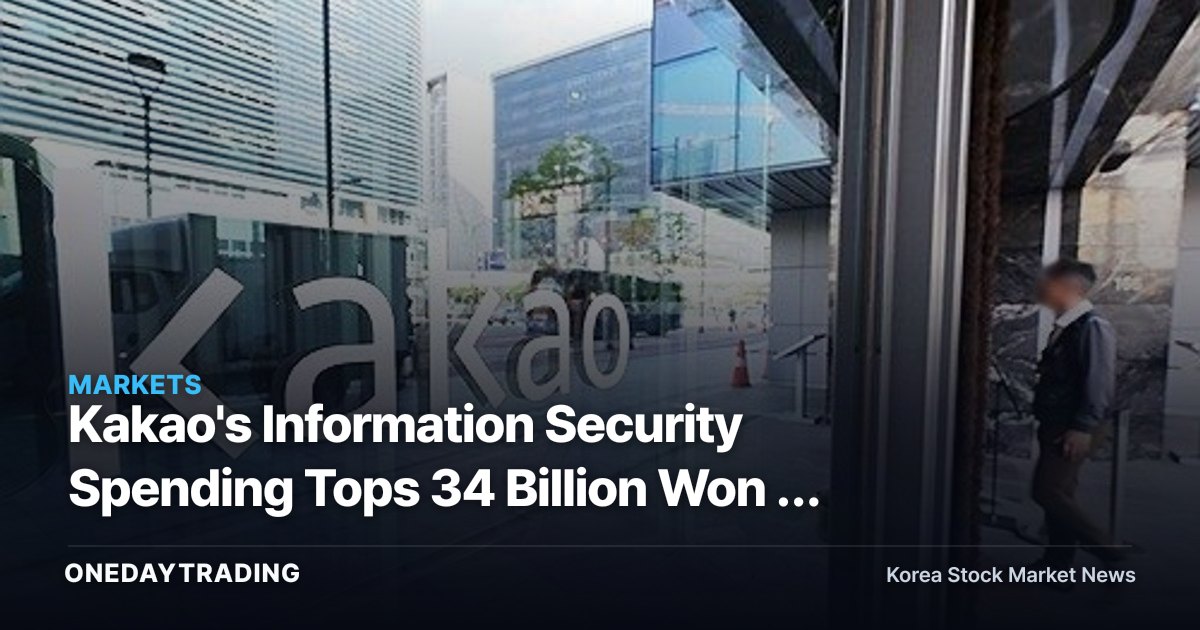
- Kakao's information security spending last year exceeded 34 billion won, so the absolute scale increased.
- Yet security's share of total IT and technology investment actually retreated.
- Behind this lies a reshuffling of investment priorities centered on AI.
What's Changing
The key is not the amount but the change in allocation structure. Looking only at the rise in security spending, the headline figure improved — but as the IT investment pie itself swelled with AI infrastructure, model training, and data costs, security's relative slice within it shrank. In other words, one can read this as Kakao scaling up its offensive AI investment faster than it is increasing its defensive spending.
This change matters because of Kakao's business model. A single KakaoTalk account ties together KakaoPay payments, Kakao Bank integration, and gift-giving and shopping payment information, so the fallout from a single security incident does not stay confined to one service. The more deeply AI features are embedded into the messenger, the broader the scope of personal data being processed and trained on — and the fact that security's share is slipping at precisely the moment it should be rising creates structural tension.
By the Numbers and in Context
An absolute figure of 34 billion won is by no means small among domestic platform companies. But the metric investors should watch is not the raw amount; it is the trend line of security's share relative to revenue and IT spending. A one-year retreat in that share does not in itself signal an imminent incident, but the point to watch is whether a pattern of relatively weakened defensive investment becomes entrenched during a period of AI-service expansion.
Beneficiary and Affected Stocks
- Kakao: Expanding AI investment is a medium- to long-term growth driver, but if the decline in security's share recurs, it could come back as regulatory and trust costs — making it double-edged.
- KakaoPay / Kakao Bank: The more an affiliate handles financial data, the more sensitive it is to changes in the parent company's security policy. In the event of an incident, licensing and supervisory risk transfers directly.
- Naver: As a peer platform, how it balances AI and security investment becomes a benchmark for comparison. A relatively strong security reputation could become a differentiator in user trust.
- Information security solution providers: The more platforms adopt AI, the greater the demand for data and access controls — a structural demand driver for security outsourcing and solution suppliers.
Risk Check
- Whether the decline in security's share is a one-off or a trend is hard to determine from a single year's figures alone.
- There is a significant lag before expanded AI investment translates into actual monetization, and in the meantime the cost burden weighs on margins.
- If oversight and sanctions by regulators such as the Personal Information Protection Commission intensify, underinvestment in security turns into a direct penalty.
- Platform trust carries an asymmetric risk: it is shaken far more by a single incident than by quantitative earnings.
Bottom Line in One Sentence
The shift of resources toward AI strengthens Kakao's growth narrative, but if the decline in security's share accumulates, it could come back as a cost that erodes the intangible asset of trust — so it is worth monitoring next quarter's information security disclosures alongside regulatory developments.
Kakao Through Real-Time Data
Kakao's latest closing price is 37,750 won (−3.94% from the previous day), and the signal light combining foreign and institutional order flow with news and momentum is 🔴 Caution. With foreign investors, institutional investors, and momentum all negative, caution is warranted right now.
- ▼ Dual selling — foreign investors −10 billion won and institutional investors −9.8 billion won selling in tandem
- ▼ Trend alignment — short- and medium-term downward alignment (today -3.9% · 1 week -9.0% · 1 month -9.3%)
- ▼ 52-week position — near the 52-week low at 4%
Recent related news breaks down as 5 positive catalysts · 4 negative catalysts, a favorable balance.
※ Price and foreign/institutional order-flow data are provided by Korea Investment & Securities (KIS), as of the time of publication.
This article is content automatically summarized and analyzed based on the original news report. View original (Yonhap News Securities)