
Summary
South Korea and Azerbaijan discussed expanding economic cooperation and supporting Korean companies' local market entry through a vice-ministerial-level policy consultation. A strengthened bridging role at the government level could improve new market access for construction, plant, and energy infrastructure companies. However, if this remains a one-off diplomatic consultation, uncertainty and lag before it translates into actual contract wins will persist.
What Happened
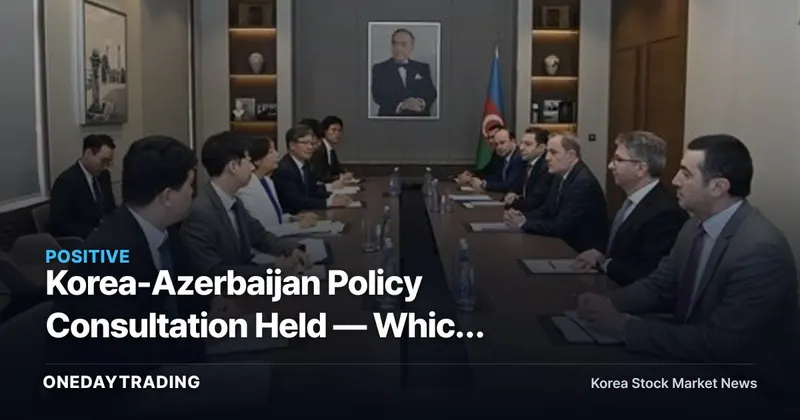
The Ministry of Foreign Affairs announced that Vice Minister Jeong Eui-hye held the 5th Korea-Azerbaijan policy consultation with Azerbaijani Deputy Foreign Minister Elnur Mammadov in Baku, Azerbaijan on the 17th. Both sides reviewed the overall state of cooperation across political, economic, and cultural affairs, with the Korean side requesting that the Azerbaijani government provide administrative support and institutional convenience for Korean companies that have entered or are seeking to enter the local market.
This consultation is part of regular dialogue through diplomatic channels, and no specific contracts or investment amounts were announced at the meeting. Still, the fact that support for corporate market entry was explicitly raised in intergovernmental talks is seen as a signal laying the groundwork for future discussion of bilateral cooperation projects in infrastructure and resources.
Structural Background
Azerbaijan is a Caspian Sea oil-producing nation with heavy reliance on oil and gas exports, and has recently been expanding its investment scope into renewable energy, transportation infrastructure, and urban development in line with decarbonization trends. This transitional phase creates order-win opportunities for foreign construction and engineering companies in areas such as power plants, refining and petrochemical facilities, and roads, ports, and smart cities.
Korean construction companies have built up a track record of contract wins in the Middle East and Central Asia, and there have been numerous cases where government-level summit and high-level diplomacy had a tangible impact on building trust with project owners. This is why the policy consultation can be interpreted as preliminary groundwork for improving the order environment.
Impact on Stocks and Sectors
- Hyundai Engineering & Construction, Daewoo Engineering & Construction, GS Engineering & Construction: With a high proportion of overseas infrastructure and plant contract wins, these companies stand to directly benefit from an expanded order pipeline if the order environment in emerging markets turns favorable.
- Samsung E&A (formerly Samsung Engineering), DL E&C: These companies have strengths in refining, petrochemical, and power plant EPC, aligning with resource-rich nations' facility investment cycles.
- Doosan Enerbility: As an exporter of power generation equipment and energy infrastructure, this company could see a supply channel open up if local power and renewable energy projects materialize.
- General trading companies and equipment suppliers: Serving as intermediaries for project sourcing and local networking, these companies may see indirect benefits in the early stages of cooperation.
Bullish vs. Bearish Scenarios
On the bullish side, if government diplomacy leads to actual contact with project owners, memoranda of understanding, and follow-up contract-win disclosures, momentum could build for related construction and plant stocks (tickers). Resource-rich nations' demand for infrastructure diversification provides grounds for medium- to long-term order capacity.
On the other hand, bearish and neutral views are also clear. This consultation is a regular dialogue rather than a binding contract, and given the limited size of the Azerbaijani market and Korean companies' limited exposure there, the short-term impact on individual companies' earnings could be minimal. Exchange rate and oil price fluctuations, local political and fiscal conditions, and competition for contracts with companies from rival countries (China, Turkey) are also variables to watch.
Investor Action Points
- Check construction and plant companies' new overseas contract-win disclosures and quarterly order backlog trends to confirm whether the diplomatic consultation translates into actual contracts.
- Track follow-up reports on MOUs related to Azerbaijan and Central Asia, or the dispatch of joint government contract-support delegations.
- Watch oil prices and international energy price trends alongside this, as resource-rich nations' fiscal capacity determines the scale of infrastructure orders.
- Rather than overreacting to a single diplomatic event, judge based on the company's overall order pipeline and valuation burden.
Hyundai Engineering & Construction in Real-Time Data
Hyundai Engineering & Construction's most recent closing price was 134,500 won (-3.45% from the previous day), and the signal combining foreign investor/institutional investor supply-demand (order flow) with news and momentum is 🟡 neutral, wait-and-see. With positive and negative signals mixed, this is a stock (ticker) to watch.
- ▲ News flow — positive catalyst 3 vs. negative catalyst 0 — positive catalyst dominant
Recent related news shows 3 positive catalyst items versus 0 negative catalyst items, a favorable balance.
※ Price and foreign/institutional investor supply-demand (order flow) data is provided by Korea Investment & Securities (KIS), as of the time of publication.
This article was automatically summarized and analyzed based on the original news source. View original (Yonhap News)