
3-Line Briefing
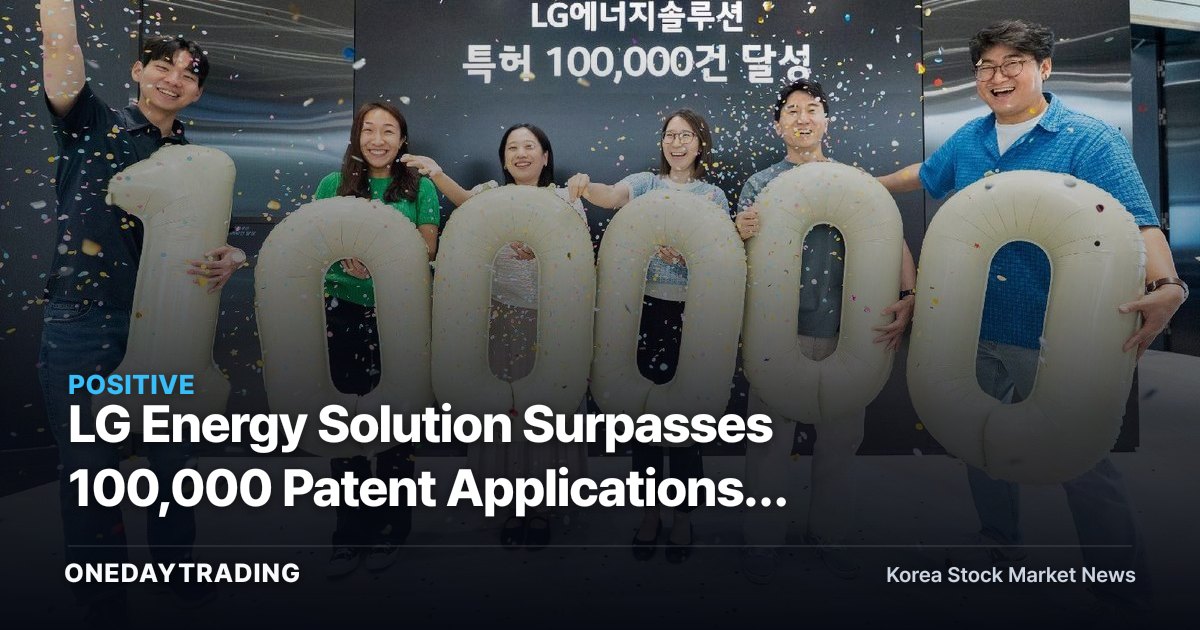
- LG Energy Solution has surpassed 100,000 global patent applications and 59,000 grants, marking a milestone in quantitative technology assets as the first company in the battery industry to do so.
- The key from an investment standpoint is that patents are intangible assets that translate not into short-term earnings but into medium-to-long-term entry barriers and licensing-negotiation leverage.
- With EV demand slowing, the valuation variable is whether the company can defend profitability with technology and litigation cards rather than price competition.
What Is Changing
The essence of this announcement lies less in the numbers themselves than in the negotiating dynamics those numbers create. The battery industry is structured around rapidly falling cell unit prices, so simple capacity expansion alone makes it hard to protect margins. In this environment, a patent portfolio becomes leverage that slows latecomers' market entry and extracts settlement payments or cross-licensing deals in disputes with global automakers and rival cell makers. LG Energy Solution's accumulation of applications across all areas—cathode and anode compositions, separators, cell structures, and processes—is the work of thickening that leverage.
The change worth particular attention is the potential to diversify the revenue structure. The more cell-sales margins come under pressure, the more licensing income from held patents and dispute settlements can serve as a buffer that offsets volatility in the core business. The fact that the company has a track record of reaching settlements in past trade-secret and patent disputes with global competitors suggests these patent assets are not mere decoration but can connect to actual cash flow.
By the Numbers and Context
The scale of 59,000 grants and 100,000 applications confirms a quantitative advantage as the first such case in the peer industry. However, the point investors should distinguish is the difference between applications and grants. Of the 100,000 applications, those confirmed as actual rights—the grants—stand at around 59,000, and the value of the application count will diverge depending on future grant outcomes and the scope of rights. Moreover, since the quality of standard-essential and foundational patents surrounding core technologies—rather than the sheer volume of filings—determines the outcome of disputes, the quantitative metric is merely a starting line. The fact that the company executed its largest-ever R&D investment last year supports the view that the renewal of these assets is ongoing.
Beneficiary and Affected Stocks
- LG Energy Solution: The subject of this issue. Strengthening its technology moat and expanding licensing leverage are long-term profit-defense factors, but the short-term stock price is more sensitive to EV shipments and utilization rates.
- LG Chem: As the parent company holding a stake in LG Energy Solution, its structure reflects gains in the subsidiary's corporate value into the value of that stake.
- Samsung SDI and SK Innovation (SK On): As domestic competitors, they face relative pressure—the higher the patent entry barrier rises, the greater their burden to differentiate their own technology.
- Secondary-battery materials and equipment partners: Companies in LG Energy Solution's supply chain—cathode materials, separators, process equipment, and more—can expect a trickle-down effect from the R&D and capacity-expansion cycle, but this is tied to order volumes.
Risk Check
- Patent counts are not a metric directly linked to revenue or profit, and monetizing licenses takes time and involves dispute procedures.
- If the EV chasm (demand slowdown) and falling utilization rates persist, technology superiority may not defend short-term earnings.
- Large-scale R&D investment is double-edged, weighing on short-term profitability as a cost burden.
- Qualitative information—such as the grant-conversion rate among applications and the proportion of core patents—has not been disclosed, leaving uncertainty in valuation.
One-Line Conclusion
The 100,000 patents are a signal that quantitatively confirms LG Energy Solution's long-term competitive advantage, but in themselves they are not an earnings catalyst. Next quarter's utilization-rate and EV-shipment recovery, along with disclosures related to licensing and disputes, will be the confirming indicators that determine actual monetization.
LG Energy Solution Through Real-Time Data
LG Energy Solution's latest closing price is 404,500 won (+1.12% from the previous day), and the signal light combining foreign and institutional investor order flow with news and momentum is 🟢 Buy-Leaning. With foreign-investor, news, and momentum factors positive, the stock is worth watching.
- ▲ Order-flow continuity — Foreign investors net buyers for 6 straight days (+6.12 billion won)
- ▲ Trend alignment — Short- and medium-term upward alignment (today +1.1% · 1 week +1.1% · 1 month +1.1%)
Recent related news is favorable, with 2 positive catalysts and 0 negative catalysts.
※ Price and foreign/institutional investor order-flow data are provided by Korea Investment & Securities (KIS), as of the time of publication.
This article is content automatically summarized and analyzed based on the original news. View original (Maeil Business Newspaper, Corporate)