
At a Glance
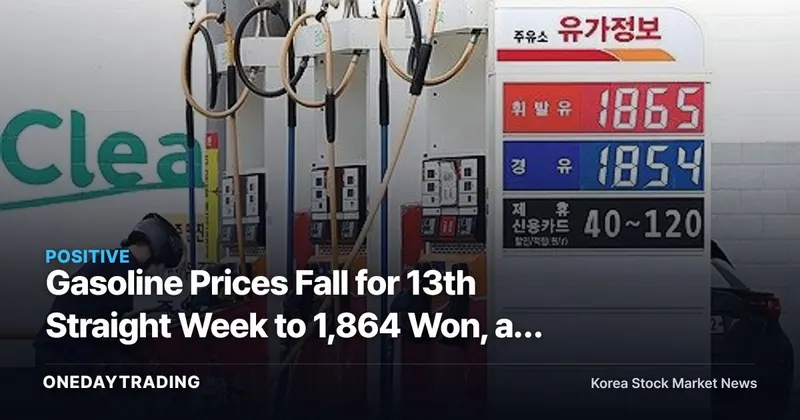
The nationwide average retail price of gasoline has declined for 13 consecutive weeks, reaching 1,864 won per liter. Diesel came in at 1,847 won, narrowing the price gap between the two fuel types to just 17 won. Weak international oil prices continue to pass through to domestic fuel prices with a time lag.
Why It Matters Now
Falling fuel prices are welcome news for consumers, but what these figures really point to is not household wallets but refiners' refining margins. Domestic filling-station prices typically track international crude and refined product prices with a two-to-three-week lag. The fact that this decline has stretched to 13 weeks suggests the current oil-price weakness is not a one-off adjustment but a trend — and the longer it persists, the greater the risk that the spread refiners earn from buying, processing, and selling crude oil (i.e., refining margins) gets squeezed as well.
Two things need to be separated here. One is a decline driven by falling international oil prices themselves; the other is a decline caused by domestic refiners failing to pass their full cost savings through to margins. In the first case, the impact on refiners' earnings could be neutral or even favorable — if costs fall faster than selling prices, margins improve. In the second case, it's a warning sign for refiner earnings. What the market currently has priced in leans toward the optimistic case — the assumption that falling oil prices have been passed through to consumer prices without eroding margins. That assumption will need to be confirmed when Korea's four major refiners report next-quarter earnings.
By contrast, the effect on consumers and the logistics/airline sectors is more clear-cut. Airlines and logistics firms, for which fuel costs make up a large share of expenses, stand to see their fuel-cost burden ease, creating room for operating profit improvement. However, this benefit only shows up in earnings if oil prices stay low for a sustained period — if prices rebound without staying down, the benefit will be short-lived.
FAQ
- Why does a 13-week consecutive decline matter? — Because it signals that this is not a short-term correction but a trending decline in international oil prices being reflected in domestic prices with a lag.
- Is falling fuel prices unconditionally good for refiners? — No. Margins only improve if the cost of crude falls faster than selling prices; if the opposite happens, refining margins can actually shrink.
- What is the impact on consumers? — Both gasoline and diesel have fallen to the mid-1,800-won range, directly easing households' fuel cost burden.
- What indicators should be watched next? — International refining margin trends, next quarter's operating profit at Korea's four major refiners, and whether Dubai crude and WTI rebound.
Related Stocks (Tickers) and Sector Impact
- S-Oil — A pure-play refiner whose earnings are directly tied to refining margins; whether falling oil prices translate into margin improvement is the key variable for its next earnings report.
- SK Innovation — Holds both refining and battery businesses, so changes in the refining segment's margins affect the overall earnings trajectory.
- GS — A holding company linked to oil-price and margin trends through its refining subsidiary, GS Caltex.
- Korean Air — Fuel costs make up a large share of expenses, making it a prime beneficiary sector (industry sector) when fuel prices fall, easing cost burdens.
- CJ Logistics — Given the logistics industry's high fuel-cost weighting, a period of falling oil prices can be expected to bring cost improvements.
Investment Considerations
- A decline in filling-station selling prices does not necessarily mean an improvement in refiners' margins — the two need to be distinguished.
- If international oil prices rebound again, the cost-improvement effect for airline and logistics stocks (stock (ticker)) could quickly reverse.
- For judging refiner stocks (tickers), it is more accurate to track refining margins (crack spreads) directly rather than oil-price levels alone.
- Seasonal demand factors (the end of peak summer demand, the shift toward heating-oil demand) are also reflected in prices, so interpreting the decline based on oil prices alone could lead to error.
Overall Outlook
The optimistic scenario is one where oil-price weakness continues while refining margins are defended. In that case, refiners' earnings (실적) could see modest improvement, while airline and logistics sectors (업종) could simultaneously enjoy cost savings. The opposite scenario is one where a slowdown in global demand drags down both oil prices and margins at once, in which case earnings expectations should be lowered not just for refiner stocks but across the entire energy value chain. The next things to watch are next month's earnings releases from Korea's four major refiners, international refining margin trends, and whether Dubai crude and WTI rebound.
S-Oil: Real-Time Data Snapshot
S-Oil's most recent closing price was 147,600 won (+4.76% from the previous session), and the signal combining foreign investors/institutional investors supply-demand (order flow) with news and momentum is 🟢 Buy-leaning. Foreign investor flows, news, and momentum are all positive, making it worth watching.
- ▲ Supply-Demand (Order Flow) Continuity — Foreign investors have been net buyers for 3 straight days (+5.2 billion won)
- ▲ Trend Alignment — Short- and medium-term uptrend alignment (+4.8% intraday · +7.3% over 1 week · +5.1% over 1 month)
Recent related news shows 1 positive catalyst and 0 negative catalysts, a favorable mix.
※ Price and foreign/institutional investor supply-demand (order flow) data are provided by Korea Investment & Securities (KIS), as of the time of publication.
This article is auto-summarized and analyzed based on original news reporting. View Original (Yonhap News Securities)