
Summary
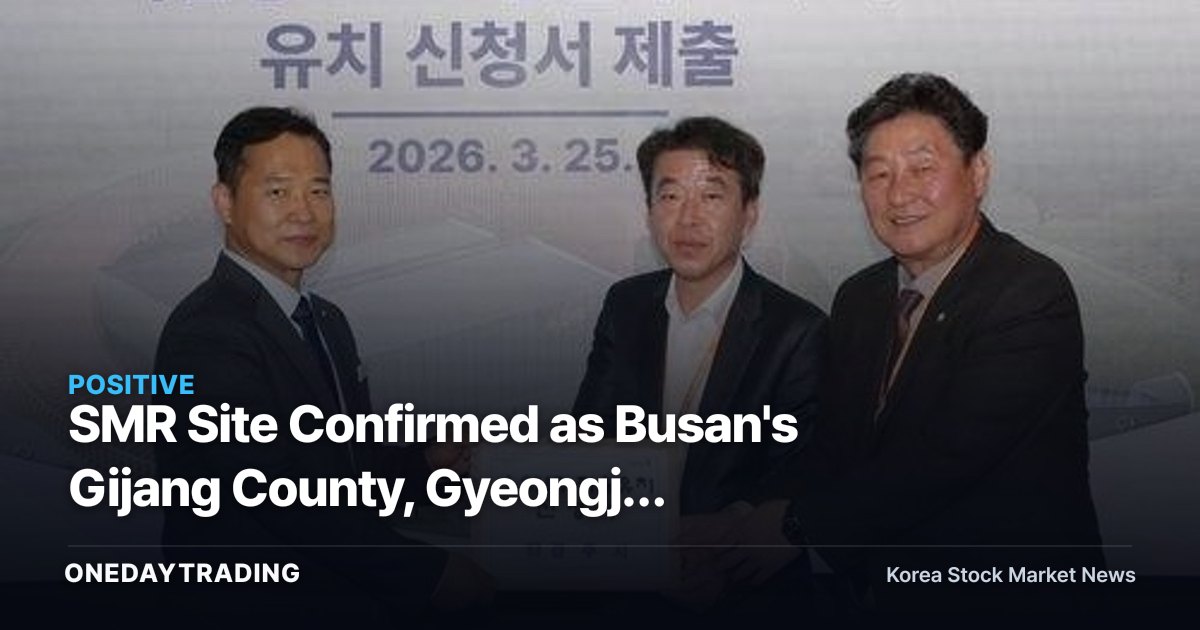
On the 17th, Korea Hydro & Nuclear Power (KHNP) selected Gijang County, Busan as the candidate site for the construction of Korea's first small modular reactor (SMR) unit, eliminating Gyeongju City, which had campaigned to host the project. Beyond the regional back-and-forth, the site confirmation marks a turning point where SMR moves from the conceptual stage to an actual construction timeline — an event that raises order visibility across the entire nuclear equipment and design value chain.
Background of the Decision
KHNP settled on Gijang County, Busan — where existing Kori nuclear power plant infrastructure is concentrated — as the first candidate site for SMR demonstration and commercialization. The location's advantages, including transmission grid access, cooling water supply, licensing experience, and a concentration of existing nuclear workforce, are seen as favorable for reducing risks in the early demonstration phase.
By contrast, Gyeongju City, which had shown strong ambition to host the project, was excluded from the first site selection despite hosting KHNP's headquarters, a low- and intermediate-level radioactive waste repository, and a nuclear power cluster — pushing back hopes for local economic revitalization. However, since SMR is not a one-unit project but is structured to expand with additional units going forward, the embers of competition for the next site selection remain alive.
Structural Background
SMRs are modular reactors with output split into smaller units, offering shorter construction periods and lower upfront investment burdens than large-scale reactors, while their factory-fabrication-and-on-site-assembly approach favors standardization and repeat production. Amid surging data center and AI power demand and the trend toward grid decentralization, SMRs have drawn attention as a next-generation carbon-free power source, with the government's abandonment of its nuclear phase-out policy and its push to restore the nuclear power ecosystem adding further policy momentum.
This site confirmation means the SMR project — which had until now remained at the design and licensing discussion stage — is entering a tangible phase that will lead to civil engineering and equipment orders. As order timing becomes more concrete, there is greater room for it to be reflected in related companies' earnings estimates.
Impact on Stocks and Industry Sector
- Doosan Enerbility: The key beneficiary stock (ticker), as it is effectively the sole domestic manufacturer of SMR main equipment (reactor modules). The site confirmation could directly lead to future main-equipment orders, raising visibility on its order pipeline.
- KEPCO E&C: A nuclear plant design specialist whose role will expand in SMR standard design and licensing processes. Demand for design services may increase as the project enters the construction phase.
- BHI and Boseong Power Technology: Nuclear auxiliary equipment and power equipment makers that stand to gain parts-supply opportunities as additional units are added.
- Woojin Entec and Woori Technology: Companies in nuclear instrumentation, control, and maintenance that could generate operation and maintenance revenue once the demonstration reactor becomes operational.
- Construction and plant contractors: Front-end demand will form once local civil engineering and construction orders in Gijang County get underway in earnest.
Bullish vs. Bearish Scenarios
The bullish case rests on a visible path from site confirmation to orders to earnings. Against a backdrop of AI-driven power shortages, if SMRs emerge as a global export item, Doosan Enerbility's main-equipment production capacity could become a structural growth driver.
The bearish risks are equally clear. A gap of several years typically exists between site selection and actual groundbreaking or revenue recognition, given the licensing, safety verification, and public acceptance processes involved. Nuclear-related stocks (tickers) have already priced in a substantial degree of anticipation, accumulating valuation burden, and disappointment-driven selling could emerge if the order timeline is delayed.
Investor Action Points
- Watch the timing and contract size of order disclosures for SMR main equipment and design as the primary trigger.
- Check Doosan Enerbility's next quarterly earnings release for changes in its nuclear-segment order backlog.
- Track the schedule for selecting additional candidate sites, including Gyeongju City, and the calendar of government energy policy announcements.
- Reassess valuations on a P/E and order-backlog basis to check whether related stocks' share prices have priced in more than the actual order substance warrants.
Doosan Enerbility: A Real-Time Data Snapshot
The most recent closing price for Doosan Enerbility is 103,200 won (-0.10% versus the previous day), and the signal combining foreign investors/institutional investors supply-demand (order flow) with news and momentum shows 🟢 Net Buying Bias. Foreign investors and news flow are positive, making it worth watching.
Recent related news shows 1 positive catalyst and 0 negative catalysts, a favorable mix.
※ Price and foreign/institutional investor supply-demand (order flow) data is provided by Korea Investment & Securities (KIS), as of the time of publication.
This article was automatically summarized and analyzed based on original news reporting. Read Original (Maeil Business Newspaper - Corporate)