
Three-Line Briefing
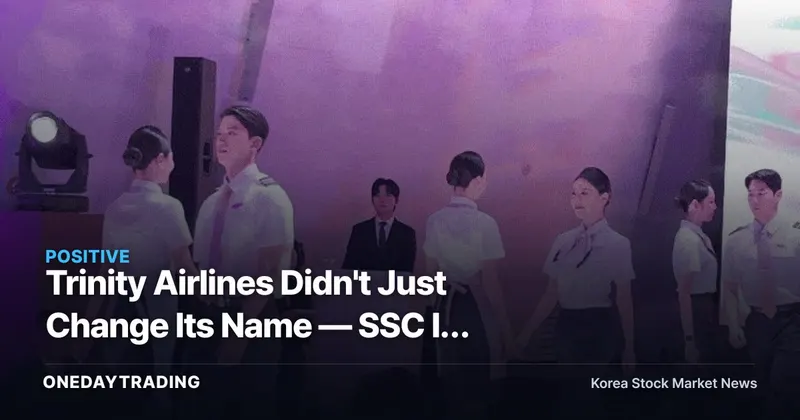
- Sono Trinity Group, which acquired T'way Air, held a brand launch event for Trinity Airlines in Seoul on the 6th, putting its new name, cabin crew uniforms, and SSC strategy front and center.
- What investors should watch isn't the signage but the cost structure. In aviation, profit is determined not by branding but by utilization rates, maintenance costs, fuel costs, and the exchange rate.
- The 136.5 billion won proprietary hangar and the tie-up with Sono's hotel and resort assets are long-term positive catalysts, but a share consolidation and rebrand alone won't immediately improve profitability.
What's Changing
Trinity Airlines' relaunch is bigger than one LCC's rebranding. It reads more like a declaration that the company is moving from a discount-fare seller to a platform-style airline bundling lodging, travel, and membership services. To put it in Lee Do-yoon's terms, the narrative is already compelling enough. What matters now is confirming the numbers — not order backlogs, but seat supply, load factor, fares, and maintenance unit costs.
The SSC strategy championed by Sono Trinity Group is a bid to move beyond the limits of selling airfare alone. Bundling airline seats with hotel and resort rooms creates room to raise package prices during peak season. Conversely, in the off-season, vacant rooms can be filled with air travel demand. The question is whether this bundling actually translates into higher booking conversion rates and higher average spend per customer. A brand launch can move a stock for a day, but operating profit is built route by route on the profit-and-loss statement.
The stock market is also watching for signs of financial normalization. According to public disclosures, Sono International has injected 330 billion won into Trinity Airlines through a paid-in capital increase and perpetual bond purchases, and the consolidated debt-to-equity ratio fell from 3,500% at the end of last year to 1,950% at the end of March this year. Emerging from capital impairment and swinging to a first-quarter profit support hopes of a bottom. Still, a debt ratio of 1,950% is a lower number — not a low one.
Numbers in Context
The core investment is proprietary maintenance infrastructure. Trinity Airlines is pushing ahead with its first company-owned hangar at Incheon Airport's advanced aviation complex, with total project costs of 136.5 billion won. The facility is reportedly sized to service five aircraft simultaneously — one roughly 350-seat Class E widebody plus four roughly 190-seat Class C narrowbody jets. The investment completion date has been pushed back to August 2028, but once finished, it could show up in earnings through lower outsourced maintenance costs and less operational downtime.
A share consolidation is also on investors' radar. The company has finalized a plan to merge five shares of common stock into one, with trading suspended from August 7 to August 28 and the consolidated new shares set to list on August 31. Post-consolidation, the share price is expected to rise into the 2,000-won range. But a consolidation is simply an accounting adjustment that changes the number of shares outstanding and the nominal price. Corporate value is determined by load factor, fares, oil prices, and the won-dollar exchange rate.
Winners and Losers
- Trinity Airlines: The company at the center of it all. Bundling airfare sales with Sono's travel and lodging assets could boost package revenue and repeat-customer rates. Its proprietary hangar is a medium-to-long-term variable that could lower maintenance costs and flight-cancellation risk.
- Sono International: Unlisted, but a key stakeholder at the group level. Trinity Airlines' turnaround affects Sono's IPO push and the valuation of its travel platform.
- Jeju Air (089590): A leading LCC and a direct point of comparison. If Trinity Airlines succeeds in defending fares through hotel-bundled products, rival carriers will need to double down on package deals and ancillary-revenue strategies too.
- Jin Air (272450): A Korean Air-affiliated LCC that can't easily avoid route competition. If Trinity Airlines bundles medium- and long-haul routes with resort demand, fare-competition pressure will build on some leisure routes.
- Korean Air (003490): As a full-service carrier, the near-term impact is limited. But if an LCC expands widebody capacity and long-haul tourism demand, pricing discipline on some leisure routes could be disrupted over the medium to long term.
Risk Check
- If oil prices and the won-dollar exchange rate rise again, jet fuel and lease costs will be the first to balloon. Cost sensitivity moves faster than any branding effect.
- The 136.5 billion won hangar investment will take time, running through August 2028. Capital outlays come first, and cost savings arrive later.
- The 5-for-1 share consolidation may shed the low-priced-stock image, but it does nothing to improve operating cash flow.
- If the Sono-airline bundled products aren't validated by actual load factors, average spend, and ancillary revenue, the SSC strategy risks remaining little more than a marketing slogan.
Bottom Line
Trinity Airlines' fresh start is a positive catalyst aimed at both the cost cuts an LCC needs and group-level synergies, but the order of verification is clear. Once trading resumes for the consolidated shares on August 31, what to watch before the stock price is route-by-route load factors, international fares, oil prices and the exchange rate, and the pace of execution on the 2028 hangar investment.
Trinity Airlines by the Numbers: Real-Time Data
Trinity Airlines' most recent closing price was 626 won (0.00% versus the previous day), and the signal combining foreign/institutional investor supply-demand (order flow) with news and momentum reads 🔴 Caution. Foreign investors are net negative, so caution is warranted right now.
- ▼ 52-Week Range Position — Near the 52-week low, at 9%
※ Price and foreign/institutional investor supply-demand (order flow) data are provided by Korea Investment & Securities (KIS) and reflect the time of publication.
This article was automatically summarized and analyzed based on the original news report. View original (Maeil Business Newspaper - Companies)