
3-Line Briefing
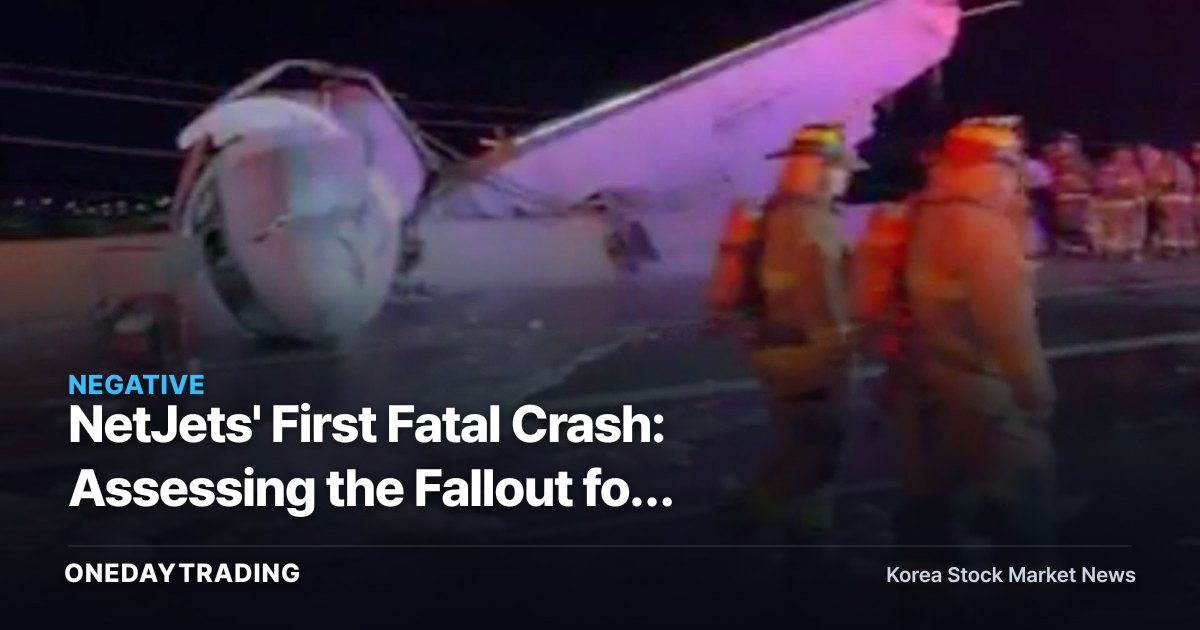
- An aircraft operated by NetJets, a Berkshire Hathaway subsidiary, crashed onto a highway in Laredo, Texas, killing an influential venture capital founder. The company has declined to determine the cause and says it is under investigation.
- Because NetJets' long-touted record of zero fatalities has now been broken, the investment angle is not the headline loss figure but whether the safety confidence that anchors the fractional ownership business is being shaken.
- The direct impact on parent company Berkshire's overall earnings is limited, but it should be viewed alongside industry-level ripple effects such as business-jet demand, insurance rates, and aircraft manufacturers' reputations.
What Changes
The investment significance of this incident lies less in the scale of damages and more in the potential impairment of intangible assets. NetJets pioneered the fractional ownership model, in which clients hold a fractional share rather than buying an entire aircraft and are guaranteed flight hours. This business's pricing power ultimately stems from the brand capital of safety and trust—because that trust is precisely why high-net-worth individuals and corporate clients are willing to pay a premium over ordinary charter flights.
The first fatal crash therefore affects the company through the reputational channel before the financial numbers. The key variable is whether the cause was an aircraft defect, an operational or maintenance failure, or an uncontrollable external factor. If responsibility narrows to the operator's side, the pricing strategy premised on a safety premium will be challenged; but if the conclusion points to external factors, the shock is likely to be short-lived. The company's avoidance of declaring a cause also reads as a cautious message mindful of this fork in the road.
From the parent company's perspective, NetJets is one of Berkshire's many non-core businesses, and in a structure where insurance, rail, energy, and consumer goods form the major pillars of profit, a single aviation accident is unlikely to sway consolidated earnings. What investors should watch is not the immediate reaction in Berkshire's share price, but the mark the accident leaves on safety perceptions and insurance costs across the business-aviation industry.
By the Numbers and Context
This report highlights two key facts: that it was a fatal crash, and that it was the first ever for NetJets. The very fact that the first loss of life occurred at an operator that had maintained a zero-fatality record for decades is a variable that shapes market perception even before precise accident-rate statistics are released. The fact that the crash site was a highway—where human and property damage tends to be large—is another factor that expands the scope of liability and the potential for litigation.
That said, the information disclosed so far does not confirm the key data that determine causation, such as the aircraft model, maintenance history, and weather conditions. With the cause still unknown, it is weakly grounded to assign blame to a specific manufacturer or operating practice, and it is reasonable to keep the scenarios open until the investigation's findings are announced.
Beneficiary and Affected Stocks
- Berkshire Hathaway — NetJets' parent company. Although directly involved, its business diversification keeps the impact on consolidated earnings limited, while reputational and litigation risks may weigh on short-term sentiment.
- Textron — A leading aircraft manufacturer producing business jets such as the Cessna Citation. Its reputation and order sentiment could hinge on the findings regarding the accident model and cause, making it sensitive to the course of the investigation.
- Embraer — A business-jet supplier whose aircraft are part of NetJets' operating fleet, leaving it exposed to shifts in business-aviation demand and safety perceptions.
- Bombardier — A key manufacturer in the medium-to-large business-jet market. Should industry-wide safety confidence weaken, its new-order cycle could be affected.
- Business-aviation and insurance sectors — If the cause is attributed to operational negligence, rising insurance rates and tighter regulation are variables that could pressure the industry's cost structure.
Risk Check
- Speculative interpretation while the cause remains undetermined. If the investigation points to external factors, the reputational shock could recover quickly, making it risky to bet on an early overreaction.
- Overstating the earnings linkage. NetJets accounts for only a small portion of Berkshire as a whole, so it is hard to tie a single accident directly to the parent company's valuation.
- Uncertainty over shifting blame to aircraft manufacturers. Maintenance/operational negligence and design defects carry opposite share-price implications, and neither has been confirmed at this point.
- The time lag in litigation and insurance costs. Damages and rate adjustments often take more than a quarter to be reflected slowly, so immediate changes in the numbers are unlikely.
Bottom Line
This is not an event that will shake the parent company's earnings, but with the intangible asset of safety confidence in fractional ownership now on trial, investors should use the announcement of the accident investigation findings, the identification of the model and cause, and trends in business-aviation insurance rates as benchmark indicators to discern whether the reputational shock is temporary sentiment or a structural cost.
This article is content automatically summarized and analyzed based on the original news report. View original (CNBC)