
Key Takeaways
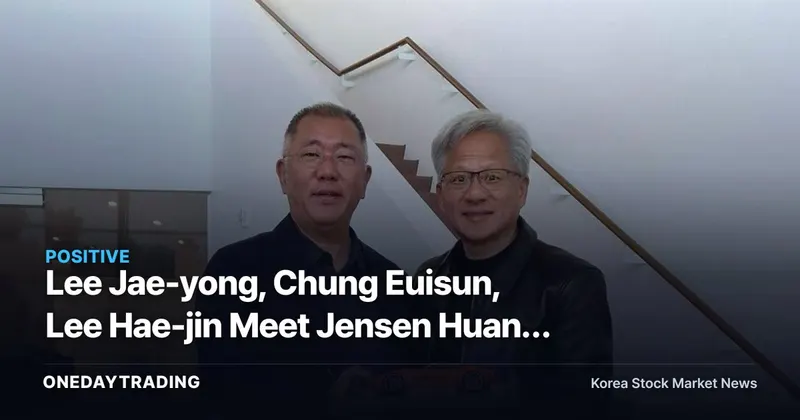
Samsung Electronics (005930) Chairman Lee Jae-yong, Hyundai Motor Group Executive Chair Chung Euisun, and Naver GIO Lee Hae-jin sat down again with Nvidia CEO Jensen Huang at Nvidia's headquarters in California, roughly a month after Huang visited Seoul last month. Typically, it's the side with more at stake in the supply chain that travels to see the dominant player — the fact that the order was reversed this time is itself a signal. Observers suggest memory chip lines were on the table for Samsung, while autonomous driving and robotics cooperation were discussed with Hyundai.
What Happened
The gathering of these three executives was no coincidence. Samsung Electronics is both a candidate HBM supplier for Nvidia's GPUs and a stakeholder angling for Nvidia foundry orders. Hyundai Motor Group already relies heavily on Nvidia's platform for robotics (through Boston Dynamics) and autonomous-driving software. For Naver, securing Nvidia GPUs is directly tied to its competitiveness in running proprietary large language models such as HyperCLOVA X. All three companies share a common thread: their business direction hinges on what Nvidia needs next.
The timing is also worth noting — this reunion came just a month after Huang's Seoul visit. CEO-level meetings typically occur on a quarterly cadence, so meeting again this quickly suggests the conversations held in Seoul may already be moving into concrete execution. That said, what has been disclosed so far remains at the level of observations — "memory chips and other topics discussed," "exploring autonomous driving and robotics cooperation" — with no confirmed order volumes or contract terms.
Background and Context
Nvidia's AI accelerator roadmap calls for increasing HBM content with every new generation, and whoever solves this bottleneck effectively secures priority status in Nvidia's supply chain. With SK Hynix currently leading in HBM supply to Nvidia, what Samsung Electronics came away confirming at this meeting could be a key fork in the road for its future valuation. At the same time, as Hyundai Motor Group expands beyond car manufacturing into robotics and urban air mobility (UAM), it is already using Nvidia's computing platform as core infrastructure — making this meeting more of a partnership check-in than a new negotiation.
Market and Stock Impact
- Samsung Electronics — If the HBM supply discussions translate into real progress, it could serve as a re-rating catalyst for the memory business, though Samsung's vendor status relative to SK Hynix for Nvidia supply has not yet been confirmed
- SK Hynix — As the current lead supplier of HBM to Nvidia, whether and how quickly Samsung enters this market will directly affect the competitive share balance
- Hyundai Motor / Hyundai Mobis — If autonomous-driving chip and software cooperation expands into commercialized robotics and UAM, it would be positive for the broader value chain, though the commercialization timeline remains uncertain
- Naver — Directly tied to the stability of GPU procurement needed to run its proprietary AI models, affecting its position in the domestic hyperscaler competition
- Nvidia — Strengthening ties with key Asian partners is seen as improving the visibility of its GPU and HBM demand planning
Investor Checkpoints
- Whether and when Samsung Electronics discloses HBM4 quality certification or supply contracts
- Any changes in commentary on HBM vendor composition at Nvidia earnings events (such as GTC)
- Hyundai Motor Group's commercialization timeline for Boston Dynamics robots and disclosures on autonomous-driving software cooperation
- Whether Jensen Huang makes further visits to Korea or announces follow-up agreements with Korean companies
Outlook
In the optimistic scenario, this reunion leads to expanded HBM supply from Samsung Electronics to Nvidia and the concrete formalization of robotics and autonomous-driving platform cooperation with Hyundai. That would be a positive catalyst for the memory and mobility value chains broadly. On the other hand, there is a risk that this meeting amounts to little more than a routine relationship-maintenance contact without translating into firm contracts. Given SK Hynix's solid hold on its existing supply chain position, it will take time before Samsung's entry is confirmed in actual order volumes.
Samsung Electronics: Real-Time Data Snapshot
Samsung Electronics' most recent closing price was 249,500 won (-7.59% from the previous day), and the combined signal based on foreign/institutional order-flow and news momentum is 🔴 Caution. Foreign investors, institutional investors, and momentum are all negative, so caution is warranted at this time.
- ▼ Dual-Side Selling — Foreign investors −868.0 billion won · institutional investors −858.8 billion won, selling in tandem
- ▼ Trend Alignment — Short- and medium-term downtrend alignment (day -7.6% · 1 week -2.2% · 1 month -26.7%)
- ▲ News Flow — 9 positive catalysts vs. 4 negative catalysts — positive catalysts dominate
Recent related news skews favorable, with 9 positive catalysts versus 4 negative catalysts.
※ Price and foreign/institutional order-flow (supply-demand) data are provided by Korea Investment & Securities (KIS) and are current as of publication.
This article is automatically summarized and analyzed based on the original news report. View original (Maeil Business Newspaper, Corporate)