
Three-Line Briefing
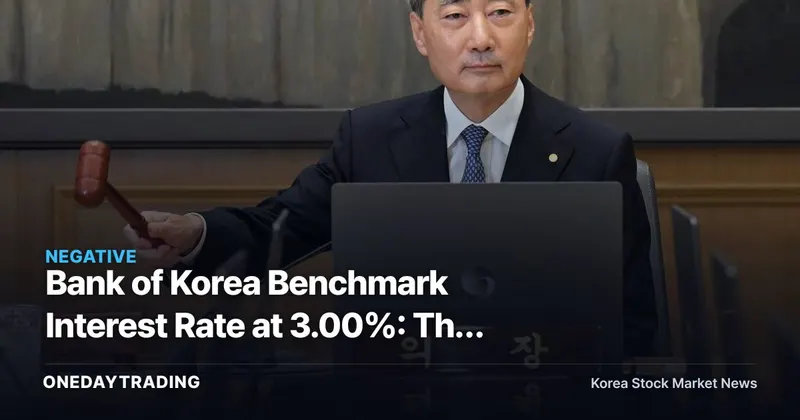
- The Bank of Korea’s decision to raise the benchmark interest rate from 2.75% to 3.00% annually helps defend net interest margins for bank stocks, while putting multiple pressure on growth stocks.
- The benchmark interest rate is the policy rate the Bank of Korea uses when transacting with financial institutions, and it is the starting point for loan rates, deposit rates, the exchange rate, and equity valuations.
- Two consecutive months of rate hikes send one message to the market: stabilizing inflation and the exchange rate now takes priority over slowing growth.
What Changes?
The Bank of Korea’s 3.00% benchmark interest rate is not just a number. What it really signals is a repricing of the discount rate. When rates rise, the stock market cuts multiples before it cuts earnings. Growth stocks in internet, biotech, and secondary batteries, where earnings are concentrated far in the future, become especially disadvantaged in present-value calculations.
By contrast, bank stocks such as KB Financial Group, Shinhan Financial Group, and Hana Financial Group have a short-term case for defending net interest margins. If loan rates adjust faster than deposit rates, interest income improves first. However, the longer rate hikes continue, the greater the delinquency burden on households and companies becomes; from that point, credit costs start to erode the margin benefit.
What the market has already priced in is the 0.25 percentage-point rate hike itself. What is still less fully reflected is the credit cost after the hike. If the KOSPI wobbles on the day of the benchmark interest rate announcement, it is not only because of the rate level, but because financing costs and demand slowdown assumptions embedded in next year’s earnings estimates are being recalculated.
Looking at the Numbers and Context
According to Dong-A Ilbo’s breaking report, the Bank of Korea raised its benchmark interest rate from 2.75% to 3.00% annually. The phrase “two consecutive months of hikes” signals that the policy direction is not a one-off adjustment. A 3.00% rate lowers the opportunity cost of holding cash for depositors and raises the cost of leverage for borrowers.
Rate hikes are also directly linked to the exchange rate. When won-denominated rates rise, the relative appeal of won assets improves, which can partially ease upward pressure on the USD/KRW exchange rate. But if U.S. rates and dollar strength move faster, Korea’s 3.00% rate alone will struggle to hold foreign investors’ supply-demand (order flow). Ultimately, the impact of rates on stock prices depends less on the rate itself than on how the exchange rate and foreign investors’ trading direction interact.
Beneficiaries and Losers
- KB Financial Group: A 3.00% benchmark interest rate is favorable for defending net interest margins by lifting the yield on loan assets. However, if a rise in delinquency rates is confirmed, the premium on bank stocks can shrink quickly.
- Shinhan Financial Group: Repricing of corporate and household loan rates may feed into interest income. The market will look not only at the rate benefit but also at the pace of increase in loan-loss provisions.
- Hana Financial Group: It is classified as a financial stock with high sensitivity to the exchange rate. If the USD/KRW exchange rate stabilizes, foreign-currency-related volatility should ease, but if the economic slowdown deepens, credit risk comes first.
- Kakao·NAVER: Platform stocks have a high share of future earnings, so they face valuation discount pressure during periods of rising rates. If advertising and commerce demand slows, earnings estimates will be lowered as well.
- Construction·Real Estate Finance: Higher mortgage rates weigh on trading volume and housing-subscription sentiment. If project financing costs rise, construction companies’ cash-flow burden also increases.
Risk Check
- Opposite Scenario: If inflation slows quickly and the USD/KRW exchange rate stabilizes, this 3.00% rate could be interpreted as the later stage of tightening. In that case, the downside for growth stocks would narrow.
- Bank Stock Risk: Rising rates initially boost interest income, but over time they come back through delinquency rates and provisions. Credit costs are the key variable for quarterly earnings.
- Foreign Investors’ Supply-Demand (Order Flow): If dollar strength persists despite Korea’s rate hike, foreign investors may delay buying to avoid FX losses. The USD/KRW exchange rate level is a condition for a stock-price rebound.
- Domestic Demand Slowdown: If household interest burdens rise, demand for consumer goods, retail, and travel may weaken. Rates are not only a variable for financial stocks; they are also a revenue variable for domestic-demand industry sectors.
Bottom Line
The Bank of Korea’s 3.00% benchmark interest rate is a short-term positive catalyst for banks’ interest margins, but for the broader KOSPI it is a tightening signal that forces investors to recalculate both multiples and credit costs.
Frequently Asked Questions
Is the Bank of Korea’s 3.00% benchmark interest rate a negative catalyst for the stock market?
The Bank of Korea’s 3.00% benchmark interest rate is generally a burden for the overall KOSPI. When the discount rate rises, the appropriate price-to-earnings ratio falls even for the same level of earnings, and earnings estimates for companies with high borrowing costs decline.
However, bank stocks may be an exception. If rising loan rates are reflected faster than rising deposit rates, KB Financial Group and Shinhan Financial Group’s net interest margins gain short-term resilience.
Which stocks benefit from a benchmark interest rate hike?
The stocks that typically benefit from a benchmark interest rate hike are financial stocks such as banks and insurers. When the Bank of Korea raises rates from 2.75% to 3.00% annually, the yield on loan assets rises, creating a case for improved bank interest income.
However, the benefit is conditional. If delinquency rates and loan-loss provisions rise quickly, the margin gained from higher rates is offset by costs.
What indicators should investors check next after the Bank of Korea’s rate hike?
The next indicators to check are the USD/KRW exchange rate, bank delinquency rates, and foreign net buying of the KOSPI. If the rate hike leads to exchange-rate stability, foreign investors’ supply-demand (order flow) can hold up, but if the exchange rate rises again, pressure on the stock market will continue.
For bank stocks, investors should look at net interest margins and credit costs together in the next quarter’s earnings. For growth stocks, the key during earnings announcements is whether they have enough earnings visibility to overcome the higher discount rate, rather than just their revenue growth rate.
This article is automatically summarized and analyzed content based on the original news report. View original article (Dong-A Ilbo)