
At a Glance
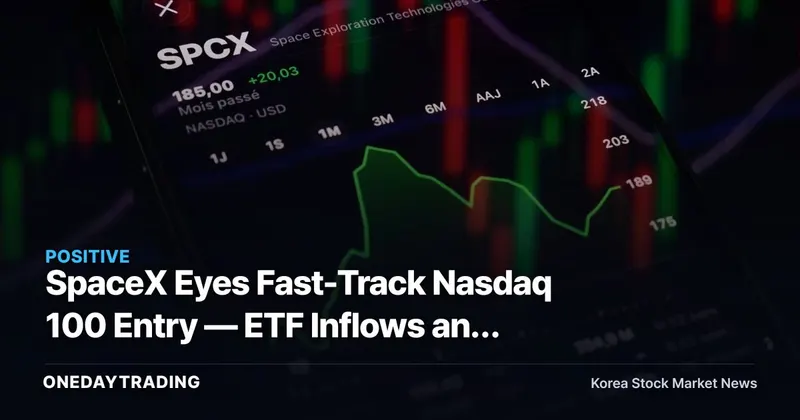
Elon Musk's SpaceX is being discussed as a candidate to join the Nasdaq 100 index quickly under Nasdaq's new fast-track (early inclusion) mechanism. The key point is that once index inclusion is confirmed, passive funds tracking the Nasdaq 100 — including QQQ — would be mechanically required to purchase the stock (ticker), and this prospect is itself acting as a catalyst that stimulates market sentiment around the aerospace and space theme.
Why This Matters Now
The mechanism by which index inclusion affects a stock price is not a simple popularity vote — it is a forced inflow of capital. ETFs and index funds tracking the Nasdaq 100 must buy constituent stocks in proportion to their assigned weights once a composition change is confirmed, generating favorable passive buying pressure on the supply-demand (order flow) side for newly added stocks. Normally, newly listed stocks must satisfy a minimum trading history requirement, but the fast-track mechanism shortens this waiting period, opening a path for large new listings to be included early.
That said, SpaceX is currently unlisted. Nasdaq 100 inclusion presupposes a listing, so the real substance of this story is closer to a signal that the market has begun to seriously price in the possibility of a SpaceX IPO. Because Korean investors cannot directly purchase SpaceX shares, domestic stocks across the space value chain — launch vehicles, satellites, and satellite communications — are likely to trade as thematic proxies.
It is particularly important to distinguish between stocks with a clear demand-side linkage to SpaceX and those that are simply grouped together under the theme. SpaceX's expansion of its satellite communications business translates directly into demand for ground-based antennas and terminals, but the company's launch vehicle manufacturing competitiveness itself has a weak direct revenue connection to Korean companies.
Frequently Asked Questions
- Can I invest in SpaceX directly? It is unlisted, so direct purchases by retail investors are not feasible. If a listing materializes, indirect exposure would become possible through a U.S. exchange ticker and ETFs such as QQQ.
- Why are Korean aerospace stocks reacting? The SpaceX story is amplifying broader growth expectations for the space industry, stimulating market sentiment around launch vehicle and satellite-related stocks such as Hanwha Aerospace and Korea Aerospace Industries (KAI).
- Is the fast-track inclusion confirmed? At this stage it is only at the level of possibility and candidacy. Actual inclusion depends on whether and when a listing occurs, and it cannot be treated as a confirmed fact.
- Does passive buying flow into Korean stocks too? Nasdaq 100 ETF capital flows into U.S.-listed stocks. The connection to domestic stocks runs through the theme and sentiment channel, not direct supply-demand (order flow).
Related Stocks and Sector Impact
- Hanwha Aerospace: As the domestic aerospace sector bellwether with system-integration responsibility for the Nuri rocket and satellite and launch vehicle businesses, it tends to take on a sector bellwether role when the space theme gains prominence.
- Korea Aerospace Industries (KAI): With satellite manufacturing and launch-vehicle-related businesses, it sits on a direct beneficiary path from government space budget expansion and the growth of commercial space activity.
- Intellian Technologies: A supplier of antennas and terminals for low-earth-orbit satellite communications, it has the most clearly defined structural link through which SpaceX's satellite communications service expansion translates into upstream demand.
- Satrec Initiative: A specialist in small satellite manufacturing and satellite imagery with high pure-play space business exposure, making it highly sensitive to the theme.
- LIG Nex1: With capabilities spanning both satellite and defense technology, it tends to attract concentrated supply-demand (order flow) when the space and defense themes overlap.
Points to Watch When Investing
- The risk of sharp gain (surge)-and-reversal moves driven by theme momentum is significant. Rallies fueled purely by sentiment without earnings backing from revenue or order wins can unwind quickly.
- The timeline and certainty of a SpaceX listing are both unclear. If the listing is delayed or abandoned, the thematic catalyst could weaken considerably.
- A number of domestic aerospace stocks already carry elevated valuation burdens from strong defense sector performance, so investors should assess both further upside potential and current price risk together.
- The KRW/USD exchange rate and fluctuations in U.S. interest rates are variables that affect risk appetite across growth stocks and theme stocks broadly.
Overall Outlook
In the optimistic scenario, expectations of a SpaceX listing advance toward the realization stage, broadening investment capital and interest in the global space industry, with positive momentum potentially spreading to domestic companies in the satellite communications and launch vehicle value chain. Stocks with a direct upstream demand connection — such as Intellian Technologies — have room to translate the theme into actual earnings momentum rather than remaining purely thematic.
On the other hand, this issue remains a story about policy mechanics and supply-demand (order flow) that is still at the possibility stage, and the connection to Korean stocks is limited by the fact that it relies on sentiment-driven indirect channels rather than direct revenue linkages. A rational approach is to monitor concrete indicators — a listing schedule announcement, next-quarter space and defense order earnings, and satellite communications terminal supply contracts — to distinguish theme-driven moves from fundamental improvement.
Hanwha Aerospace — Real-Time Data Snapshot
Hanwha Aerospace's most recent closing price is 1,011,000 won (–5.43% vs. the prior day). The composite signal integrating foreign investors and institutional investors supply-demand (order flow) along with news and momentum reads 🟡 neutral / wait-and-see. Positive and negative signals are mixed, suggesting a monitoring stance is appropriate.
- ▼ Trend Alignment — Short- and medium-term downward alignment (–5.4% on the day · –9.9% over 1 week · –18.7% over 1 month)
- ▲ News Flow — Positive catalysts 7 vs. negative catalysts 1 — positive catalyst majority
Recent related news: 7 positive catalyst items · 1 negative catalyst item — overall favorable.
※ Price and foreign investors/institutional investors supply-demand (order flow) data are provided by Korea Investment & Securities (KIS) and are current as of the time of publication.
This article is automatically summarized and analyzed based on the original news source. View original article (CNBC)